
Croatia Minivan Luggage: Real 730–763L and When to Choose a Transfer
For families planning a Croatia trip, the safe choice is a long-wheelbase (L2) seven- or eight-seat minivan, or a private seven-seater transfer with luggage handling built in. Short-wheelbase minivans with all seats occupied often leave only a few hundred liters behind the third row, which disappears fast once suitcases, beach bags, and a stroller enter the picture. Minimum age and license rules in Croatia can also narrow which vehicles are even available to you.
TL;DR:
- Long-wheelbase seven- or eight-seat minivans in Croatia typically offer around 730 to 763 liters of cargo space behind the third row when fully occupied, sufficient for four to five suitcases and soft bags.
- Confirm the wheelbase code and whether the third-row seats fold flat or need removal before booking, as vehicle dimensions can differ significantly from standard listings.
- Manufacturer-reported cargo volumes often exaggerate usable space; real-world measurements based on actual loading are more reliable for planning luggage capacity.
- Croatia’s rental age restrictions generally require drivers to be at least 21, with larger vans often needing drivers to be 25 or older with at least one to two years of license holding.
- Booking a private transfer tailored to your group size and luggage needs ensures predictable capacity and optional services like child seats and oversize item handling.
Table of Contents
- Seating configurations and how much luggage they really hold
- How cargo volume gets measured, and why the number on paper can mislead you
- Croatia rental rules that shape which minivan you can book
- Packing and loading tactics that stretch your minivan’s capacity
- Why a private transfer solves the luggage problem for many travelers
- What minivan rentals cost in Croatia and where cargo-related fees appear
- How far ahead to book a minivan with enough luggage room
- Luggage weight and size restrictions you might not expect
- What seasoned operators notice about Croatia luggage planning
- Book a private 7-seater transfer with luggage handling included
- FAQ
- Sources
Seating configurations and how much luggage they really hold
Minivan luggage capacity depends far more on wheelbase and seat count than most rental listings let on. The two wheelbase options you will see across Europe, including Croatia, are L1 (short) and L2 (long), and the difference between them often decides whether your bags ride inside the cabin or on someone’s lap.
Seven-seat layouts typically follow a 2+3+2 or 2+2+3 arrangement, while eight-seat vans add a center seat to the middle row. Some models offer removable second-row seats, which trade flexibility for a bit more installation effort at pickup. When every seat is filled with a passenger, the luggage area behind the third row is what you are working with, and that number varies more than buyers expect.
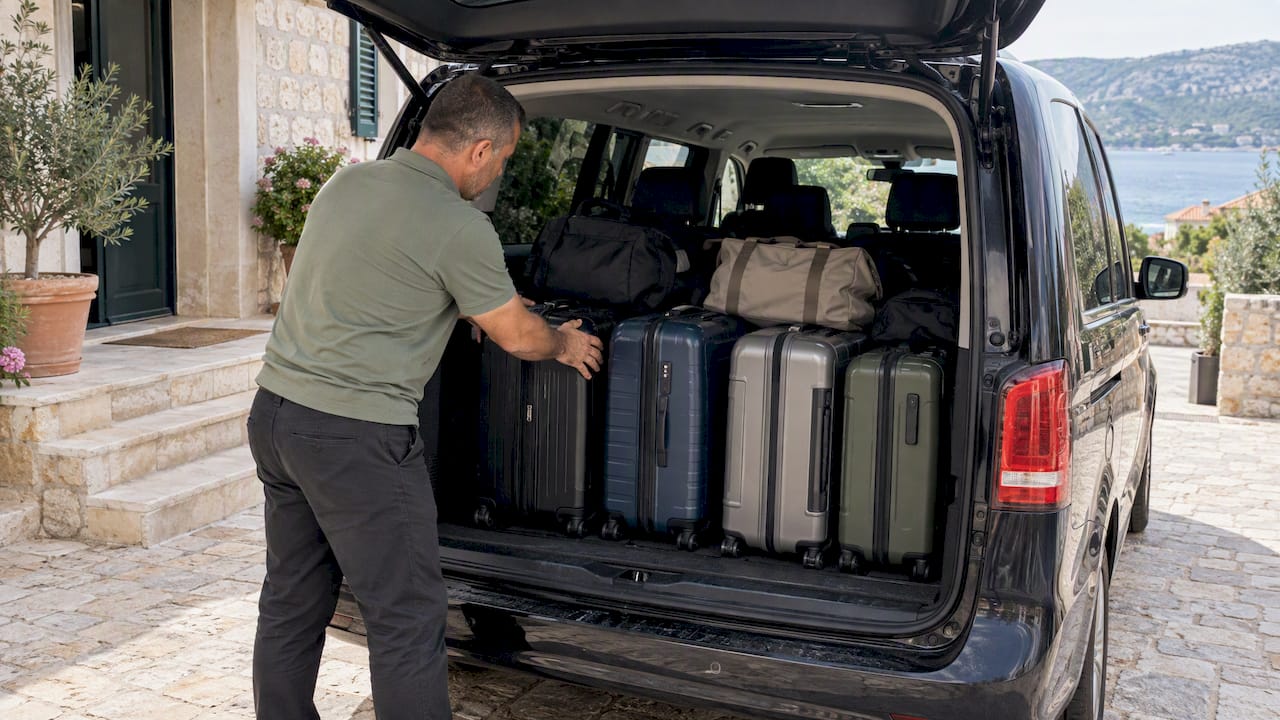
The Volkswagen Multivan L2 in standard configuration leaves around 730 to 763 liters behind the third row, a figure drawn from real-world testing rather than a marketing brochure. That is enough for four to five mid-size suitcases plus soft bags, but it assumes the long-wheelbase variant specifically. The short-wheelbase L1 version of the same vehicle offers noticeably less, which is why confirming the wheelbase code before booking matters more than the model name alone.
The Kia Carnival follows a similar pattern: Kia’s own owners’ manual lists VDA volume ranges that shift significantly between seats-up and seats-folded states, which is typical of how passenger vans are documented across the segment. The takeaway for travelers is consistent: the number that matters is the one measured with your actual seating plan, not the one printed on a spec sheet with the third row collapsed flat.
Before confirming a rental, ask a few pointed questions so the vehicle that shows up matches the listing.
- Confirm the wheelbase code (L1 or L2), since listings often show only the model name.
- Ask whether the third-row seats fold flat or must be physically removed to free extra space.
- Request a photo of the cargo area with all seats in the upright position you plan to use.
How cargo volume gets measured, and why the number on paper can mislead you
Manufacturers often advertise “liters to roof,” a figure calculated by stacking cargo to the headliner in a way no traveler actually packs. Consumer Reports takes a different approach, using an expandable rectangular box to find the largest usable rectangular volume that fits through the cargo opening. That box method produces a figure closer to what a real suitcase load will require, since it accounts for the shape of the opening rather than the theoretical air space above the floor.
European manufacturers also quote VDA volumes, a standardized industry measurement, but VDA figures still assume an idealized stacking pattern that rarely matches how a family loads duffel bags, car seats, and beach gear around wheel wells and seat tracks.
Before trusting a spec sheet, run through this short checklist.
- Compare liters measured with seats in your intended configuration, not the maximum with seats removed.
- Ask the rental or transfer provider for a photo of the loaded trunk space, not a stock image.
- Check whether the quoted figure is VDA, manufacturer claim, or an independent measurement like the Consumer Reports method.
Croatia rental rules that shape which minivan you can book
Age and license requirements in Croatia directly affect your options once you move beyond compact cars. Most providers set a baseline minimum age of 21, but larger minivans and luxury-class vehicles commonly require drivers to be 25 or even 28, and a license held for at least one to two years is a typical prerequisite. If your group’s youngest eligible driver falls below that threshold, the roomy eight-seat van you had in mind may simply be off the table.
Travelers holding a license in a non-Roman alphabet should carry an International Driving Permit alongside the original document, and it is worth verifying current requirements with the specific rental company before arrival, since policies vary by agency rather than by national law alone.

Driving conditions add another layer. Croatia’s highways are modern and well signed, but historic centers in Dubrovnik, Split, and Trogir have narrow streets, limited parking, and restricted vehicle access that make maneuvering a long-wheelbase minivan genuinely stressful. Many travelers who would otherwise self-drive end up preferring a private transfer for exactly these legs of the trip.
Pro Tip: Call the rental desk and ask specifically about the minimum age for the eight-seat or L2 trim you want, since online booking engines don’t always flag the restriction until checkout.
- Confirm your driver’s age meets the minivan-specific threshold, not just the general rental minimum.
- Carry an International Driving Permit if your license uses a non-Roman alphabet.
- Plan for a private transfer through historic centers where parking and access are limited.
Packing and loading tactics that stretch your minivan’s capacity
A few loading habits can turn a tight trunk into a workable one. Soft duffel bags and compressible packing cubes conform to irregular spaces far better than hard-shell suitcases, which waste volume around wheel wells and seat hardware. Weight distributed low and centered also keeps the vehicle stable on Croatia’s coastal roads, many of which include tight switchbacks.
- Load the largest, heaviest bags first, flat against the rear seat or floor, before adding smaller items on top.
- Fold or remove the third row if your group size allows, since even partial seat removal can add several hundred liters of usable space.
- Use a labeled “baggage mode” seating configuration where the vehicle offers one, since some modern MPVs let you shift between passenger and cargo priority without fully removing hardware.
- Reserve a roof box in advance if your bag count exceeds what the trunk area realistically holds, rather than discovering the shortfall at pickup.
Pro Tip: Weigh your bags before departure if your itinerary includes a roof box, since overloading one affects both fuel economy and highway stability.
Confirm with your rental or transfer provider ahead of time whether tie-downs, luggage straps, or a roof box are available to add, since same-day requests are often limited by stock on hand.
Why a private transfer solves the luggage problem for many travelers
For groups who want certainty rather than guesswork, booking a 7 Seater Family Transfer removes the wheelbase math entirely, since the vehicle and luggage capacity are matched to your group before you ever arrive. We handle loading, and certified child seats can be arranged with 24 to 72 hours’ notice, which spares families the scramble of installing a seat themselves in an unfamiliar vehicle.
A private transfer also changes the calculation for specific legs of a Croatia itinerary where self-driving a large minivan adds real friction.
- Navigating Dubrovnik’s old town by car is difficult even for confident drivers, given narrow streets and restricted parking near the historic core.
- Intercity routes with a full set of suitcases benefit from a driver who manages loading rather than a family doing it curbside.
- Cross-border day trips toward Montenegro or Bosnia and Herzegovina involve border checks that a professional driver handles routinely.
If your group has an unusual mix of passengers and bags, requesting a custom quote with your exact passenger and luggage count lets us recommend the right vehicle rather than leaving it to chance.
What minivan rentals cost in Croatia and where cargo-related fees appear
Minivan rental rates in Croatia vary by season, provider, and vehicle class, and no single published figure applies across the market, so it is worth requesting a quote for your specific dates rather than relying on a general estimate. What stays consistent across providers is where the extra charges tend to show up: roof boxes, additional luggage racks, and upgrades from a short-wheelbase to a long-wheelbase trim are usually priced as add-ons rather than included in the base rate.
Peak summer months bring both higher base rates and tighter availability for the larger, more luggage-friendly trims, since families booking Dalmatian coast itineraries compete for the same limited fleet of L2 and eight-seat vehicles. Off-season travelers generally find both lower prices and an easier time securing the exact configuration they want.
For travelers who would rather avoid comparing fee structures across multiple rental agencies, a private transfer folds vehicle size, luggage handling, and driver costs into one quoted arrangement, which simplifies budgeting considerably for a family or small group moving between cities or from the airport.
How far ahead to book a minivan with enough luggage room
Securing the right vehicle, not just any minivan, requires booking earlier than many travelers expect, particularly for long-wheelbase and eight-seat trims. In peak summer, these higher-capacity vehicles are a smaller slice of any agency’s fleet, and they tend to sell out weeks before standard sedans and compact SUVs do.
A reasonable timeline for a Croatia trip is to lock in your rental or transfer vehicle as soon as your travel dates are fixed, especially for July and August arrivals. Shoulder-season travelers, from April through June and in September, generally have more flexibility to book closer to their travel date without losing access to the right seat configuration.
For private transfers specifically, requesting a quote for an intercity or airport route well ahead of arrival also gives us time to confirm a certified child seat if your family needs one, since that detail benefits from a 24 to 72 hour lead time rather than a same-day request.
Luggage weight and size restrictions you might not expect
Most minivan rentals in Croatia do not impose a strict per-bag weight limit the way airlines do, but practical restrictions still apply once a vehicle is loaded. Exceeding the manufacturer’s stated payload capacity, which includes passengers and cargo combined, can affect handling and is something rental agencies take seriously, particularly for mountain routes near Plitvice Lakes or coastal roads with elevation changes.
Oversized items such as surfboards, large sports equipment, or extra suitcases beyond what the trunk comfortably holds often require a roof box, which is typically a separate rental add-on rather than a standard inclusion. Agencies may also charge a cleaning or damage fee if bags are improperly secured and shift during transit, so using tie-down straps for loose items is a reasonable precaution rather than an unnecessary one.
If your group’s bag count is borderline for the vehicle class you are considering, flagging that detail when booking, whether through a rental agency or a private transfer request, avoids an uncomfortable surprise at pickup. A provider who knows your exact luggage count in advance can confirm whether your preferred vehicle actually accommodates it or whether a larger trim makes more sense.

What seasoned operators notice about Croatia luggage planning
The most common mistake we see is a family booking a seven-seat minivan sized for passengers alone, without checking what remains once every seat is filled. The fix is straightforward: choose an L2 long-wheelbase model, or book a private transfer where luggage capacity is matched to your group before the vehicle is confirmed. Reserving early in peak season matters just as much as the vehicle choice itself, since the right configuration disappears from rental fleets well before July arrives.
— Croatia
Book a private 7-seater transfer with luggage handling included
Once you know how little room a short-wheelbase minivan leaves for bags, a private transfer removes the guesswork for the rest of your trip. We match the vehicle to your group size and luggage count before you arrive, and certified child seats can be arranged with advance notice rather than sorted out at the curb.
A few details help us recommend the right setup for your trip.
- Share your exact passenger and luggage count when requesting a quote so we can confirm the vehicle fits comfortably.
- Ask about certified child seats early, ideally 24 to 72 hours before pickup.
- Mention any oversized items, such as golf bags or surfboards, so we can plan loading in advance.
Request a quote through our private transfers page and let us handle the vehicle sizing and the bags.
FAQ
What is the minimum age to rent a car in Croatia?
Most rental companies in Croatia set a baseline minimum age of 21, though larger minivans and luxury vehicles often require drivers to be 25 or 28. A license held for at least one to two years is also a common requirement for these larger vehicle classes.
Can older drivers rent a minivan in Europe, including Croatia?
Rental policies rarely set a strict upper age cutoff, but some agencies apply extra conditions or surcharges for drivers over a certain age, and these vary by company rather than by national regulation. It is worth confirming directly with your chosen provider before booking a larger minivan.
Is driving a minivan in Croatia straightforward for visiting families?
Croatia’s highways are modern and easy to navigate, but historic centers like Dubrovnik and Split have narrow streets and limited parking that make a large minivan harder to handle. Many families find a private transfer more practical for these specific legs of a trip.
Is it worth renting a minivan instead of booking a private transfer in Croatia?
A self-drive minivan rental can work well for flexible, multi-stop itineraries where you control the schedule, but it comes with age restrictions, luggage-capacity tradeoffs, and parking challenges in historic towns. A private transfer removes those variables by matching the vehicle and luggage handling to your group in advance.
How much luggage actually fits in a long-wheelbase minivan?
A long-wheelbase model like the VW Multivan L2 typically leaves 730 to 763 liters behind the third row with all seats occupied, enough for four to five mid-size suitcases. Folding or removing the third row increases that figure substantially, often by several hundred liters or more.
Sources
- Car rental age Croatia — RoadTripCar
- Measured cargo room for SUVs and minivans — Consumer Reports
- Volkswagen Multivan L2 2.0 TDI: Gospodar daljina — Cargo Magazin