


Arriving in Croatia With 5–7 People? Book a 7 Seater Family Transfer
For most Croatian family trips, the right vehicle for a family transfer comes down to a simple headcount rule: up to four travelers with normal luggage fit comfortably in an estate car or SUV, five to seven people need a 7-seater minivan like a Mercedes V-Class, and groups of eight or more should book a small minibus. Whichever size fits, prioritize a licensed driver and a fixed price agreed before pickup, since that combination protects families from the price swings and availability gaps now common in Croatia’s taxi market.
TL;DR:
- Booking a vehicle at least two to three weeks in advance is crucial during peak season to secure the right size and avoid last-minute surcharges.
- Private transfers with fixed quotes provide stability against Croatia’s rising taxi fares and availability issues during busy coastal months.
- Confirming vehicle details, such as model, luggage capacity, and child seat features, before payment helps prevent surprises on travel day.
- Season and traffic conditions greatly influence transfer times, requiring drivers to build in buffer time for routes like Split or Dubrovnik.
- Families should carefully count luggage, include all child seats and gear, and specify any mobility needs for a smooth, stress-free transfer.
Table of Contents
- Vehicle Types For Family Transfers And When Each Fits
- How To Choose The Right Vehicle: A Compact Decision Checklist For Families
- Booking And Pricing Expectations In Croatia
- Safety, Driver Credentials, And Vehicle Standards To Verify
- Practical Tips For A Smooth Family Transfer
- Cancellation And Refund Policies For Family Transfers
- How Traffic And Travel Times Affect Your Transfer
- A Note From Croatia Private Transfers & Tours
- Book Your Family Transfer With Croatia Private Transfers & Tours
- Sources
Vehicle Types For Family Transfers And When Each Fits
A family of three with two suitcases and a stroller has completely different needs than a multigenerational group of nine heading to Plitvice Lakes. Matching the vehicle to the actual trip, not just the passenger count, is what separates a relaxed transfer from a cramped one.
Sedan or estate car works well for couples or a family of three or four with one suitcase each. Boot space in an estate typically handles two large cases plus carry-ons, making it the right pick for a quick airport run with light packing.
SUV suits families who need extra ground clearance or gear space, think a coastal transfer with surfboards, diving equipment, or bulky beach bags. The higher seating position also helps parents keep an eye on kids during winding coastal roads.
7-seater minivan (Mercedes V-Class or similar) is the workhorse for most family transfers. A group of five to seven with airport-sized luggage, a folded stroller, and a car seat or two fits without anyone squeezed in the middle row. This is the vehicle most families searching for a proper family transfer vehicle in Croatia should default to.
Small minibus becomes necessary once you cross eight passengers, common for extended family reunions or a group booking a multi-day private driver tour between cities.
Scenario check:
- Airport arrival, family of four, three suitcases: estate or SUV
- Coastal transfer with surfboards and beach gear: SUV
- Multi-stop day trip with a stroller and grandparents: minivan, prioritize low step-in height for accessibility
How To Choose The Right Vehicle: A Compact Decision Checklist For Families
Before you request a quote, run through this checklist so the vehicle that shows up actually matches your trip:
- Count every passenger, including infants who will occupy a car seat rather than a lap.
- Count luggage pieces, not just suitcases, strollers, golf bags, and beach gear all take space.
- Note any child seat requirements and the ages/weights involved.
- Flag mobility needs, elderly parents may need a lower step-in height or extra loading time.
- Identify the route type: single airport run, multi-stop city tour, or intercity transfer.
- Confirm the number of planned stops so the driver can plan timing.
When you contact a provider, ask directly: What is the exact make and model? Does the vehicle have ISOFIX anchor points? What are the luggage compartment dimensions? Is this a fixed quote or a metered fare? What is the cancellation policy?
A vague answer to any of these is a red flag. A reputable operator should answer vehicle class and ISOFIX questions without hesitation.
Pro Tip: Ask for the driver’s plate number and mobile contact in writing before pickup day, not on the morning of the transfer. It removes the single biggest source of arrival-day stress.
Booking And Pricing Expectations In Croatia
Family transfer pricing in Croatia has shifted noticeably. In June 2026, taxi rides across the country fell 17.51% year-on-year while the average taxi fare rose 15.77% compared to June 2025. Fewer rides at higher prices means families relying on street taxis or ride-hailing apps face both availability gaps and less predictable costs, especially during peak coastal season.
City-level rates vary too. Reporting on taxi fares from Dubrovnik to Osijek shows Zagreb and Osijek running cheaper on start fees and per-kilometer rates, while Dubrovnik and Pula sit noticeably higher, a real budgeting factor for families flying into the coast rather than the capital.
Taxi rides down 17.51%, average fare up 15.77%, in a single year.
Prebooked private transfers sidestep this volatility entirely. A fixed quote agreed at booking means:
- No surge pricing during peak arrival windows
- No meter running if traffic backs up near Split or Dubrovnik
- No guessing whether a car will even be available at 11 PM
Analysts covering Croatia’s 2026 tourism season note that travelers increasingly weigh value for money over rock-bottom price, and for families, a fixed number you can plan around usually wins over a fare that might spike halfway through the season.
Safety, Driver Credentials, And Vehicle Standards To Verify
Croatia scores well on overall traveler safety. The government invested roughly €280,000 in its “Safe Tourist Destination” project, reinforcing the country’s reputation as one of Europe’s more secure travel destinations. That national safety record does not replace the need to verify the specific vehicle and driver in front of you.
Before you hand over your family’s travel day to a stranger’s car, confirm:
- The driver holds a valid commercial license
- The vehicle carries active insurance covering passengers
- Plate and registration match what was sent in your booking confirmation
- Seatbelts are present at every seat and ISOFIX points exist if you need a child seat
- You have the driver’s phone number and exact pickup point in writing
That standard, drawn from operational guidance for airport pickups, is exactly what a written confirmation should include: vehicle class, plate number, fixed quote, child seat details, pickup time, and meeting point. Providers that publish author expertise, testimonials, and specific vehicle classes on their booking pages, rather than a generic contact form, are giving you the transparency worth looking for.
Practical Tips For A Smooth Family Transfer
Small planning choices save real stress on travel day. Consider these before you finalize a booking:
- Count luggage per person, not per family, most vehicle classes cap total pieces, and extra bags or child seats sometimes carry a small additional charge.
- Build a buffer of at least 45 to 60 minutes after international flight arrivals for baggage claim and customs before your driver’s wait clock matters.
- During July and August, book coastal transfers at least two to three weeks ahead; last-minute requests risk paying peak-season premiums or finding nothing available at all.
- For island-connected itineraries, confirm your transfer provider can coordinate pickup around ferry departure times rather than a fixed clock time, since boat schedules shift with weather and season.
- On multi-stop day trips, tell your driver every planned stop upfront so the itinerary and total drive time are set before you leave, not renegotiated mid-route.
Cancellation And Refund Policies For Family Transfers
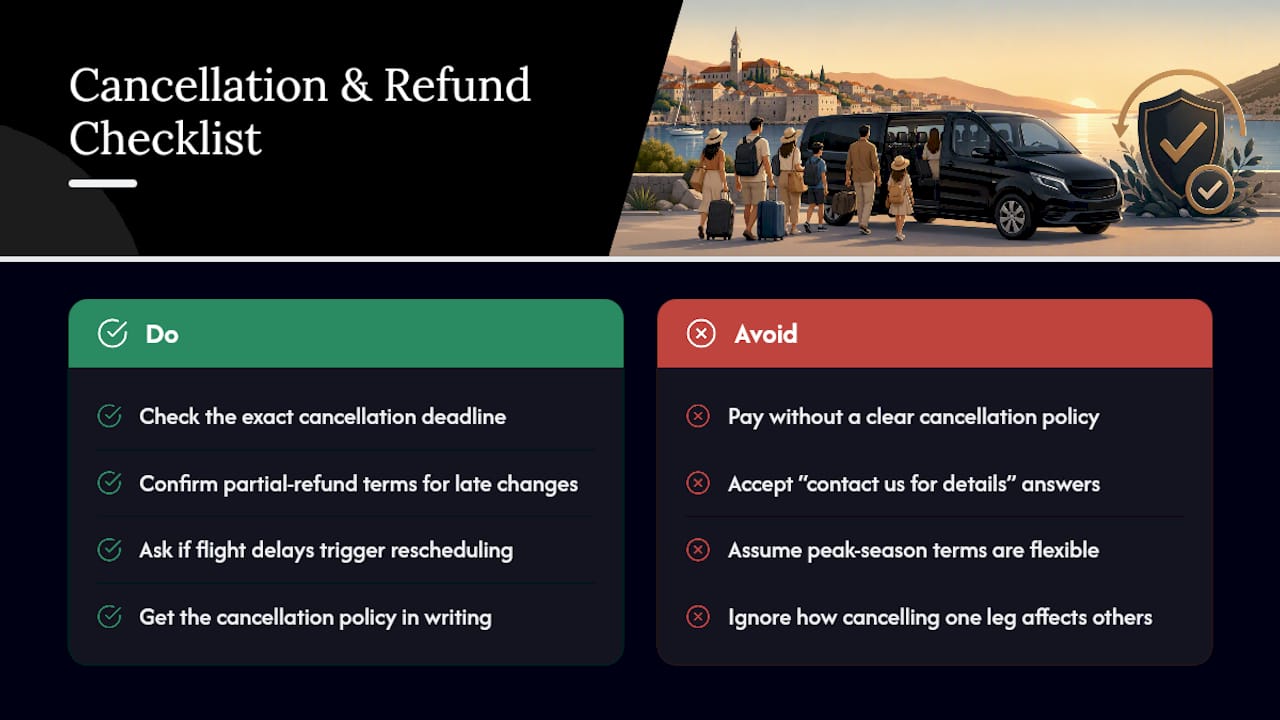
Family plans change more than most, a sick toddler, a delayed flight, a shifted ferry schedule. Before booking, read the cancellation window closely. Most reputable private transfer providers in Croatia offer free cancellation up to 24 to 48 hours before pickup, with a partial or full charge applying closer to departure since a vehicle and driver were already reserved specifically for you.
Ask these questions directly when booking: What is the exact cancellation deadline? Is a partial refund available for late changes? Does a flight delay trigger automatic rescheduling, or do you need to call in? A transparent provider states this in writing at booking, not only after something goes wrong.
Families booking during peak coastal season should be especially careful here. Vehicles reserved months out for Split, Dubrovnik, or the islands are harder to rebook on short notice, so a provider’s cancellation terms matter more in July and August than in the shoulder season. If your itinerary includes multiple legs, ask whether canceling one leg affects the pricing or availability of the others.
Avoid any provider that will not state a cancellation policy clearly before you pay. A vague “contact us for details” answer, especially paired with a request for full payment upfront, is worth treating with caution. Fixed-quote bookings with a clear refund window remove one more variable from a trip that already has enough moving parts with kids involved.
How Traffic And Travel Times Affect Your Transfer
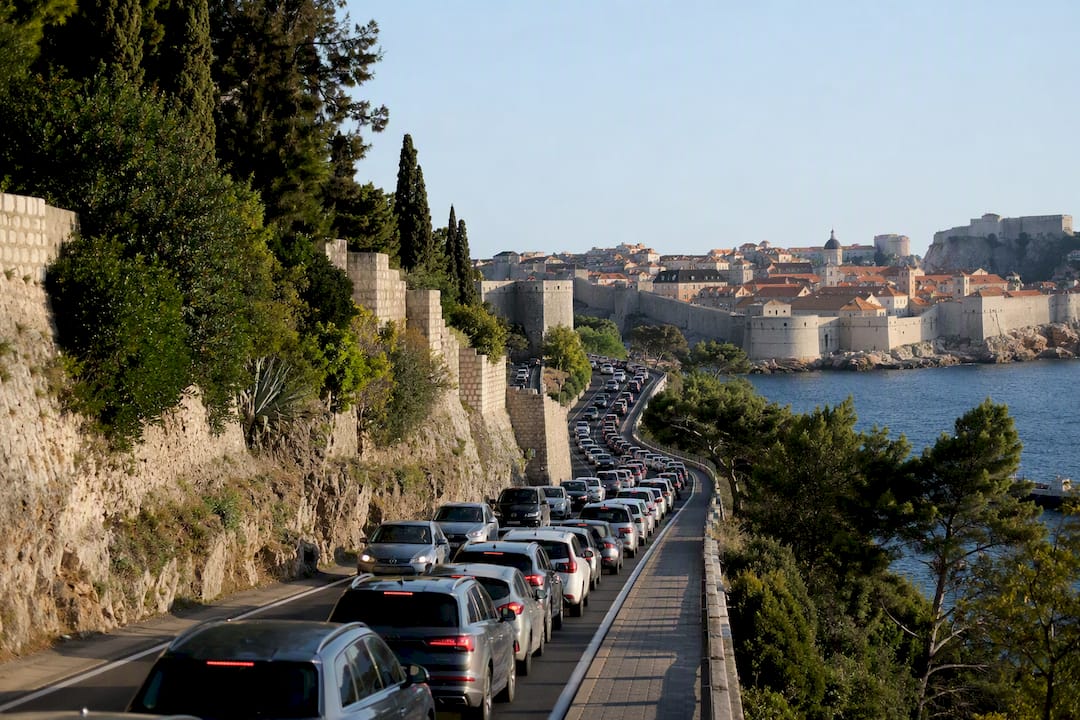
Croatia’s coastal roads and city centers behave very differently depending on season and time of day, and that has a direct effect on how long your family transfer actually takes. The Split airport to city center run that takes 25 minutes in April can stretch past 45 minutes in peak July traffic, when tour buses and rental cars flood the same narrow coastal roads.
Dubrovnik’s Old Town approach faces similar congestion, especially when cruise ships dock and thousands of passengers move through the same streets your driver needs to navigate. Zagreb’s traffic follows a more typical urban pattern, heavier during weekday rush hours, lighter on weekends and in the evening.
For families with young children or connecting flights, this matters more than it might seem. A driver who knows local patterns will build in buffer time rather than quote you the shortest possible route on a map app. When you book, ask whether your quoted transfer time already accounts for seasonal traffic, particularly if you are traveling between June and September. Intercity routes, say Zagreb to Split, also vary widely, a 1980s-era motorway model won’t match today’s toll-road drive times, so confirm your driver is quoting current conditions rather than an outdated estimate.
A Note From Croatia Private Transfers & Tours
Most family bookings we see follow the same pattern: parents underestimate luggage, then scramble for a bigger vehicle the night before travel. The fix is simple, count every bag and car seat honestly at booking, not the morning of.
We have also watched families assume any vehicle will do for a coastal day trip with kids, then regret not asking about step-in height or seatbelt count until they are standing curbside. If you want a fuller sense of what makes a transfer genuinely work for families, our family-friendly tour guide covers it in more depth.
One-line recommendation: book your vehicle class two to three weeks ahead in peak season, and put every luggage and child seat detail in writing before you pay.
— Croatia
Book Your Family Transfer With Croatia Private Transfers & Tours
Croatia Private Transfers & Tours runs door-to-door private transfers built around exactly the scenarios families face: airport pickups with a full luggage count, minivans with proper child seats, English-speaking licensed drivers, and day trips to UNESCO sites like Plitvice Lakes and Krka Waterfalls without switching vehicles mid-route.
Booking is straightforward. Tell us your group size and luggage so we can recommend the right vehicle class, from a sedan up to a Mercedes V-Class minivan. Declare any child seats you need so they are waiting in the car, not sourced last minute. We confirm a fixed quote and send your driver’s contact and vehicle details in writing before pickup day, no meter, no surge pricing, no guessing.
If you are still comparing a private transfer against a taxi or app-based ride, our breakdown of private transfer versus taxi options lays out the tradeoffs plainly. When you are ready, head to our private transfers page to request your vehicle class and lock in a fixed quote for your family’s trip.
Sources
- Hrvati masovno odustaju od taksija: Broj vožnji pao 17,5 posto
- Hrvatska je percipirana kao jedna od najsigurnijih turističkih zemalja
- Globalne nesigurnosti i sezona 2026.: Krešić analizira poziciju hrvatskog turizma