
Hvar in One Day: A Plan That Works From Split
One day is enough to feel Hvar, but not to see all of it. The island is roughly 80 kilometers long, and its two historic centers, Hvar Town and Stari Grad, sit on opposite sides of it. The best day is built around one clear choice: a polished morning in Hvar Town with a quieter afternoon elsewhere, or a slower day that begins with the island’s UNESCO landscape and ends with a swim in a cove. This guide gives you both, with realistic timings, the logistics that catch people out, and an honest view of when a private day makes sense.
TL;DR
- Choose your arrival port first: catamaran passengers land in Hvar Town, while anyone arriving by car ferry lands in Stari Grad, about a 20-minute drive away (Hvar Tourist Board).
- A one-way public catamaran ticket from Split to Hvar costs €25.00 in 2026, and the crossing takes roughly an hour (2026 price list).
- The strongest one-day combination is Hvar Town (square, monastery, Fortica) plus either a quiet cove or the Stari Grad Plain, not all three.
- Your day is set by the last boat back, so check the return time before you plan anything else.
- A private driver removes the main constraint of a day on Hvar: reaching places the public bus and ferry network handles poorly.
Table of Contents
- Getting to Hvar: the decision that shapes the day
- A timed itinerary for Hvar Town
- The alternative day: the Stari Grad Plain and the quiet south
- What to skip, and what not to attempt
- When a private day is worth it
- Our perspective on a day on Hvar
- Plan your Hvar day with us
- Practical tips for a smooth day
- FAQ
- Sources
Getting to Hvar: the decision that shapes the day
Most visitors from Split take the catamaran, which is the fastest option. The Hvar Tourist Board lists the boat connections as Split to Hvar, Split to Stari Grad, and Drvenik to Sućuraj, and notes regular catamaran service between Split and Hvar Town. Local guidance puts the crossing at about 65 minutes. Our own door-to-door guide to the Split to Hvar crossing gives 50 to 65 minutes by catamaran and 110 to 120 minutes when you travel by car on the ferry.
The catamaran is a foot-passenger service. If you arrive with a vehicle, the car ferry docks at Stari Grad, and that port is a 20-minute drive from Hvar Town, so a plan that assumes you step off in the main square will lose time. Match the boat to the part of the island you want first.

What the boat costs and when it runs
The published 2026 fare for a one-way catamaran ticket between Split and Hvar is €25.00. Children aged 3 to 12 pay half, and children under 3 travel free. Timetables change with the season. The same operator’s schedule lists different departure blocks for 30 April to 14 June and 21 September to 31 October, with a separate summer timetable from 15 June to 20 September, so read the page for your exact date. The Tourist Board also publishes a sailing schedule valid from 6 July 2026 covering the catamaran, the Stari Grad ferry and the Hvar to Korčula line.
In practice, take the earliest sensible morning departure and look at the last return before anything else. A day that ends with a dash to the pier is not a good day.
Public boat or private transfer?
Both work. The public catamaran is cheap, simple and well suited to a solo traveler or couple who plan to stay around Hvar Town. A private arrangement earns its cost when you want to leave the waterfront. Local guidance is clear that the island’s southern coves, such as Ivan Dolac and Sveta Nedjelja, are far less crowded than the town beach, and they are awkward to reach by the standard bus and ferry network. If you are traveling as a family or a small group, that flexibility matters more than the fare.
If you are starting from your hotel in Split, a door-to-pier transfer in Split takes the stress out of the first 30 to 40 minutes of the day.
A timed itinerary for Hvar Town
This is the classic version, designed around a morning catamaran and an evening return. Times are approximate and flex with your boat.
| Time | Plan |
|---|---|
| Arrival | Coffee on the main square, a first walk along the harbor |
| Morning | Old town lanes, cathedral square, Benedictine monastery |
| Midday | Climb to the Fortica for the view, then a long lunch in the old town |
| Afternoon | Swim or boat out to the Pakleni Islands, or a taxi to a cove |
| Late afternoon | Final walk, a drink by the harbor, board the return boat |
The main square and the old town
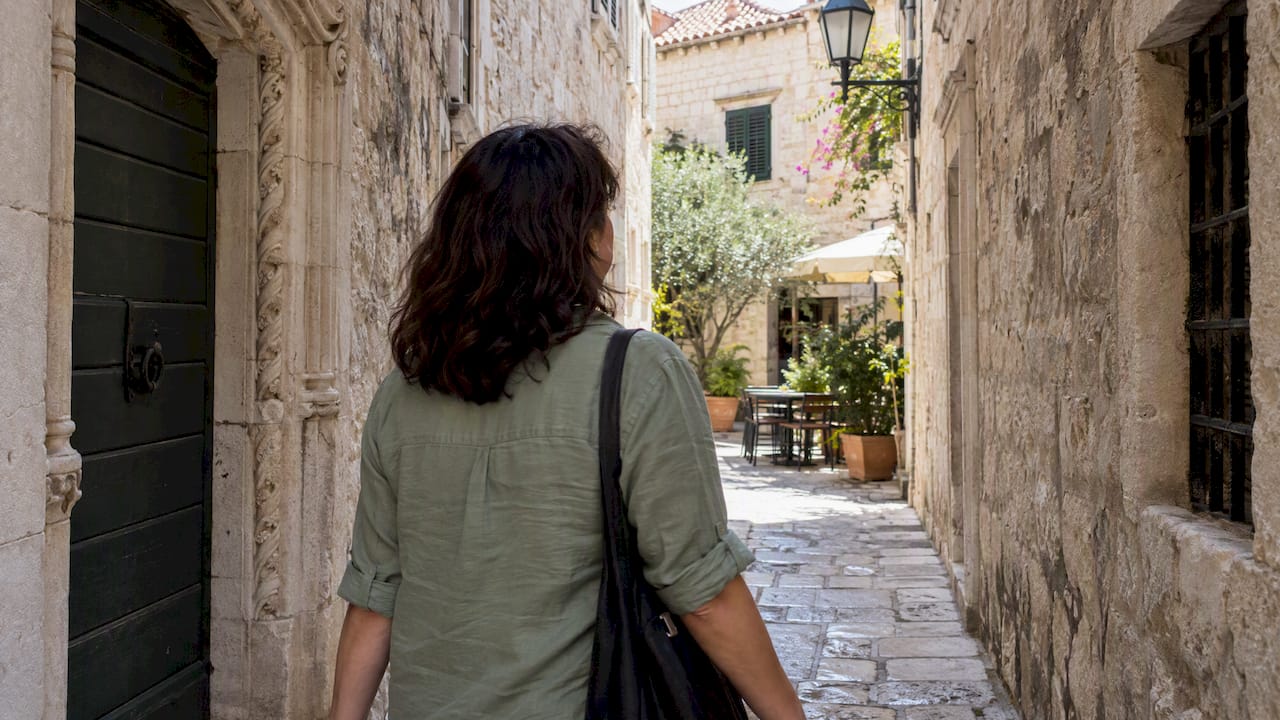
Hvar Town is small. The 2021 census counted 3,979 residents, down from 4,251 in 2011, so the compact center feels very different at 8 a.m. than at noon, when day-trippers and yachts fill the waterfront. Walk the lanes early, before the heat and the crowds arrive. Stone stairways, small chapels and the large main square, one of the biggest in Dalmatia, reward unhurried wandering rather than a checklist.
The Benedictine monastery and agave lace
This is the stop most day-trippers skip, and it is worth the time. The Tourist Board describes the island as home to six UNESCO-recognized cultural heritages, and one of them is agave lace-making, practiced by the Benedictine sisters for centuries. A single piece takes the nuns five to six months to complete. You come away with an understanding of the island that no beach can offer. Opening hours vary, so confirm them locally on the day.

The Fortica
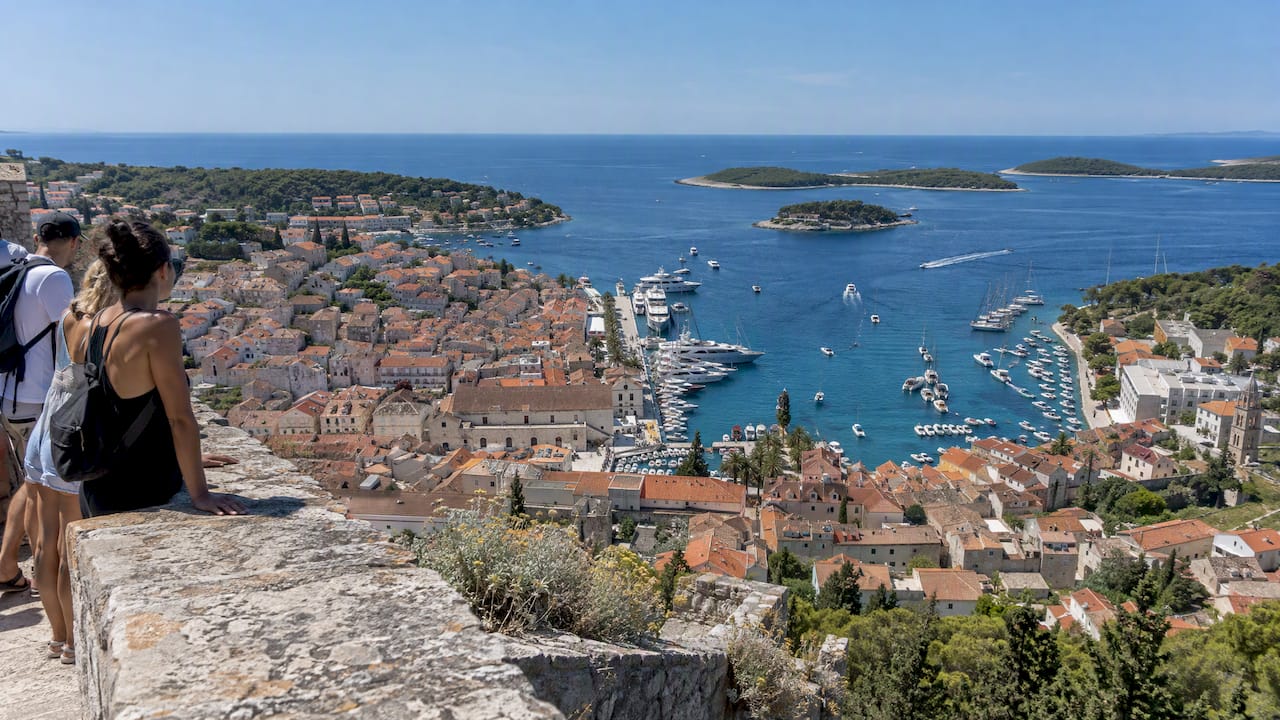
The fortress above the town is the best viewpoint on the island. The climb runs through stone streets and Mediterranean gardens with plenty of steps, and visitors consistently say it is worth it. From the top you see the town roofs, the harbor and the Pakleni Islands spread across the water. Inside there is a collection of amphorae and artifacts, and an old prison in the lower levels. Go in the late morning or the softer light of late afternoon, carry water, and wear shoes with grip, because the old stone is polished smooth.
Lunch and the swim
Keep lunch local: grilled fish, octopus, a glass of Hvar white or red. Then decide how you want your swim. The town beaches are convenient but busy. A short water taxi to the Pakleni Islands or a drive to a southern cove gives more space and cleaner, calmer water. Whichever you choose, leave a margin of at least an hour before your boat.
The alternative day: the Stari Grad Plain and the quiet south
If you prefer substance to spectacle, build your day around the island’s cultural landscape. The Stari Grad Plain has remained practically intact since Ionian Greeks from Paros colonized it in the 4th century BC. The original land division, in plots of roughly 180 by 190 meters, still shapes the fields today, which makes it the best-preserved example of Greek land division in the Mediterranean. The Hvar Tourist Board encourages visitors to look past the busy town and explore what it calls the fertile heart of the island, a living record of 24 centuries of agriculture.
The dry stone walls (suhozid) that cross the plain are not decoration. Local experts want visitors to understand that they are functional, built over centuries of hard work, and that they have held the soil in place for millennia. Walk or cycle a short stretch between vineyards and olive groves, and the scale of that effort becomes obvious.
A sample day on this route:
- Arrive in Stari Grad (by car ferry, or by catamaran to Hvar Town and a transfer across the island).
- Walk the old town of Stari Grad and its waterfront.
- Spend the late morning on the plain, among stone walls, vines and olive trees.
- Have a long lunch at a family-run konoba, ideally with local wine.
- Finish with a swim at a southern cove such as Ivan Dolac or Sveta Nedjelja, both known for their wine villages and quieter beaches.
- Return to your boat or hotel.
This day works best with your own transport, because the plain, the villages and the coves are spread across the island.
What to skip, and what not to attempt
Hvar is small on the map but not in practice. Three things regularly go wrong in a single day.
- Trying to see both ends of the island. Stari Grad and Hvar Town are about 20 minutes apart by car. Add a cove, lunch and a boat, and the schedule is already full.
- Planning around a one-off event. The Following the Cross procession, another of the island’s UNESCO-recognized traditions, takes place only on Maundy Thursday. If you are not there that day, prioritize the Stari Grad Plain or the monastery instead.
- Leaving the return boat to chance. Seasonal timetables change, and the evening sailings are the ones you need. Check them before you commit to a restaurant or a long swim.
When a private day is worth it
A public boat gets you to Hvar. It does not get you to the island. If your group includes children, grandparents or anyone who will tire on a hot hillside, if you want a vineyard lunch and a quiet cove in the same afternoon, or if you simply prefer not to negotiate timetables, a private day changes the character of the trip. You choose the pace, stop when something catches your eye and skip what does not. For travelers weighing this up, our overview of private tours of Hvar explains what a luxury day includes.
Our perspective on a day on Hvar
We plan a great many Croatian days, and Hvar is the one where the gap between a good and a forgettable day is widest. The island rewards a narrow plan. Travelers who try to cover everything end up on the waterfront at 4 p.m., tired, with a boat to catch. Those who choose one thread, whether the old town and Fortica, the Stari Grad Plain, or the wine villages and quiet coves of the south, tend to remember the day for years.
Our advice is to treat the island’s time as the scarce resource, not the money. A driver who knows which cove is calm on a given morning, which konoba holds a table and how long the road really takes can give you back two hours that a public timetable would take. Our drivers are licensed and English-speaking, and our vehicles are modern, air-conditioned Mercedes sedans and minivans, so the journey itself is comfortable. And we shape every itinerary around the people in the car: a family with young children needs a very different day from a couple who want to taste wine until sunset.
One honest note: if you want only the main square, a coffee and a swim, the public catamaran is a perfectly good choice. We would rather tell you that than sell you more than the day needs.
— Croatia
Plan your Hvar day with us
If you would like the island arranged around you, our Hvar page shows what we can build, from a relaxed old-town day to a route through the Stari Grad Plain and the southern coves. We also arrange the mainland side of the journey, including private transfers across Croatia and day tours from Split. Tell us your group, your boat time and what you want to see, and we will plan the rest.
Practical tips for a smooth day
- Start early. The first catamaran gives you Hvar Town while it is still calm, and the light is better for photographs.
- Carry cash and a card. Small cove bars and village konobas do not always take cards.
- Bring water and sun protection. The Fortica and the Stari Grad Plain have little shade.
- Wear proper shoes. Stone steps and lanes are smooth and steep.
- Book lunch in advance in high season. The best tables on the waterfront fill early.
- Leave a buffer before your boat. Thirty minutes is the minimum, an hour is better in summer.
FAQ
Is one day enough for Hvar?
Yes, if you choose a focus. One day comfortably covers Hvar Town with its old town, monastery and Fortica, plus a swim. If you would rather see the Stari Grad Plain and the southern coves, you will need your own transport. Trying to do all of it is what makes the day feel rushed.
How long does it take to get from Split to Hvar?
The catamaran takes about an hour, and our own guide puts it at 50 to 65 minutes. Traveling by car on the ferry to Stari Grad takes longer, around 110 to 120 minutes door to door. Seasonal schedules differ, so check your date before you plan.
How much is the catamaran from Split to Hvar?
A standard one-way ticket is €25.00 in 2026. Children aged 3 to 12 get a 50 percent discount, and children under 3 travel free. Prices and timetables can change, so confirm them on the operator’s page before you travel.
What is the best thing to see on Hvar if I only have a day?
For most visitors it is the view from the Fortica, paired with a walk through the old town and the Benedictine monastery. If you care about history and landscape more than views, the Stari Grad Plain, a UNESCO World Heritage Site, is the more distinctive choice.
Sources
- Hvar Tourist Board: How to reach Hvar
- Split to Hvar catamaran price list and schedule, 2026
- Hvar Tourist Board: sailing schedule from 6 July 2026
- Hvar Tourist Board: brochure
- Hvar Tourist Board: UNESCO heritage
- UNESCO World Heritage Centre: Stari Grad Plain
- CityPopulation: Hvar town population
- Turističke priče: What to see in Hvar town