

Luxury Travel Trends 2026: What Defines True Luxury
TL;DR:
- Luxury travel in 2026 emphasizes immersive, personalized experiences over status or material possessions.
- Travelers seek privacy, cultural depth, and emotional rewards through slow, intimate journeys.
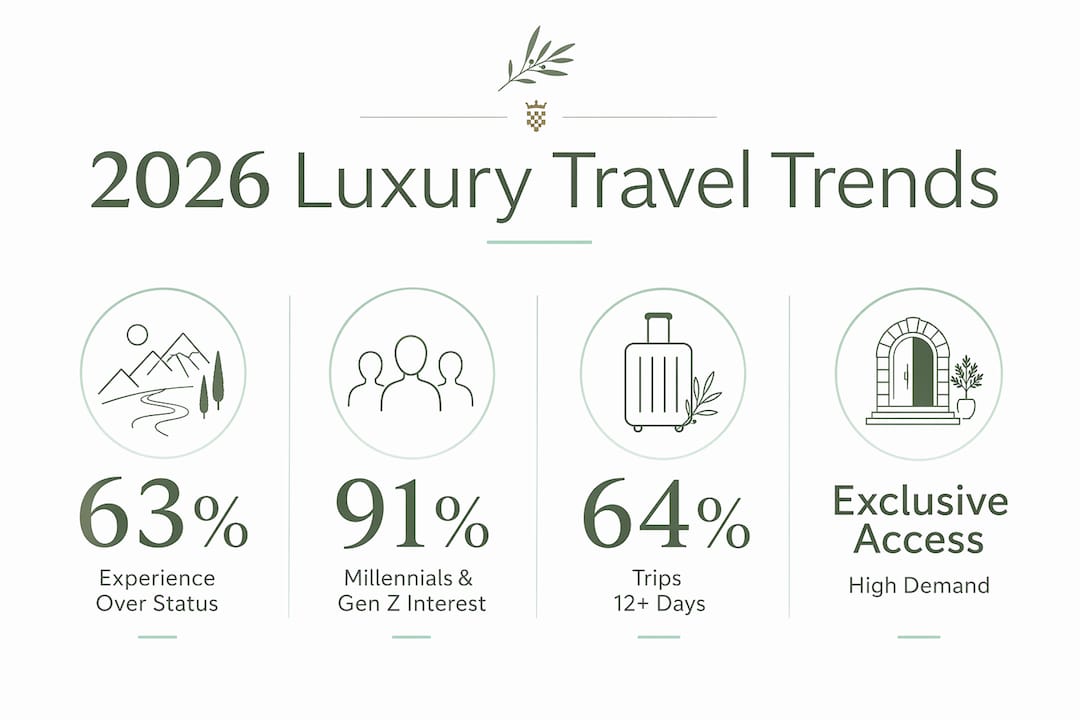
Luxury travel in 2026 is defined by immersive, personalized experiences and genuine emotional returns rather than traditional status-driven motives. The shift is measurable and decisive. According to The New Luxury Traveler report, 63% of affluent travelers now cite unique, personalized experiences as their primary travel motivation, while just 1% travel for status or social recognition. Reports from American Express Travel, Virtuoso, and The Prestige Edit all confirm the same pattern: the luxury travel trends 2026 is shaping are rooted in emotional depth, cultural access, and the quiet pleasure of genuine discovery.
What are the defining characteristics of luxury travel experiences in 2026?
The defining feature of 2026 luxury travel is the rise of hushpitality, the industry’s term for quiet, crowd-free, deeply restorative travel. This is not simply about booking a five-star hotel. It is about choosing experiences that offer genuine privacy, unhurried pacing, and a sense of place that no mass-market itinerary can replicate.

The hushpitality trend reflects a fundamental shift in what affluent travelers consider valuable. Rest, intimacy, and cultural depth now outrank spectacle and social visibility. Travelers are choosing private villas over branded hotel towers, secluded coastlines over crowded resort beaches, and curated cultural encounters over tourist-circuit landmarks.
Key characteristics that define luxury travel experiences in 2026 include:
- Privacy as the primary amenity. Exclusive access to spaces, whether a private estate in Tuscany or a converted Ottoman palace in Dubrovnik, is now the clearest signal of true luxury.
- Emotional ROI over material display. Travelers measure the success of a trip by how it changed them, not by what they acquired or posted.
- Crowd-free cultural access. Experiences at restricted historical sites, private museum tours after hours, and intimate performances for small groups command the highest premiums.
- Wellness woven into the itinerary. Restorative elements, from thermal baths to forest immersion, are built into the trip structure rather than treated as optional add-ons.
Pro Tip: When evaluating a luxury itinerary, ask your operator how many other guests will share each experience. True exclusivity is measured in single digits.
The emotional dimension of this shift is significant. American Express Travel’s 2026 Global Travel Trends Report confirms that emotional ROI now drives luxury travel decision-making more than any other factor. Travelers are extremely intentional about choosing experiences that leave lasting impressions rather than fleeting pleasures.
How are travel duration and slow travel influencing luxury itineraries?
Slow travel is the structural expression of the hushpitality philosophy. Rather than racing through five cities in seven days, affluent travelers in 2026 are choosing depth over breadth, spending extended time in one region to absorb its culture, cuisine, and character.
The data is clear. 64% of affluent travelers now prefer trips lasting 12 days or more. That preference reshapes every aspect of itinerary design, from transportation choices to accommodation selection to the rhythm of daily activities.
Successful 2026 luxury itineraries share four structural qualities:
- Coherent cultural narrative. The best itineraries follow a single thread, such as the winemaking traditions of Dalmatia or the medieval maritime history of the Adriatic coast, rather than collecting unrelated highlights.
- Anchored base locations. Travelers stay in one or two carefully chosen properties and take day excursions outward, reducing travel fatigue and deepening local connection.
- Multi-generational design. Extended family groups traveling together require itineraries that satisfy multiple age groups simultaneously, with private transportation and flexible scheduling as non-negotiable elements.
- Intentional pacing. Mornings might involve a private guided walk through a UNESCO site; afternoons are left open for spontaneous discovery or genuine rest.
“The most memorable trips are not the ones where you saw the most. They are the ones where you felt the most.” — Enchanting Travels, The New Luxury Traveler Report, 2026
Extended stays in private estates and wellness retreats are growing markedly in the 2026 luxury market. Multi-generational travel, in particular, is driving demand for private ground transportation that can accommodate varied group sizes without compromising comfort or flexibility. For travelers planning coastal excursions in Croatia, this means choosing operators who can adapt routes and timing to the group’s natural rhythm rather than a fixed schedule.
Which destinations and exclusive access experiences define top luxury travel in 2026?
The most sought-after destinations in 2026 share three qualities: political stability, strong infrastructure, and the promise of genuine exclusivity. Sun-drenched coastal regions with layers of history, from the Dalmatian coast to the Greek islands to the Amalfi coast, continue to attract the highest concentration of discerning travelers.
What separates a premium destination from a truly elite one is the quality of access it offers. Luxury travelers are increasingly seeking privilege of access to restricted cultural and historical sites, experiences that simply cannot be purchased through a standard booking platform. This access relies almost entirely on personal relationships and local expert operators who have spent years building trust with site custodians, private estate owners, and cultural institutions.
| Experience type | What it delivers | Who provides it |
|---|---|---|
| Private historical site access | After-hours entry to UNESCO sites, restricted archaeological zones | Local specialist operators with institutional relationships |
| Luxury rail travel | Scenic, unhurried transit through landscapes inaccessible by road | Specialized rail tour companies and private charter services |
| Converted historical stays | Accommodation in castles, monasteries, and palaces with curated cultural programming | Boutique heritage hotel groups |
| Private estate immersion | Farm stays, vineyard residencies, and family-hosted cultural experiences | Regional luxury travel curators |
The role of specialized local operators in securing this level of exclusivity cannot be overstated. Access to hard-to-book locations depends on personal relationships that take years to build. No app or aggregator platform replicates that. For travelers exploring Croatia, working with a provider like Croatia-private-transfers means gaining access to local knowledge and trusted networks that open doors a standard tour operator simply cannot.
What price dynamics define the ultra-luxury travel market in 2026?
Ultra-luxury travel in 2026 operates by a different set of economic rules than most consumer markets. Higher prices are not deterring demand. They are generating it. This is the principle of inverted price elasticity, and it is reshaping how premium travel brands position their offerings.
The clearest example comes from Zeus World, whose premier package doubled in price to $70,800 and subsequently saw demand increase by 10%. The price increase itself became the signal of exclusivity. That is the logic of the ultra-luxury segment: scarcity and cost combine to create desirability rather than resistance.
Key pricing dynamics shaping the 2026 market include:
- Price as a quality signal. In a market where travelers are paying for access and authenticity, a higher price communicates that the experience is genuinely rare and carefully curated.
- Segmentation between tiers. The luxury travel market is splitting into accessible luxury (premium but bookable) and opulent experiences (invitation-only or extremely limited availability). Both segments are growing, but for different reasons.
- Value defined by transformation. Travelers at the ultra-luxury tier are not comparing prices. They are comparing the depth of transformation a trip promises to deliver.
Pro Tip: If a luxury operator’s pricing seems surprisingly high, that is often the point. Ask what the price includes in terms of access, exclusivity, and personalization before comparing it to standard alternatives.
The elite market’s inverted price elasticity is a practitioner-level insight that most travelers miss. Understanding it helps you read the market more clearly and recognize genuine value when you encounter it.
How are emotional motivations reshaping luxury travel planning?
The most significant shift in 2026 luxury travel is the move from status to meaning. Travelers are choosing trips that connect them to something larger than themselves, whether that is their family heritage, a craft tradition, a natural landscape, or a cultural community they want to understand more deeply.
American Express Travel’s 2026 report found that 76% of luxury travelers value skills and knowledge gained from travel more than physical souvenirs. That figure tells you everything about where the market is heading. The souvenir economy is giving way to the experience economy, and within the experience economy, the most prized currency is personal transformation.
Experiences that reflect this emotional orientation include:
- Ancestry and heritage travel. Travelers tracing family roots through specific regions of Croatia, Italy, or Ireland, with private guides who can access local archives and introduce living community members.
- Skill-building immersions. Cooking with a Michelin-starred chef in their home kitchen, learning traditional boat-building techniques in a Dalmatian workshop, or studying mosaic restoration in a centuries-old atelier.
- Wellness retreats with cultural context. Not generic spa breaks, but restorative stays that incorporate local healing traditions, indigenous botanicals, and the specific landscape of the destination.
- Private tours with expert narration. The difference between walking through a Roman amphitheater and understanding it through the eyes of an archaeologist who has spent 20 years excavating it.
Among Millennials and Gen Z affluent travelers, 91% show strong interest in private luxury rail travel and unique stays. That cohort is now entering its peak earning years, and its preferences are setting the direction for the entire luxury travel market through the rest of the decade. For industry professionals, this is the most important demographic signal in the 2026 data.
Key takeaways
Luxury travel in 2026 is defined by emotional depth, extended immersion, and exclusive access rather than visible status or material indulgence.
| Point | Details |
|---|---|
| Experience over status | 63% of affluent travelers prioritize unique, personalized experiences; only 1% travel for social recognition. |
| Slow travel is the new standard | 64% of luxury travelers prefer trips of 12 days or more, favoring depth over destination count. |
| Hushpitality drives destination choice | Crowd-free, private, and restorative experiences now command the highest premiums in the luxury market. |
| Price signals exclusivity | Ultra-luxury pricing operates on inverted elasticity; higher costs increase demand by signaling genuine rarity. |
| Emotional ROI is the primary currency | 76% of luxury travelers value knowledge and skills gained from travel more than any physical souvenir. |
Why the quiet revolution in luxury travel matters more than you think
I have watched the luxury travel market shift over many years, and what is happening in 2026 feels genuinely different from previous cycles. This is not a trend driven by a new destination becoming fashionable or a new hotel brand entering the market. It is a philosophical realignment in what travelers believe travel is for.
The travelers I work with through Croatia-private-transfers are not asking for the most expensive option. They are asking for the most meaningful one. They want to arrive at a destination and feel that the entire experience was designed around them, not assembled from a catalog of standard components. That distinction matters enormously in how we plan routes, select vehicles, and brief our drivers and guides.
What concerns me about some corners of the industry is the tendency to rebrand existing products as “experiential” without actually changing what is delivered. Slapping the word “immersive” on a standard group tour does not make it one. The travelers who are driving these trends are sophisticated enough to recognize the difference immediately.
My honest advice for travelers planning a 2026 trip: prioritize operators who can tell you specifically what doors they can open that others cannot. Ask about their local relationships. Ask how long they have been working in a particular region. The answer will tell you whether you are booking a genuine luxury experience or a well-packaged standard one.
Croatia, in particular, rewards this approach. Its layers of Roman, Venetian, and Ottoman history, combined with a coastline of extraordinary beauty, make it one of the most rewarding destinations for slow, immersive travel. The travelers who discover it on their own terms, through private routes and local expertise, leave with something that no highlight reel can capture.
— Croatia
Plan your 2026 luxury experience with Croatia-private-transfers
Croatia-private-transfers offers private transfers across Croatia designed for travelers who value precision, comfort, and genuine local knowledge. Every journey is handled in a modern, air-conditioned Mercedes vehicle by a licensed, English-speaking driver who understands that the transfer itself is part of the experience. Whether you are planning an extended stay along the Dalmatian coast, a multi-generational family trip through UNESCO heritage sites, or a bespoke luxury tour that weaves together wine, history, and breathtaking scenery, Croatia-private-transfers builds each itinerary around your preferences. Discover what thoughtfully curated private travel in Croatia truly feels like.
FAQ
What is hushpitality in luxury travel?
Hushpitality is the practice of choosing quiet, crowd-free, and deeply private travel experiences that prioritize genuine rest and cultural intimacy over high-energy tourism. It is one of the defining luxury vacation trends shaping the 2026 market.
Why do luxury travelers prefer longer trips in 2026?
64% of affluent travelers now prefer trips lasting 12 days or more because extended stays allow deeper cultural immersion, reduce travel fatigue, and deliver the emotional returns that short itineraries cannot provide.
What makes exclusive access experiences worth the premium price?
Exclusive access to restricted historical sites, private estates, and after-hours cultural venues relies on personal relationships built by specialist local operators over many years. That access is genuinely scarce and cannot be replicated by standard booking platforms.
How does inverted price elasticity work in luxury travel?
In the ultra-luxury segment, higher prices signal exclusivity and rarity rather than deterring buyers. Zeus World’s premier package doubled to $70,800 and demand increased by 10%, demonstrating that price itself becomes a quality signal in this market.
What are the top luxury destinations for 2026?
Politically stable, infrastructure-rich destinations with rich cultural heritage lead the 2026 list. The Dalmatian coast, the Greek islands, and the Amalfi coast are among the most sought-after, particularly for travelers seeking exclusive travel experiences that combine natural beauty with historical depth.