

Premium Travel Service: What It Means for Discerning Travelers
A premium travel service is a coordinated, end-to-end experience designed to save you time, remove logistical friction, and deliver moments that feel personally meaningful rather than simply expensive. The core promise is reliability: every transfer, guide, and reservation connects without gaps, and someone knowledgeable is always reachable when plans shift.
Before you read further, here is what premium travel service actually delivers:
- Time recovered. Coordinated logistics mean you spend your hours at a destination, not managing them.
- Predictability. Confirmed vehicles, vetted guides, and clear communication replace the anxiety of improvised arrangements.
- Personal relevance. Itineraries are shaped around your interests, pace, and travel style, not a generic template.
- Curated access. Trusted local partnerships open doors to experiences, timing, and knowledge that independent booking rarely reaches.
Providers like Croatia-private-transfers build their entire model around this promise: licensed, English-speaking drivers in modern Mercedes-class vehicles, door-to-door coordination, and bespoke itineraries across Croatia’s most breathtaking destinations.
Key Takeaways
Premium travel service is, at its core, a coordinated system that saves you time, removes logistical friction, and delivers experiences shaped around your interests rather than a generic template.
| Point | Details |
|---|---|
| Premium vs. luxury distinction | Premium prioritizes coordination and personal relevance; luxury centers on exclusivity and prestige. |
| Coordination over features | A provider’s operational system matters more than its feature list; ask how components connect. |
| Key selection questions | Verify licensing, day-of contact, contingency plans, and transparent pricing before booking. |
| Value-led definition | Travelers trade up for time-saving and personally meaningful experiences, not price signals alone. |
| Croatia-private-transfers | Offers licensed drivers, Mercedes-class vehicles, and bespoke itineraries with real-time coordination across Croatia. |
Table of Contents
- What is premium travel service, and how does it differ from luxury?
- What are the core elements that make a travel service truly premium?
- What do you actually gain from choosing a premium travel service?
- What types of services fall under the premium travel category?
- What should you expect when booking, and what drives the price?
- How do premium providers actually deliver a stress-free experience?
- How do you choose a premium travel service provider?
- How is the premium travel market changing in 2026?
- How did premium travel services evolve into what they are today?
- What premium service feels like in practice
- Croatia-private-transfers: a premium service built around your itinerary
- Sources
What is premium travel service, and how does it differ from luxury?
The terms “premium” and “luxury” are used interchangeably in marketing, but they describe meaningfully different postures. Understanding the gap helps you spend more wisely.
Premium centers on coordination, personal relevance, and value-conscious trade-ups. A premium traveler wants the right experience at the right time, with friction removed and expertise on hand. According to LEK Consulting’s survey findings, premium travelers are more value-conscious and more flexible with trip timing than their ultra-luxury counterparts, and they fall into distinct segments motivated by convenience, personal fit, or emotional impact. They are not chasing status; they are chasing a well-spent day.
Luxury, by contrast, leans into exclusivity, scarcity, and prestige. It often involves peak-season one-off access, ultra-rare accommodations, and price points that signal arrival as much as they deliver comfort. The Travel Institute’s 2026 practitioner analysis notes that luxury and premium travelers differ in seasonality, price sensitivity, and trip length, and that advisors must adapt proposals accordingly.
A practical illustration: a premium traveler books a flexible shoulder-season itinerary along the Dalmatian coast, with a private driver, a local food guide, and a curated winery stop, all coordinated to fit their pace. A luxury traveler books a peak-summer superyacht charter with a Michelin-starred chef on board. Both are high-quality experiences. Only one requires a system of coordinated moving parts that most travelers actually need.
| Dimension | Premium travel | Luxury travel |
|---|---|---|
| Core driver | Coordination and personal relevance | Exclusivity and prestige |
| Price posture | Value-conscious trade-up | Price-secondary |
| Timing flexibility | Often flexible, shoulder-season friendly | Peak-season, fixed access |
| Key differentiator | Friction removed, expertise on hand | Scarcity and status |
| Typical format | Private transfers, bespoke itineraries | Ultra-rare access, one-of-a-kind events |
What are the core elements that make a travel service truly premium?
A long feature list does not make a service premium. What does is the integration of those features into a coherent, guest-centered system. ZS’s strategic analysis makes this explicit: premiumization fails when isolated high-end features are added without coordination across the full service chain.
The components that matter most:
- Personalization. The itinerary reflects your interests, dietary needs, pace, and travel history, not a default template. Providers who ask detailed questions before confirming a booking are demonstrating this, not just promising it. See how personalized travel experiences are designed for discerning travelers.
- Frictionless logistics. Transfers connect to guide timings; accommodations are confirmed before arrival; contingency plans exist for delays. Nothing is left to chance or to the traveler to sort out.
- Local expertise and trusted partnerships. The best providers work with vetted local guides, licensed operators, and preferred venues built through years of relationship, not one-off bookings.
- Predictable communication. You receive confirmation at every stage: before departure, on the day, and in real time if anything changes.
- High operational standards. Vehicles are modern, licensed, and maintained. Guides are trained, fluent, and briefed on your preferences. Accommodations are inspected, not just listed.
- Flexible problem resolution. When a ferry is delayed or a restaurant closes, the provider adapts without asking you to manage the fallout.
Pro Tip: Ask any provider how they synchronize private transfers and guides for last-mile timing. A confident, specific answer, including who contacts whom and how far in advance, is one of the clearest signals of genuine operational coordination versus a polished brochure.
What do you actually gain from choosing a premium travel service?
The benefits of premium travel are concrete, not abstract. Euromonitor’s research frames it clearly: travelers trade up for experiences that feel personally relevant and time-saving, not simply for higher price points.

Consider a full-day shore excursion. A self-arranged day involves researching transport, booking a guide separately, navigating ticket queues, and hoping the timing holds together. A premium version has a driver waiting at the pier, a private guide who has pre-arranged priority entry, a curated lunch reservation at a local spot the guidebooks haven’t found yet, and a return transfer timed to your ship’s departure. The difference is not just comfort. It is three to four hours of recovered time, zero cognitive load, and a day that actually matches what you came for.
The emotional dimension matters too. Knowing that someone knowledgeable is reachable, that the car will be there regardless of a delayed flight, and that the itinerary was built around your family’s pace rather than a group schedule, produces a qualitatively different kind of travel. Imvoyager’s 2026 sector review confirms that premium travelers increasingly prioritize predictable communications and technology that reduces friction, placing these above on-property luxury in their hierarchy of value.
What types of services fall under the premium travel category?
Premium travel services span a wide range of formats. Here are the main categories you will encounter:
- Private transfers and chauffeur services. Door-to-door transport in vetted, modern vehicles with a professional, often multilingual driver. This is the most common entry point into premium travel and the foundation of any coordinated itinerary.
- Bespoke itinerary design. A travel designer or specialist builds a multi-day or multi-destination plan around your interests, pace, and budget, coordinating all moving parts. Custom itinerary design is the architecture behind a truly personal trip.
- Private boat and charter services. Exclusive use of a vessel for coastal exploration, island-hopping, or sunset cruises, with a crew and guide included. Croatia’s Adriatic coastline makes this format particularly compelling.
- Curated small-group premium journeys. Intimate group experiences, typically eight guests or fewer, with a specialist guide and a fixed, thoughtfully paced itinerary. The group format keeps costs accessible while preserving depth.
- VIP airport services and fast-track clearance. Meet-and-greet assistance, expedited security and immigration, and lounge access that transforms the airport from a stressor into a neutral transition.
- Premium cabin and private-jet arrangements. Business and first-class air travel coordinated as part of a broader itinerary, or private charter for groups where schedule flexibility outweighs cost.
- Boutique and villa-based hospitality. Smaller properties with localized character, personalized service ratios, and curated programming that large hotels cannot replicate.
What should you expect when booking, and what drives the price?
Premium bookings follow a more deliberate process than standard travel. For a bespoke multi-day itinerary, expect a consultation phase of several exchanges before a proposal is confirmed. Single private transfers can often be booked with shorter lead times, though peak-season availability narrows quickly. A practical guide to booking private transportation covers what to expect at each stage.
The main cost drivers:
- Coordination complexity. More moving parts, more providers to synchronize, and more contingency planning all add to the service fee.
- Seasonality. Peak-season pricing reflects both demand and the premium placed on confirmed availability during high-traffic periods.
- Exclusivity and access fees. Private entry, reserved timeslots, and specialist guides carry costs that shared-group options absorb across many travelers.
- Personnel and vehicle standards. Licensed, trained, insured staff and maintained premium vehicles cost more than informal alternatives, for good reason.
- Last-minute changes. Modifications after confirmation often carry fees that reflect the real cost of rescheduling confirmed suppliers.
Pro Tip: When requesting a quote, ask the provider to separate the core service fee from optional add-ons. A transparent breakdown tells you exactly what you are paying for and makes it easier to compare offers honestly.
How do premium providers actually deliver a stress-free experience?
The effortless feeling of a well-run premium day is the product of systems the guest never sees. Expedition operators like those described by Dr. Jones have long understood this: the difference between a remarkable itinerary and an unforgettable journey often lies in what the guest never has to manage.
Operationally, premium providers rely on:
- Coordinated supplier networks with pre-vetted, relationship-based partners rather than one-off bookings.
- Real-time communication protocols between drivers, guides, and a central coordinator.
- Contingency plans for common disruptions: flight delays, weather changes, venue closures.
- Dedicated day-of contact, a single person the traveler can reach directly.
- Standardized quality checks for vehicles, guide briefings, and accommodation readiness.
Before confirming a booking, ask your provider these questions: Who is my direct contact on the day? How do you handle a significant flight delay? Are your drivers and guides licensed and insured? What is your contingency plan if a key supplier cancels? The answers reveal whether a provider operates a genuine system or simply lists premium features. What sets premium tours apart goes deeper on the operational signals worth checking.
How do you choose a premium travel service provider?
The selection process is where most travelers either protect their investment or lose it. A polished website and aspirational photography are not trust signals. These are:
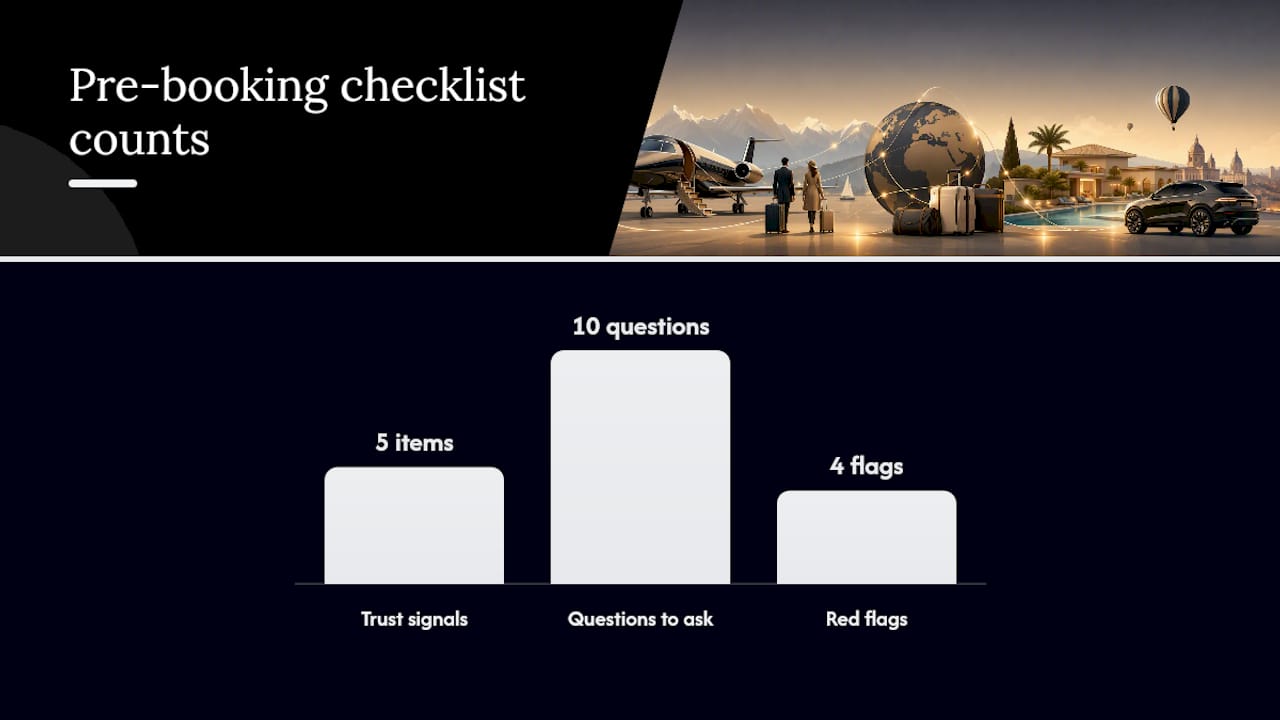
Trust signals to verify:
- Licensed vehicles and drivers with current insurance documentation.
- Vetted local partners with named relationships, not anonymous “local experts.”
- Visible, specific reviews from travelers with similar trip profiles.
- Transparent cancellation and refund terms in writing before payment.
- Clear communication from the first inquiry, including response time and detail quality.
Ten questions to ask before booking:
- What is your recommended lead time for a trip like mine?
- Who is my single point of contact on the day of travel?
- How do you handle a significant flight delay or cancellation?
- Can you share a sample itinerary for a similar trip?
- What is included in the quoted price, and what is optional?
- What are your cancellation and modification terms?
- Are your drivers and guides licensed, insured, and fluent in English?
- Can you provide references from past travelers with similar itineraries?
- What are your payment terms and accepted methods?
- How do you handle special requests, dietary needs, or accessibility requirements?
Red flags to watch for:
- Responses that list features without explaining how they are coordinated.
- Vague or missing cancellation and insurance policies.
- Inconsistent communication tone or significant delays in responding to inquiries.
- Prices that seem unusually low without a clear explanation of what is excluded.
How is the premium travel market changing in 2026?
The premium travel sector is undergoing a meaningful shift, and understanding it helps you evaluate provider claims more critically.
Euromonitor’s market research shows that “premium” is now defined more by personal relevance and meaningful experiences than by price or exclusivity. Travelers trade up for what feels time-saving and personally resonant, not for what signals status to others.
Stat to know: LEK Consulting’s survey found that brands targeting premium travelers with broad demographic segmentation are likely missing significant spend. Segmenting by traveler motivation, specifically time-saving, emotional relevance, and convenience, performs substantially better.
Three practical takeaways for travelers evaluating offers today:
- Prioritize coordination over features. A provider who explains their operational system is more trustworthy than one who lists amenities. ZS’s industry analysis confirms that premiumization fails without integration across the full service chain.
- Ask about sustainability. Premium travelers increasingly expect providers to demonstrate environmental responsibility, from vehicle emissions to local community partnerships.
- Value flexibility. The Travel Institute’s 2026 analysis notes that premium travelers are often more flexible on seasonality than luxury travelers. Providers who offer meaningful shoulder-season options are responding to this, not cutting corners.
Independent travel designers reinforce the same point: premium is a process of understanding the traveler and coordinating trusted local partners so the journey feels effortless and personally relevant, not a price bracket.
How did premium travel services evolve into what they are today?
The concept of coordinated, personally attended travel is older than the word “premium.” Grand Tour escorts in 18th-century Europe provided wealthy travelers with guides, translators, and logistical support across unfamiliar cities. Thomas Cook’s 19th-century organized tours democratized coordinated travel for the middle class, establishing the template of pre-arranged transport, accommodation, and itinerary.
The post-war era brought the first-class cabin, the hotel concierge, and the corporate travel manager, each representing a layer of coordination added on top of mass travel infrastructure. By the 1980s and 1990s, specialist operators began carving out a distinct tier between budget group tours and ultra-luxury bespoke travel, offering private guiding, vetted accommodations, and personalized itineraries at accessible price points.
The internet era initially threatened this model by giving travelers direct access to booking platforms. What it actually did was raise the floor of traveler expectations while making the coordination gap more visible. Travelers who booked every component themselves discovered that the hardest part was not finding options but making them work together. That realization drove renewed demand for providers who specialize in exactly that: not selling components, but orchestrating experiences.
What premium service feels like in practice
Picture arriving at a coastal airport after a delayed flight. Your driver already knows, because the provider’s coordinator tracked the flight in real time and sent a message confirming the updated pickup time before you landed. The vehicle is cool, the driver greets you by name, and the route to your accommodation takes a brief detour past a viewpoint the driver knows you requested. By the time you reach the property, your luggage is handled and your first morning’s guide has already been briefed on the delay and adjusted the departure time accordingly.
That small chain of events, a tracked flight, a proactive message, a briefed guide, represents what Imvoyager’s sector review identifies as the defining premium value: predictable communications and operational integrity. No single moment is dramatic. Together, they produce a day where you never once had to manage logistics, and the destination got your full attention.
Croatia-private-transfers: a premium service built around your itinerary
Croatia-private-transfers delivers exactly the coordination this article describes: licensed, English-speaking drivers in modern Mercedes sedans and minivans, door-to-door private transfers across Croatia, and bespoke day trips or multi-day itineraries built around your interests and pace. Every booking includes a direct point of contact, real-time flight monitoring for airport transfers, and contingency planning as standard, not as an upgrade.
Whether you are planning a single airport transfer or a fully bespoke Croatia itinerary that combines coastal drives, UNESCO sites, and curated local experiences, the booking process starts with a conversation about what you actually want. Request a quote or reach out directly to discuss your itinerary. The team responds promptly, with specific answers, which is itself the first signal of a provider worth trusting.
Sources
- Brands likely missing out: premium traveler spending finds — LEK Consulting
- Premium travel strategy is a system, not a feature list | ZS
- Beyond affordability: how premium drives value in travel — Euromonitor
- Premium vs. Luxury Travelers in 2026: Using technology to streamline workflows and personalize more – The Travel Institute
- What Services Do Premium Travelers Value The Most In 2026? — Imvoyager
- About | Premium Travel Service