


When €35–€80 Private Transfers Beat Taxis: Split Airport Prices 2026
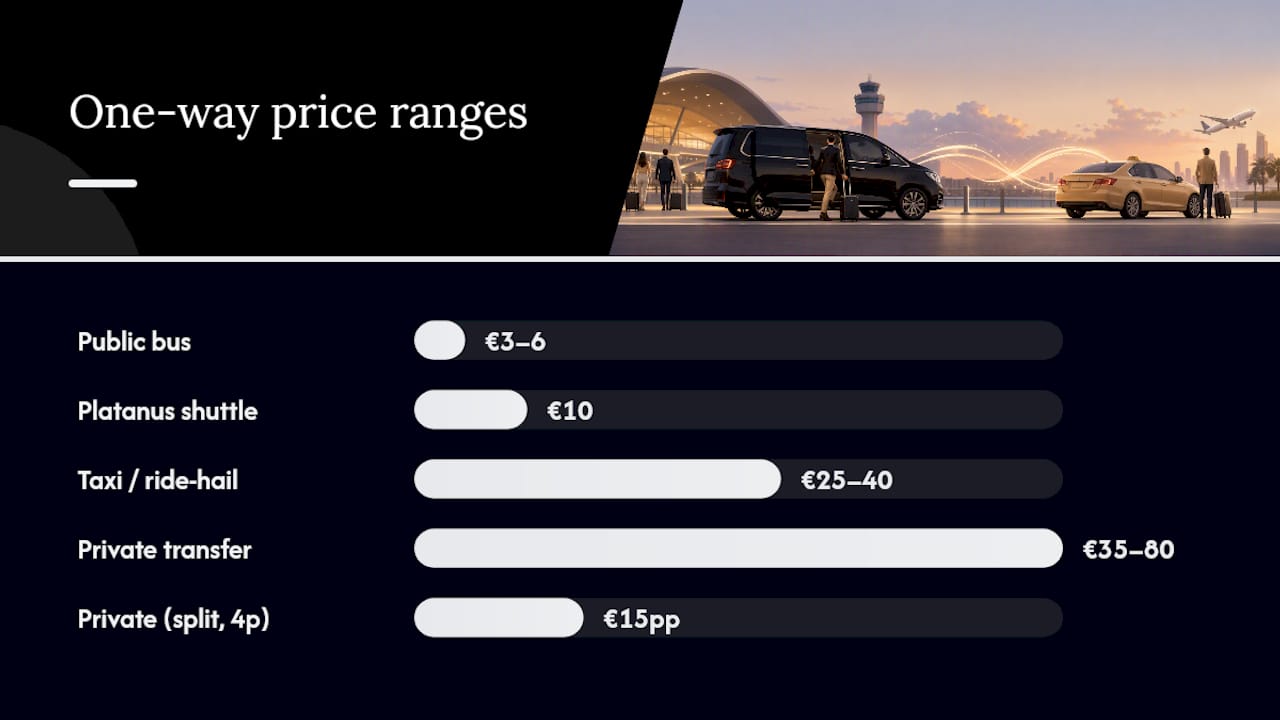
Transfer aerodrom Split cijena ranges from about €3 on the public bus to €80 or more for a private car, and the right pick depends on your timing more than your budget. The Platanus shuttle runs about €10 one-way, the local bus costs €3 to €6, a taxi or ride-hail trip into central Split runs €25 to €40, and a pre-booked private transfer typically lands between €35 and €80. Journey times swing from 30 minutes off-peak to well over 50 during the summer crush. The breakdown below shows exactly which option fits your trip.
TL;DR:
- The Platanus shuttle costs about €10 one-way and takes 30 to 40 minutes, with schedules tied closely to flight arrivals.
- Public buses are the cheapest option at €3 to €6 but can take over an hour during peak season with minimal luggage space.
- Private transfers cost €35 to €80 and offer door-to-door service, pre-booking ensures fixed prices and flight monitoring.
- Taxis and ride-hail services usually range from €25 to €40 for central Split, with demand spikes during summer evenings and late nights.
- For travelers with heavy luggage, mobility needs, or tight ferry connections, private transfers provide the most reliable, comfortable solution.
Table of Contents
- How Do Split Airport Transfer Prices Compare?
- What Does the Official Platanus Shuttle Cost?
- Is the Local Bus a Cheaper Option Than the Shuttle?
- How Much Does a Taxi or Uber Cost From Split Airport?
- When Does a Private Transfer Make Sense?
- How Do You Choose the Right Transfer for Your Trip?
- Which Transfer Option Gives You the Best Value?
- How Do You Avoid Taxi and Ride-Hail Overcharging at Split Airport?
- What Should Travelers With Mobility Needs Know?
- What Are the Luggage Rules for Each Transfer Option?
- Why We Recommend Private Transfers for Certain Travelers
- Book Your Split Airport Transfer With Croatia-private-transfers
- Where This Pricing Information Comes From
- Sources
- FAQ
How Do Split Airport Transfer Prices Compare?
Every traveler landing at Split Airport (SPU) faces the same four choices, and each one trades price against speed, comfort, and predictability. Here’s the quick rundown before you dig into specifics:
- Official shuttle (Platanus): about €10 one-way, €15 return; 30 to 40 minutes to the main bus station.
- Public bus (Promet, line 37): roughly €3 to €6; 40 to 60 minutes with multiple stops.
- Taxi or ride-hail (Uber, Bolt): €25 to €40 to central Split, €10 to €20 to Trogir; 25 to 45 minutes.
- Private pre-booked transfer: €35 to €80 for a standard car depending on vehicle class; 25 to 40 minutes with door-to-door service.
- Rental car: desk prices vary by season and provider, plus fuel and parking in central Split, which fills up fast in summer.
Demand spikes hard between June and September, when flight arrivals cluster and taxi queues stretch long. Buses and shuttles keep running into the evening, but frequency drops late at night, so travelers on last flights should confirm their option is still active. All prices here reflect 2026 local rates in euros, Croatia’s currency since 2023.
What Does the Official Platanus Shuttle Cost?
The Platanus shuttle is the city’s official airport bus service, and it prices a one-way ticket at €10, with a return ticket at €15. That return fare only makes sense if your dates are flexible, since tickets don’t expire on a fixed day but the savings only work out if you actually use both legs.
What makes Platanus genuinely useful is how its schedule ties to flight arrivals rather than a fixed clock. Buses typically depart about 30 minutes after a plane lands, giving passengers enough time to clear customs and collect luggage without a mad dash to the curb. The ride itself takes 30 to 40 minutes and drops you at Split’s main bus station, right next to the ferry port.
That drop-off point matters more than it sounds. Anyone heading onward to Hvar, Brač, or another island benefits directly from landing steps away from the ferry terminal, and it’s one reason island-bound travelers favor the shuttle over other ground options.
- Buy tickets online in advance through Platanus’s ticketing page or at the airport desk on arrival.
- Seats can sell out in peak July and August departures, so reserving ahead avoids standing on the curb watching a full bus pull away.
- The shuttle suits budget-conscious travelers who still want a seat, air conditioning, and a predictable arrival time.
Pro Tip: If you’re catching an evening ferry, book the shuttle departure tied to your actual flight rather than guessing a time. The 30-minute buffer after landing is built in, but customs lines in peak season can eat into it.
Is the Local Bus a Cheaper Option Than the Shuttle?
Yes, and by a wide margin. The Promet Split public bus network, including line 37, connects the airport to the city for roughly €3 to €6 per ticket, making it the cheapest way to travel besides walking. You board on the main road just outside the terminal rather than a dedicated shuttle bay, so it takes a bit more attention to spot the right stop.
The tradeoff is time and space. Local buses stop frequently along the route, stretching the trip to 40 minutes or more in normal traffic and past an hour during peak summer congestion. Luggage racks are minimal, so travelers with large suitcases often find themselves wedging bags between seats.
- Buy tickets through the Promet Split app before boarding, or pay the driver directly with exact change.
- Line 37 and connecting routes run regularly during the day but thin out late at night.
- This option fits travelers with light luggage, flexible timing, and no urgent ferry or event to reach.
If your flight lands at midnight with a ferry to catch at dawn, the local bus is the wrong tool for the job. It’s built for patience, not connections.
How Much Does a Taxi or Uber Cost From Split Airport?
Taxi fares from Split Airport into central Split typically run €25 to €40, while a run to nearby Trogir costs less, around €10 to €20. Ride-hail apps like Uber and Bolt operate in the area too, with fares landing in a similar €25 to €40 band for central Split, though actual pricing shifts with real-time demand.
Pickup happens in the designated parking or ride-hail zone directly in front of the terminal, clearly marked and a short walk from baggage claim. Booking through an app rather than flagging a curbside taxi gives you a fixed estimate before you commit, which matters more than it sounds once you’re comparing quotes from three drivers at once.
- Central Split: €25 to €40 by taxi or ride-hail.
- Trogir: €10 to €20 by taxi.
- Fares climb during peak summer hours and late-night arrivals when demand outstrips supply.
Pro Tip: If your flight lands after midnight in July or August, don’t assume a taxi or Uber will be waiting. Availability thins out fast in those hours, and a pre-booked private transfer guarantees a driver is there regardless of the clock.
When Does a Private Transfer Make Sense?
A standard private car from Split Airport typically costs €35 to €80, with the exact figure shaped by vehicle class, distance, and any extra stops along the way. A minivan for a larger group or a premium vehicle for a more polished ride costs more within that range.
The value extends beyond the ride itself to include certainty of service. A private transfer means a driver tracking your flight number, waiting through delays, and meeting you at arrivals with your name on a sign rather than leaving you to hunt for transport after a long flight.
- Families with car seats, strollers, or multiple bags avoid the scramble of fitting everyone and everything into a shared shuttle.
- Travelers on early-morning or late-night flights sidestep the reduced frequency of buses and shuttles during off-hours.
- Groups with a tight ferry connection get a guaranteed departure time instead of hoping a shuttle seat is free.
Croatia-private-transfers built its Split Airport service around exactly these situations, pairing licensed, English-speaking drivers with modern, air-conditioned vehicles for travelers who’d rather not gamble on a taxi queue. Before booking any private option, confirm three things: whether flight monitoring is included, how long the driver will wait past your scheduled landing, and the cancellation policy if your plans shift.
How Do You Choose the Right Transfer for Your Trip?
Picking the right option comes down to four questions, answered honestly before you book anything.
- How time-sensitive is your arrival? A flight landing at 11 p.m. with a hotel check-in waiting doesn’t leave room for a bus that might not show up.
- How much luggage are you carrying? Two carry-ons fit fine on a public bus; four suitcases and a stroller do not.
- How many people are traveling together? A solo backpacker and a family of five have completely different math on cost-per-person.
- Do you have a ferry or onward transfer to catch? Allow at least 60 minutes between landing and a ferry departure to cover passport control, baggage claim, and the walk to the terminal.
When you book anything beyond walk-up options, ask the operator directly: is flight tracking included, what happens if the flight is delayed, is the price fixed or metered, and where exactly will the driver meet you? A legitimate operator answers all four without hesitation.
Watch for red flags before handing over payment: no written price confirmation, vague meeting instructions like “look for someone near the exit,” or an inability to name their licensing. Those are signs to walk away.
Pro Tip: As a rule of thumb, tight budget and light bags point to the bus or shuttle. A balanced need for value and a ferry connection points to Platanus. Anything time-sensitive or luggage-heavy points to a private transfer.
Which Transfer Option Gives You the Best Value?
Cost-effectiveness isn’t just the number on the ticket. It’s the price divided by how much hassle you’re willing to absorb. The public bus wins on pure cost at €3 to €6, but that value collapses fast if you’re hauling luggage up narrow steps or standing for 50 minutes in August heat with no seat available.
The Platanus shuttle strikes the most balanced deal for most travelers. At around €10, it costs a fraction of a taxi while still guaranteeing a seat, air conditioning, and a drop-off next to the ferry port. For solo travelers and couples without heavy luggage, it’s often the sharpest value on the list.
Taxis and ride-hail apps earn their €25 to €40 price tag through door-to-door convenience and flexible timing, but that convenience erodes the moment demand spikes and drivers become scarce or fares surge. A private transfer costs more upfront, generally €35 to €80, but it converts an unpredictable variable, whether a driver will actually be available at 1 a.m., into a fixed guarantee.
For groups of three or more, the math often flips entirely in favor of a private transfer. Split €60 across four people and you’re paying €15 per person, cheaper than four individual taxi fares and far more comfortable than four squeezed onto a public bus with luggage in the aisle. Convenience scales differently than cost does, and that’s the calculation worth running before defaulting to whichever option seems cheapest at first glance.
How Do You Avoid Taxi and Ride-Hail Overcharging at Split Airport?
The most common overcharge tactic at any airport is a driver quoting a flat cash rate that’s noticeably higher than the posted range, especially with tired travelers who just want to get moving. Always ask for the fare before getting in, or better yet, book through an app like Uber or Bolt where the price is locked in before the trip starts.
Legitimate taxis operating from Split Airport should have a visible license and a working meter or a clear fixed-rate card. If a driver approaches you inside the terminal offering a ride at a suspiciously low or unusually specific price, that’s typically a sign of an unlicensed operator working outside the official taxi rank.
- Use the official taxi rank or ride-hail pickup zone directly outside the terminal, not drivers soliciting inside baggage claim.
- Confirm the fare or check the app estimate before the car pulls away.
- Keep small bills handy. Drivers “without change” for a large note is a classic overcharge tactic worldwide, not just in Croatia.
- If a fare seems far outside the typical €25 to €40 range to central Split, ask for a receipt or decline and try another car.
Booking a private transfer in advance sidesteps this entirely, since the price is agreed upon before you land and confirmed in writing.
What Should Travelers With Mobility Needs Know?
Travelers with mobility challenges face real constraints that the cheapest options don’t accommodate well. Public buses require climbing steps with no ramp access, and luggage racks aren’t designed for wheelchairs or mobility scooters. The Platanus shuttle is more comfortable but still involves standard bus boarding, which can be difficult without assistance.
A private transfer is generally the most practical option for anyone using a wheelchair, walker, or traveling with limited mobility. Door-to-door service means no navigating a terminal to find a bus stop, no standing in a taxi queue, and a driver who can assist with luggage directly from the curb to the vehicle.

If you need specific accommodations, mention them when booking rather than assuming any option can handle it on arrival. Confirm vehicle type, whether the driver can assist with transfers in and out of the car, and how much time is built in for boarding without rushing. Taxi and ride-hail drivers aren’t obligated to provide physical assistance, so if that’s a requirement, a private service that confirms it in advance is the safer bet over hoping a driver happens to be accommodating.
What Are the Luggage Rules for Each Transfer Option?
Luggage space varies more than most travelers expect, and it’s worth checking before you’re standing at baggage claim with more bags than the bus can hold. The Platanus shuttle includes standard luggage storage in the bus’s under-carriage compartment at no extra charge for a normal one or two suitcases per passenger.
The Promet public bus offers minimal dedicated luggage space, since it’s designed primarily for local commuters rather than travelers with suitcases. Oversized bags or more than one large case per person can be genuinely difficult to manage, and there’s no formal extra-luggage fee structure since it’s not really built for that use case.
Taxis and ride-hail vehicles typically fit two to three standard suitcases in the trunk without issue, though larger groups with excess luggage may need to request a bigger vehicle through the app or accept that everything won’t fit in one car. Private transfers are the most flexible here. Vehicle class is chosen upfront based on group size and luggage volume, so a family with several large suitcases and a stroller can request a minivan rather than discovering mid-trip that nothing fits. Always confirm luggage allowance when booking a private transfer, since extra bags beyond what was specified can sometimes carry an additional charge depending on the operator.
Why We Recommend Private Transfers for Certain Travelers
Split Airport transfer pricing isn’t complicated once you separate travelers by what they actually need. Families juggling car seats and suitcases, luxury travelers who want a Mercedes-class vehicle waiting curbside, and anyone with a tight ferry connection all get more value from paying for certainty than from chasing the lowest fare.
Consider a family of four flying in on a delayed evening flight with a ferry to Hvar the next morning. A shared shuttle or public bus leaves too much to chance. A private transfer priced in the standard €35 to €80 range, confirmed in advance with a licensed, English-speaking driver, removes that risk entirely.
That’s the traveler profile Croatia-private-transfers built its Split Airport service around.
— Croatia
Book Your Split Airport Transfer With Croatia-private-transfers
Booking a private transfer in advance is a direct alternative to gambling on a taxi queue or hoping a shuttle seat is free. Instead of arriving and hunting for transport, travelers can arrange everything before they fly, often with a licensed, English-speaking driver tracking their flight and waiting at arrivals in a modern, air-conditioned vehicle.
Booking is straightforward: choose your route and vehicle class through Private Airport Transfers in Croatia, confirm your flight number, and the driver handles the rest, from monitoring delays to meeting you curbside with your name on a sign. For travelers continuing beyond Split, the same door-to-door approach extends to intercity and long-distance routes across the coast, and to multi-stop itineraries through private transfer routes linking Split with Dubrovnik, Zadar, and beyond.
If you’re traveling in July or August, book your pickup at least a few days ahead. Peak season fills vehicles fast, and a confirmed private transfer means one less thing to worry about the moment your wheels touch down in Split.
Where This Pricing Information Comes From
The prices and schedules in this guide draw on official operator and airport sources rather than secondhand estimates. For shuttle fares and timetables, Platanus’s official page lists current one-way and return pricing. Split Airport’s own transport page covers shuttle, taxi, and bus options along with seasonal traffic warnings. Local bus routes and fares come from Promet Split, and broader 2026 pricing context for taxis and private transfers comes from independent travel guides covering the route in detail.
Sources
- Split Airport Shuttle – Official Bus Tickets To Split
- Split Airport Transfers 2026 | Bus, Taxi & Private Car
- Split Airport Transfer 2026: Every Option Compared
FAQ
How much does a taxi cost from Split Airport?
A taxi from Split Airport to central Split typically costs €25 to €40, while a trip to Trogir runs roughly €10 to €20. Fares rise during peak summer hours and late-night arrivals when demand outpaces available drivers.
How much is the airport shuttle bus in Split?
The official Platanus shuttle costs €10 for a one-way ticket and €15 for a return, with buses departing roughly 30 minutes after each arriving flight.
Is there a shuttle bus from Split Airport to Split?
Yes. Platanus runs the official airport shuttle, taking passengers from the terminal to Split’s main bus station in about 30 to 40 minutes, right next to the ferry port for onward island connections.
Can you get Uber at Split Airport?
Yes, Uber and Bolt both operate at Split Airport, with fares to central Split generally falling in the same €25 to €40 range as traditional taxis, depending on demand at the time.
How much does a private transfer from Split Airport cost?
A standard private car transfer typically runs €35 to €80 depending on vehicle class and distance. Exact pricing for routes with Croatia-private-transfers is available directly on the private transfer booking page.


