

Top Business Travel Transportation Croatia: Corporate Guide
For most business travelers and corporate groups, private transfers through Croatia Private Transfers & Tours represent the clearest, most reliable choice: fixed quotes, English-speaking licensed drivers, corporate invoicing, and door-to-door service that fits tight professional schedules without the uncertainty of metered fares or transit connections. According to Trade.gov guidance on Croatia business travel, pre-booked private chauffeur services are increasingly preferred precisely because they offer fixed rates and professional English-speaking drivers — a combination that matters when you’re reconciling expenses back at headquarters.
That said, no single mode covers every scenario. Here is where the alternatives earn their place:
- Domestic flights: Best for time-critical transfers between Zagreb and Dubrovnik or Split when road distance makes driving impractical.
- Rental cars: Suited to multi-stop field visits or remote site access where a driver is unavailable or cost-prohibitive.
- Chartered minibuses and coaches: The right call for groups of 8 or more heading to a single venue or event.
- Ferries and catamarans: Necessary for island meetings; plan them in advance and build in buffer time.
- Urban taxis and rideshare (Bolt, Uber, Cammeo): Practical for last-mile hops within a city when a pre-booked transfer is not already in place.
Before you book anything, confirm three things: total passenger count, all meeting times and addresses, and the invoicing reference or purchase order number your finance team requires. Those three details determine the right vehicle class, the correct lead time, and whether a supplier can issue a proper VAT receipt.
Pro Tip: U.S. travelers do not need a business visa for stays up to 90 days within any 180-day period, but your hotel or corporate accommodation must complete mandatory guest registration, which can take up to 24 hours. Factor that into your arrival-day schedule.
Table of Contents
- When do flights make sense for business itineraries in Croatia?
- How practical is train travel for business schedules in Croatia?
- Why private transfers are the professional choice for business travel
- When does renting a car make sense for business trips in Croatia?
- How should corporate groups approach coach and minibus charters?
- How do ferries and private boats fit into a business itinerary?
- What are the best last-mile options in Croatian cities?
- How do you choose the right transport for a business trip in Croatia?
- Why Croatia Private Transfers & Tours works best for corporate itineraries
- Key Takeaways
- A planner’s perspective on timing business travel in Croatia
- Croatia Private Transfers & Tours: corporate travel, handled properly
- Useful sources and references for planners
When do flights make sense for business itineraries in Croatia?
Croatia’s geography stretches roughly 1,100 kilometers from Istria in the northwest to Dubrovnik in the south. Driving that full length takes the better part of a day, which makes domestic flights genuinely useful for time-critical itineraries rather than just a convenience upgrade.
Croatia’s major airports include Zagreb Franjo Tuđman (the primary hub with connections to most European capitals), Split, Dubrovnik, Zadar, Pula, Rijeka, and Osijek. Zagreb handles the highest volume of business traffic and offers the widest range of intra-Croatia connections, particularly to Split and Dubrovnik.
| Route | Typical flight time | Airport-to-city transfer | Notes for business travelers |
|---|---|---|---|
| Zagreb to Split | ~50 min | 25–35 min | Seasonal frequency; road alternative is ~4.5 hrs |
| Zagreb to Dubrovnik | — | — | High summer demand; book early |
| Zagreb to Zadar | — | — | Fewer daily departures |
| Zagreb to Pula | — | — | Useful for Istria-based meetings |
| Split to Dubrovnik | — | — | Coastal road is scenic but slow in summer |
The catch with domestic flights is the airport-to-city transfer time on both ends. A 50-minute flight between Zagreb and Split still requires check-in, security, and two separate ground transfers. For most business travelers, that means the total door-to-door time is closer to three hours, versus roughly four and a half hours by private road transfer. Flights win decisively on the Zagreb–Dubrovnik leg, where the road alternative is six hours or more.
Pro Tip: Pre-book your airport transfer before you land, not after. Fixed-rate corporate airport transfers allow your driver to monitor your flight status and adjust pickup timing automatically. A metered taxi cannot offer that, and the fare difference is often smaller than you’d expect once you factor in surge pricing and the time spent queuing.
Key figure: Zagreb Franjo Tuđman Airport is the primary aviation hub in Croatia, serving the majority of international business arrivals and the primary domestic connection network.
How practical is train travel for business schedules in Croatia?
The honest answer: Croatian rail is limited for time-sensitive corporate travel. The network connects Zagreb to Split, Rijeka, and Osijek, but journey times are long relative to road alternatives, and on-time performance on some routes is inconsistent enough to make tight meeting schedules risky.

The Zagreb–Split rail journey, for example, runs through mountainous terrain and takes roughly six hours, compared to four and a half hours by car. The Zagreb–Rijeka line is similarly slow. These are not high-speed corridors, and frequency on most routes is low, often just two or three departures per day in each direction.
Where rail does make sense is for lower-stakes secondary legs: a solo traveler with a flexible afternoon, a scenic transfer where the journey itself is part of the experience, or a situation where road congestion (particularly around Zagreb or on the coastal highway in summer) makes driving genuinely worse. Trains also work reasonably well for the Zagreb–Osijek route in eastern Croatia, where the road alternative offers no meaningful time advantage.
Practical notes for business travelers using Croatian rail:
- Validate your ticket before boarding; failure to do so can result in a fine even with a valid ticket.
- Luggage handling is self-service; there are no porters at most stations.
- Plan a last-mile transfer from the arrival station to your meeting venue. Stations in Split and Rijeka are not always close to business districts, and taxi availability at smaller stations is unpredictable.
- Booking in advance online through HŽ Putnički Prijevoz (Croatian Railways) secures a seat on popular routes.
For corporate groups, rail is rarely the right answer. The logistics of coordinating multiple travelers on a fixed schedule with limited departure times and no guaranteed seating blocks make private charter a far more controlled option.
Why private transfers are the professional choice for business travel
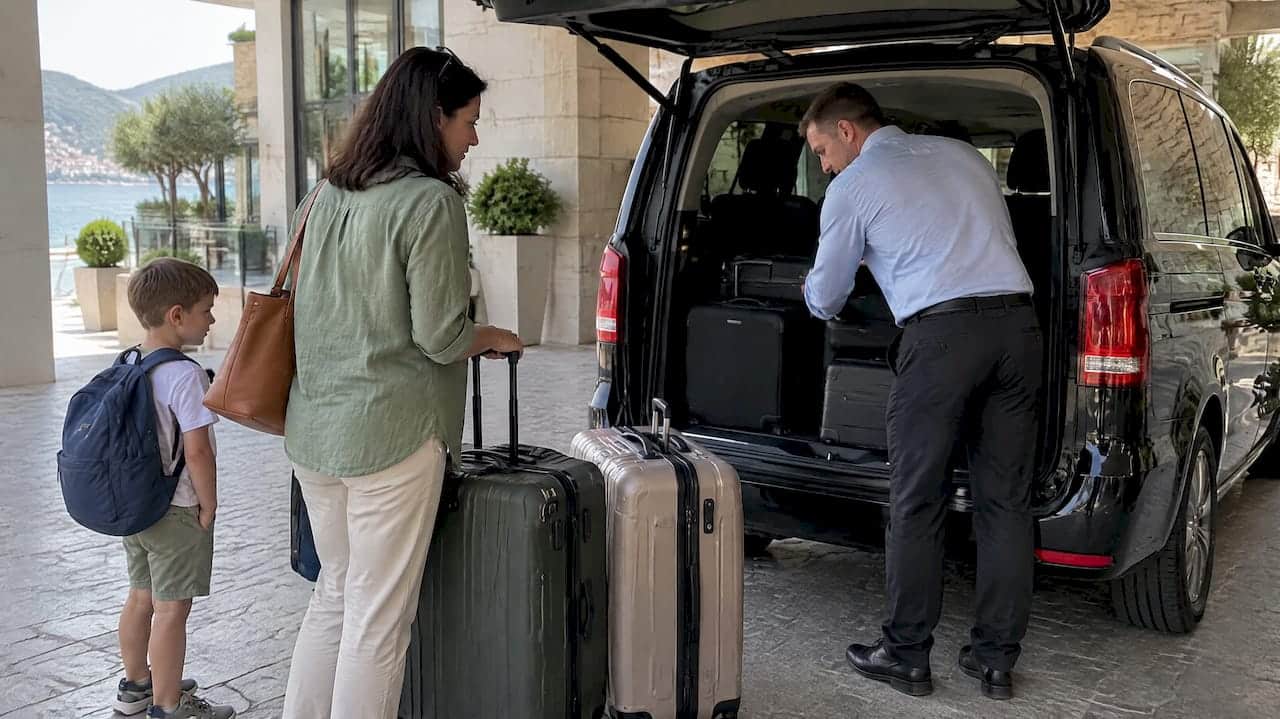
Professional private transfers deliver something no other mode in Croatia reliably matches: a single point of accountability from pickup to drop-off. The driver knows your flight number, monitors arrival status, meets you at the terminal with a name board, loads your luggage, and delivers you to the meeting address. No queuing, no negotiating a fare, no uncertainty about whether the vehicle will accommodate your team and their bags.
For corporate billing, the advantage is equally clear. Fixed-price transfers with written confirmations simplify corporate billing compared to metered taxis or rideshare receipts. A single invoice with your PO number attached covers the entire transfer, which matters when your finance team is processing expense reports across multiple travelers and cities.
A professional private transfer service should include:
- Licensed drivers with visible company registration and ID.
- Vehicle class options ranging from executive sedans to business vans and full-size coaches.
- Flight monitoring with automatic adjustment of pickup time for delays.
- Meet-and-greet service at the arrivals hall, not the curb.
- Clear cancellation terms in writing, with a defined notice period.
- Corporate invoicing with VAT breakdown and PO/reference number support.
- On-board Wi-Fi and a clean, quiet workspace for calls or document review during longer transfers.
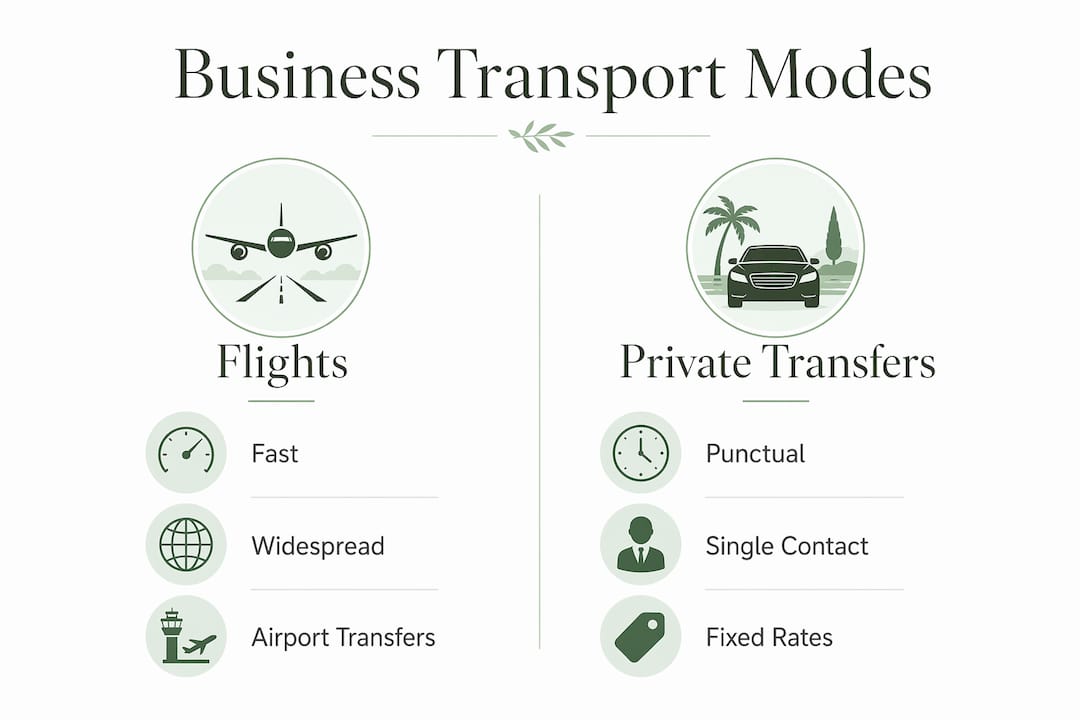
The benefits of private chauffeur services for business travel extend beyond comfort. Punctuality guarantees, consolidated logistics, and a single English-speaking contact reduce the coordination overhead that typically falls on an executive assistant or travel manager.
Pro Tip: When you send your booking request, ask for the driver’s full name, the company’s operating license number, and confirmation that flight monitoring is included. Add your invoicing reference or PO number at the time of booking, not after. Changing billing details post-trip creates unnecessary back-and-forth.
When does renting a car make sense for business trips in Croatia?
Rental cars earn their place in specific scenarios: multi-stop field visits across a region, remote site access where no private driver is available, or situations where a traveler needs genuine on-the-ground flexibility across several days. For a solo executive visiting three industrial sites in Slavonia over two days, a rental is often the most practical solution.
For corporate groups or time-sensitive single-city itineraries, a rental car is usually the wrong call. Parking in Zagreb’s city center is limited and expensive. Dubrovnik’s old town is inaccessible by car entirely. One-way drop fees between islands and the mainland add up quickly, and navigating an unfamiliar road network while preparing for a meeting is not a productive use of anyone’s time.
Pro Tip: Before you pick up the vehicle, photograph every panel and document any existing damage with the rental agent present. Croatia’s rental market includes some operators whose damage assessment practices are aggressive. A timestamped photo record protects you.
A rental checklist for business travelers:
- Add all driver names to the rental agreement before departure.
- Confirm your corporate insurance covers CDW (collision damage waiver) excess; many standard corporate cards do, but the coverage limits vary.
- Check the fuel policy (full-to-full is standard; pre-purchase fuel options are rarely cost-effective).
- Verify GPS availability or confirm your mobile data plan covers Croatian roaming.
- Ask explicitly about cross-border permission if your itinerary includes Montenegro. Not all rental agreements include it, and driving across without authorization voids your insurance.
How should corporate groups approach coach and minibus charters?
For groups, chartering a dedicated vehicle is almost always more efficient than coordinating individual transfers. It consolidates logistics, eliminates the risk of stragglers missing a metered taxi, and gives the planner a single point of contact for the entire movement.

Destination management experts consistently advise that pre-arranged private transportation is the most effective way for corporate groups to navigate Croatia, particularly in high-demand areas like Dubrovnik and Split where ad hoc transport options are strained in peak season.
| Group size | Recommended vehicle | Capacity notes |
|---|---|---|
| 2–6 passengers | Executive minivan (e.g., Mercedes V-Class) | Ideal for small leadership teams; luggage space for 6 bags |
| 8–15 passengers | Minibus | Comfortable for half-day or full-day transfers; air-conditioned |
| 17–29 passengers | Midi-coach | Standard for corporate event shuttles; luggage hold included |
| 30+ passengers | Full-size coach | Best for large conference groups; plan for an extra capacity buffer |
For large groups, planning additional seating capacity or staggered departures is advisable due to logistical considerations. Luggage loading at hotels and conference venues takes longer than most planners expect, and traffic on coastal roads in summer compounds delays.
Booking timeline guidance:
- High season (June–September): Secure vehicles at least 4–6 weeks in advance; deposit expected at confirmation.
- Shoulder season (April–May, October): 2–3 weeks lead time is usually sufficient.
- Off season (November–March): One week is often workable, but confirm driver availability for remote routes.
Pro Tip: Assign a single named operations contact on your side for the charter. That person handles all real-time adjustments: departure time changes, route modifications, and communication with the driver. Multiple people calling the driver directly during an event creates confusion and delays.
Operational tips worth building into your brief:
- Label all luggage with the group name and a contact number.
- Confirm rest-stop locations for transfers over two hours.
- Request on-board amenities (water, Wi-Fi, USB charging) in writing at booking.
How do ferries and private boats fit into a business itinerary?
Croatia’s islands are genuinely beautiful settings for corporate retreats, incentive programs, and client entertainment. Hvar, Brač, Korčula, and the Dalmatian archipelago are all accessible by scheduled ferry or fast catamaran from Split, Zadar, or Dubrovnik. The logistics, however, require more planning than a road transfer.
Scheduled ferries and fast catamarans are reliable for planned island legs when timed correctly. The key word is “planned.” Ferries run on fixed schedules, and in peak summer months, vehicle ferries in particular can reach capacity quickly. Foot-passenger catamarans are more flexible but still require advance booking for groups.
Timing and connection considerations:
- Budget an extra 30–60 minutes for embarkation and disembarkation when connecting ferry arrivals to meeting venues.
- Weather contingency matters. The Adriatic is generally calm, but bora winds can disrupt services, particularly in autumn and winter. Build a backup road route into any itinerary where the meeting cannot be rescheduled.
- Confirm ferry frequency during shoulder season before finalizing an itinerary. Summer schedules increase frequency significantly, but the same route may run once or twice daily in October.
- For island transfers to Hvar and similar destinations, coordinate the ferry leg with a ground transfer on both ends.
For VIP guests or when schedule flexibility is non-negotiable, a private boat charter eliminates the fixed-schedule constraint entirely. Private charters require advance coordination, a named captain, and documentation of passenger details, but they offer point-to-point flexibility that no scheduled service can match.
What are the best last-mile options in Croatian cities?
Within Zagreb, Split, Dubrovnik, and other major cities, business travelers have three practical choices: a pre-booked private transfer, a metered taxi, or a rideshare app.
Quick comparison:
- Pre-booked private transfer: Fixed rate, invoiceable, driver confirmed in advance. Best for airport pickups, hotel-to-venue runs, and any trip where a VAT receipt is required.
- Metered taxi: Widely available at airports and taxi stands; fares vary with traffic and time of day. Receipts are available but may not include VAT breakdowns suitable for corporate expense reporting.
- Rideshare (Bolt, Uber, Cammeo): Bolt and local platforms operate in Croatia; Uber’s availability varies by city and demand period. In-app receipts are standard, but VAT invoices for corporate billing are not always straightforward to obtain.
Zagreb’s public tram and bus network is extensive and reliable, with tickets validated before boarding. For a solo traveler moving between a hotel and a meeting in the city center, it is a perfectly reasonable option. For anyone carrying luggage or working to a tight schedule, it is not.
Pro Tip: Always request a digital receipt or invoice at the end of every taxi or rideshare trip. Check the driver’s ID against the app or the vehicle license plate before you get in. For expense reporting, a Bolt or Cammeo in-app receipt is usually sufficient for reimbursement, but if your company requires a VAT invoice, a pre-booked private transfer is the only consistently reliable source of one.
Rideshare apps are a reasonable fast option for solo travelers during business hours in Zagreb and Split. Late at night in smaller cities, availability drops and surge pricing can make a pre-booked transfer the better value.
How do you choose the right transport for a business trip in Croatia?
The right mode depends on three variables: group size, schedule sensitivity, and invoicing requirements. Get those three right and the decision usually makes itself.
Decision checklist:
- Match group size to vehicle class. Solo or duo: executive sedan. Three to seven: minivan. Eight or more: minibus or coach.
- Assess schedule sensitivity. If a missed connection has real consequences (a flight, a client presentation, a board meeting), pre-book a private transfer with flight monitoring. Do not rely on metered taxis or rideshare for time-critical pickups.
- Verify licensing and insurance. Ask for the operator’s company registration number and confirm drivers hold the appropriate professional license.
- Confirm invoicing capability. Can the provider issue a VAT invoice with your PO number? If not, your finance team will push back.
- Check cancellation terms in writing. A verbal “no problem” is not a policy. Get the notice period and refund terms in the booking confirmation.
Questions to ask every supplier before you confirm:
- What language does the driver speak?
- Is flight monitoring included, and how is the pickup time adjusted for delays?
- What is the cancellation policy and the notice period for a full refund?
- Can you issue a VAT invoice with a purchase order reference?
- What is the vehicle make and model, and is Wi-Fi available?
Red flags that should prompt you to look elsewhere:
- Vague or verbal-only cancellation terms.
- No corporate invoicing or VAT receipt capability.
- No flight monitoring for airport pickups.
- Drivers without visible ID or company identification.
- Last-minute vehicle substitutions communicated without prior notice.
For choosing airport transfer services, the same principles apply: verify the operator, confirm the vehicle, and get the price in writing before you travel.
| Transport mode | High season lead time | Off season lead time |
|---|---|---|
| Domestic flights | 3–4 weeks | 1–2 weeks |
| Private transfer (sedan/van) | 1–2 weeks | 2–3 days |
| Minibus/coach charter | 4–6 weeks | 1–2 weeks |
| Ferry (foot passenger) | 1–2 weeks | 2–3 days |
| Ferry (vehicle) | 4–6 weeks | 1 week |
Why Croatia Private Transfers & Tours works best for corporate itineraries
A well-run corporate itinerary in Croatia typically looks like this: an international arrival at Zagreb or Split airport, a transfer to the first meeting venue, an intercity leg the following morning, possibly a day trip to an island or UNESCO site for a client entertainment segment, and a return transfer to the airport. Each leg has a different vehicle requirement, a different timing constraint, and a different invoicing line.
Croatia Private Transfers & Tours handles that kind of multi-leg itinerary as a single coordinated program. The service features English-speaking licensed drivers, a fleet that spans executive sedans, business minivans, and full-size coaches, flight monitoring on every airport pickup, and corporate invoicing with VAT breakdown and PO reference support. Business-class travel in Croatia at this level means the driver is already tracking your flight before you land.
Sample itinerary flow for a four-person leadership team:
- Day 1, 14:30: Meet-and-greet at Zagreb Airport arrivals hall. Executive minivan transfer to hotel (35 minutes, fixed rate, invoice issued).
- Day 2, 08:00: Zagreb hotel to Split meeting venue. Intercity transfer, approximately 4.5 hours. Wi-Fi on board; working time during transit.
- Day 3, 09:00: Split to Hvar by coordinated ferry and ground transfer. Private boat option available for VIP flexibility.
- Day 4, 07:00: Split to Split Airport. Fixed-rate transfer with 90-minute buffer for check-in.
Booking checklist for planners requesting a quote:
- Full names of all passengers.
- Flight numbers and scheduled arrival/departure times.
- Physical meeting addresses (not just city names).
- PO number or invoicing reference.
- Special requests: extra luggage, accessibility requirements, AV equipment, child seats.
Verified customer reviews consistently highlight punctuality, driver professionalism, and the clarity of the fixed-price quote as the features that matter most for repeat corporate bookings. When evaluating any provider, confirm company registration and operating license during procurement, not after.
Pro Tip: Send your booking details in RFC-style format: passenger full names, mobile numbers with country codes, flight numbers, physical meeting addresses, and your invoicing reference. This single step eliminates most of the back-and-forth and speeds confirmation significantly.
Key Takeaways
Private transfers are the default professional choice for business travel in Croatia, with domestic flights, rental cars, coaches, and ferries each serving specific scenarios where road transfers are impractical or cost-inefficient.
| Point | Details |
|---|---|
| Default mode: private transfer | Pre-booked private transfers offer fixed rates, VAT invoicing, and flight monitoring — the most reliable option for corporate schedules. |
| Flights for long distances | Use domestic flights for Zagreb–Dubrovnik and similar long routes; always pre-book a ground transfer on both ends. |
| Groups need charters | For 8 or more travelers, a dedicated minibus or coach is more efficient and controllable than coordinating individual transfers. |
| Book early in high season | Coaches and ferries in June–September require 4–6 weeks lead time; private transfers need 1–2 weeks minimum. |
| Croatia-private-transfers | Croatia Private Transfers & Tours provides door-to-door corporate transfers with English-speaking drivers, fleet options, and VAT invoicing across Croatia. |
A planner’s perspective on timing business travel in Croatia
Anyone who has tried to confirm a supplier in Dubrovnik during the last week of July knows the particular frustration of watching email responses slow to a trickle. July and August are peak holiday months in Croatia, and many local business contacts, including transport operators, venue coordinators, and local DMC staff, are operating at reduced capacity or are simply unavailable. That is not a complaint about Croatian business culture; it is a scheduling reality that planners need to build around.
The practical adjustment is straightforward: move critical logistics confirmations to June at the latest, or shift the program to September, when the weather remains excellent and supplier responsiveness returns to normal. If July or August is unavoidable, secure driver names, vehicle confirmations, and PO numbers at the time of booking, then reconfirm everything 48–24 hours before each transfer. That reconfirmation step alone prevents the majority of day-of surprises.
For itineraries that include ferry legs, the buffer matters more than most planners initially budget. A 30-minute embarkation window sounds generous until you are loading six colleagues and their luggage onto a catamaran in Split harbor during a busy Tuesday morning. Build the buffer in, confirm the ferry schedule for the specific travel date rather than the general summer timetable, and always have a road alternative identified for island legs where weather could be a factor.
Croatia rewards planners who respect its rhythms. The country is genuinely beautiful, the meeting venues are often extraordinary, and the local hospitality is warm. Getting the logistics right simply requires a little more lead time and a clearer confirmation process than a comparable program in a major European capital.
Croatia Private Transfers & Tours: corporate travel, handled properly
When your program demands punctuality, professional presentation, and expense-ready documentation, Croatia Private Transfers & Tours delivers a level of corporate transport that matches the standard your clients and colleagues expect.
The service covers door-to-door private transfers across Croatia, from Zagreb Airport arrivals to Split meeting venues to Dubrovnik hotel drop-offs, in a fleet that includes Mercedes executive sedans, business minivans, and full-size coaches. Every booking includes English-speaking licensed drivers, flight monitoring, meet-and-greet at the arrivals hall, and a fixed-price quote confirmed in writing before you travel. Corporate invoicing with VAT breakdown and PO reference support is standard, not an add-on.
Core features for corporate buyers:
- Fixed quotes with written confirmation before travel.
- Flight monitoring and automatic pickup adjustment for delays.
- Meet-and-greet service at all major Croatian airports.
- Fleet options from executive sedans to coaches for groups of 30+.
- VAT invoicing with purchase order reference support.
- Tailored multi-leg itineraries for conferences, incentive programs, and executive visits.
To request a corporate quote, visit the private transfers Croatia booking page and include your passenger count, flight details, meeting addresses, and invoicing reference. A confirmed quote comes back with the vehicle class, driver details, and full pricing in writing.
Useful sources and references for planners
- U.S. Embassy in Croatia: Visa requirements, entry rules, and guest registration guidance for U.S. business travelers. Essential reading before a first trip.
- Trade.gov Croatia Business Travel Guide: The U.S. Commercial Service’s practical overview of transport options, airport infrastructure, and business travel norms in Croatia. Covers airport taxi fares, private transfer preferences, and general logistics.
- Government of Canada Travel Advice: Croatia: Covers public transport, safety, and ticketing practices. Useful for understanding Zagreb’s urban transit system.
- BusinessCulture.org: Croatia: Covers local business culture, working hours, and seasonal availability patterns, including the July–August holiday slowdown that affects supplier responsiveness.
- Euromic Destination Management: Destination management expertise for corporate groups in Croatia. Useful for planners coordinating incentive programs or large-scale events requiring coordinated private transport.
- Croatia Private Transfers & Tours: Private Transfers: The client’s primary service page for airport and intercity transfers, fleet details, and corporate booking information.
- Croatia Private Transfers & Tours: Corporate Airport Transfers Guide: Detailed guidance on airport transfer logistics, timing, and corporate billing for business travelers arriving at Croatian airports.