


Book Croatia Business Transfers 24–48 Hours Ahead With VAT Invoices
The right move for corporate travel in Croatia is straightforward: book a licensed private-transfer provider rather than a taxi or ride-hailing app. A properly organized business transfer means guaranteed punctuality with flight monitoring, confidentiality in an executive-ready vehicle, and clean corporate invoicing. A specialized private-transfer provider can deliver this combination for airport, intercity, and event travel across the country.
TL;DR:
- Private transfer services in Croatia guarantee punctual pickups, flight monitoring, and itemized invoicing, making them more reliable than taxis for business travelers.
- Booking early—at least 24 hours for airport rides and up to a week for multi-vehicle events—helps lock in availability and avoid last-minute price surges.
- Expect added costs of around 10 to 15 percent for delays, extra stops, or last-minute changes, with consolidated invoicing simplifying expense tracking.
- Confirm licensing, driver credentials, insurance, and confidentiality policies in advance, and request written proof before dispatch to mitigate security risks.
- Real-time flight and vehicle tracking technology improves communication, allowing automatic schedule adjustments and visibility for travel managers.
Table of Contents
- What Is the Best Way to Organize Business Transfers in Croatia?
- What Do Professional Business-Transfer Services Actually Include?
- How Do You Plan and Book a Business Transfer Step by Step?
- How Much Should You Budget for a Corporate Transfer?
- What Questions Should You Ask Before Choosing a Provider?
- How Do Providers Protect Security and Manage Risk During Transfers?
- How Does Technology Improve Transfer Tracking and Communication?
- What Customization Options Exist for Corporate Clients?
- What Legal and Compliance Rules Apply to Business Transfers?
- How Do You Handle Cancellations and Last-Minute Changes?
- Provider Perspective: Supporting Executive Travel in Croatia
- Book Your Corporate Transfer With Croatia-private-transfers
- Sources
- FAQ
What Is the Best Way to Organize Business Transfers in Croatia?
Organizing business transfers in Croatia well means removing every variable a traveling executive would otherwise have to manage themselves. That includes knowing exactly when a driver arrives, who that driver is, and whether the invoice lands cleanly in the company’s accounting system afterward. Private transfer organization solves all three at once, which is precisely why it has overtaken taxis and public transport as the default choice for business travelers moving through Zagreb, Split, and Dubrovnik.
Research on how foreign visitors move around Croatia found that travelers increasingly favor private transfers over public transport or taxis, largely because of safety, price transparency, and reduced waiting stress. For a business traveler running between a morning flight and an afternoon meeting, that transparency matters more than a marginally cheaper fare. A delayed taxi with no fixed price is a bad trade against a fixed-fee car that already knows your flight number.
Executive travelers cite the same priorities on a global level. Analysis of why C-suite passengers choose private car services points to punctuality, confidentiality, and in-vehicle amenities that let work continue during the ride. Private transfers clearly outperform shared alternatives when:
- A confidential call or document review needs to happen en route to a meeting.
- Multiple connecting flights or back-to-back appointments leave zero buffer for a late pickup.
- A small delegation needs to move together without splitting across separate taxis.
- Corporate policy requires an itemized, VAT-compliant invoice rather than a cash receipt.
What Do Professional Business-Transfer Services Actually Include?
A properly organized transfer service is built around vehicle fit, driver credentials, and a handful of operational guarantees that separate a professional operator from an app-hailed car. Getting these right at the booking stage avoids awkward surprises at the curb.
Vehicle classes. A Mercedes-class sedan suits a single executive or a two-person meeting run; a minivan fits small teams of four to seven traveling to the same conference or site visit. Larger delegations typically need a private minibus, which domestic corporate operators routinely offer alongside 24/7 availability for grouped business moves and events.
Driver qualifications. Licensed status, solid knowledge of local routes (including construction detours and event closures), and working English are the baseline. For sensitive itineraries, the AutoGuru analysis on executive travel recommends going further: insist on a named driver with ID, confirmed English proficiency, and a no-recording confidentiality policy before the vehicle is dispatched.
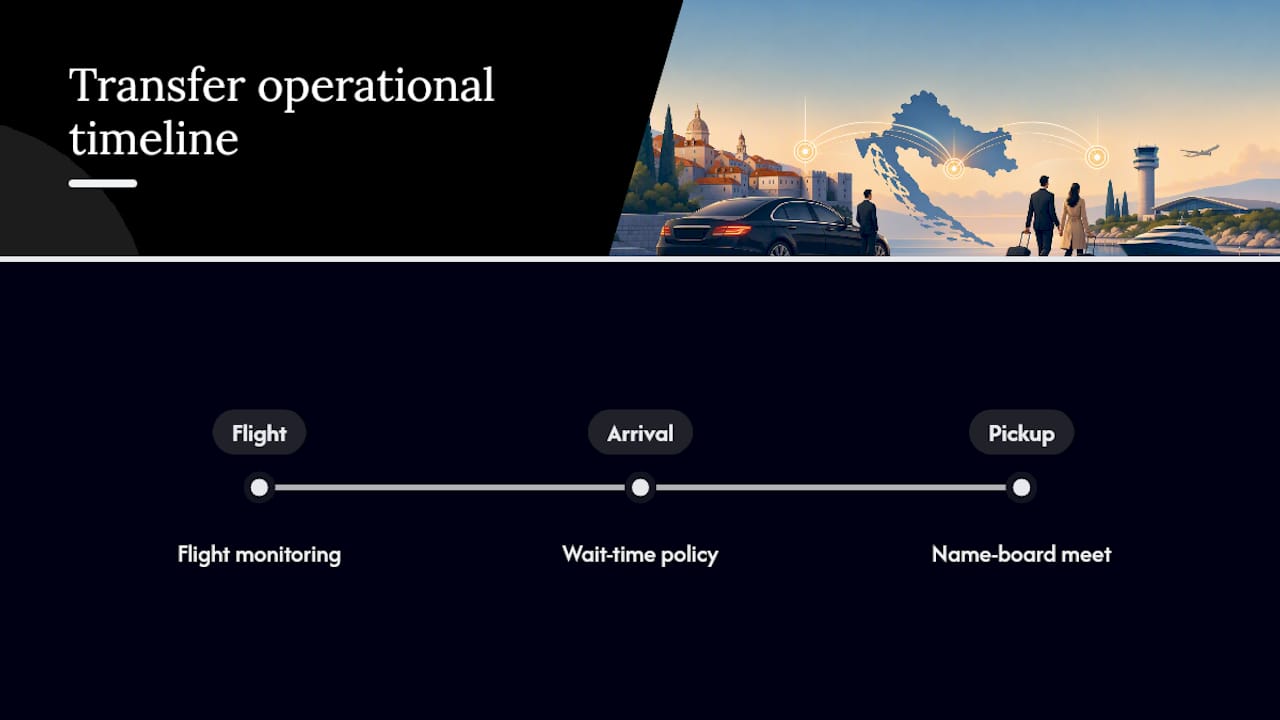
Operational elements to confirm. Flight monitoring so the driver adjusts to delays automatically, a written wait-time policy so nobody argues about grace periods at the curb, and a name-board meet-and-greet at arrivals.
Executive extras. Onboard Wi-Fi, phone chargers, and the option to pre-set a seating or client profile for repeat travelers all belong on the request list, not treated as bonus features. You can review how a service like private transfers in Croatia structures these inclusions before booking.
Pro Tip: Ask for the driver’s confidentiality policy in writing, not verbally. A one-line email confirmation is enough, and it protects both sides if a sensitive call happens mid-ride.
How Do You Plan and Book a Business Transfer Step by Step?
Booking a transfer well is less about the phone call and more about what you prepare before making it. Croatian business-travel advisors consistently recommend defining trip objectives, setting a budget, and pre-booking transport early to avoid the higher costs that come with last-minute arrangements.
- Set your lead time. Book airport transfers at least 24 to 48 hours out, intercity transfers three to five days ahead, and multi-vehicle event transport one to two weeks in advance to lock in availability.
- Collect the essential data up front. Passenger names, flight numbers, mobile contact numbers, and the company’s VAT number should all sit in one booking record, not scattered across email threads.
- Confirm the flight-monitoring method. A serious provider tracks your flight automatically and adjusts pickup time without you calling to explain a delay.
- Build in a fallback. Ask what happens if the assigned vehicle breaks down or the driver is sick. A back-up vehicle and a direct emergency contact number should be standard, not an upsell.
- Set a standing order for recurring routes. If your team runs the same airport-to-office route weekly, a standing booking removes repetitive admin.
Digitizing this process pays off at scale. Croatian procurement guidance on managing travel costs found that avoiding last-minute bookings and tracking bookings digitally increases transparency and reduces overall spend. That is worth internalizing before your third or fourth booking, not after a scheduling mistake.
- Airport transfers: 24 to 48 hours lead time.
- Intercity transfers: 3 to 5 days.
- Multi-vehicle event transport: 1 to 2 weeks.
- Recurring routes: set up a standing order once, not per trip.
If your itinerary includes an airport leg, a step-by-step guide to arranging a luxury airport transfer walks through the specific timing details for Croatian airports.
How Much Should You Budget for a Corporate Transfer?
Distance, vehicle class, waiting time, cross-border legs, and time of day are the five variables that move a transfer quote up or down. A Dubrovnik airport run to the Old Town costs far less than a cross-border leg from Split into Montenegro or Bosnia and Herzegovina, and a late-night pickup often carries a small premium over a mid-morning one.
Build in a contingency margin of roughly 10 to 15 percent on top of your baseline transfer budget for unexpected costs like flight delays that extend waiting time or a last-minute added stop. That buffer keeps a single schedule change from blowing up your quarterly travel line.
Corporate billing solves the reconciliation headache that comes with individual receipts. Opening a business account with a transfer provider and using consolidated monthly invoicing simplifies accounting and helps control transport costs across an entire travel program rather than trip by trip. When requesting quotes, ask providers to itemize:
- Base fare by route or by hour.
- Waiting time charges beyond the included grace period.
- Cross-border or toll surcharges.
- Applicable VAT and whether an official invoice is issued automatically.
What Questions Should You Ask Before Choosing a Provider?
Ask directly about licensing, driver vetting, and insurance coverage before you ask about price. A provider unwilling to confirm these in writing is telling you something. Request a sample corporate invoice, a current vehicle list, and proof of driver identification as standard documentation, not a special favor.
Confidentiality and data-protection policies deserve the same scrutiny, particularly if your itinerary involves sensitive client meetings or unreleased business information discussed in transit.
Watch for these red flags:
- Opaque pricing that changes after the ride instead of being confirmed at booking.
- No ability to issue a proper VAT invoice for business expense reporting.
- No stated flight-monitoring policy, meaning delays become your problem to manage.
- Reluctance to name the actual driver or vehicle before pickup day.
Pro Tip: Request a sample invoice before your first booking, not after. If the format doesn’t satisfy your finance team, find out now rather than during expense season.
How Do Providers Protect Security and Manage Risk During Transfers?
Security in a business transfer context covers two distinct concerns: physical safety on the road and confidentiality of whatever happens inside the vehicle. Both need explicit handling, not assumption.
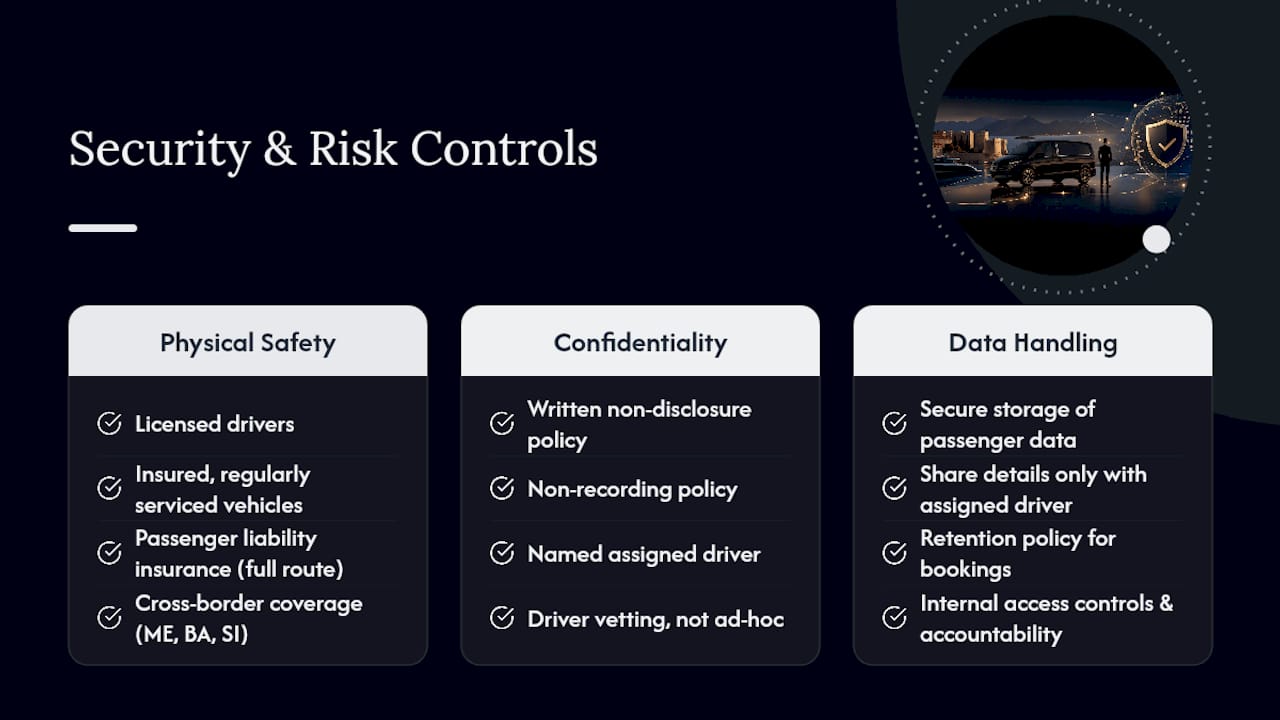
On the safety side, licensed drivers operating insured, regularly serviced vehicles remove most of the physical risk that comes with unregulated taxis or informal ride arrangements. Ask specifically whether the provider carries passenger liability insurance covering the full route, including any cross-border legs into Montenegro, Bosnia and Herzegovina, or Slovenia.
Confidentiality risk is less obvious but just as real for executive travel. A driver who overhears a merger discussion or sees a confidential document on a passenger’s laptop screen is a genuine exposure point. This is where a written non-disclosure or non-recording policy earns its place in the vetting process, alongside confirmation that the driver assigned to your booking is a named, identified individual rather than whoever happens to be available that day.
Data handling around the booking itself also matters. Passenger names, flight numbers, and contact details should be stored securely by the provider and shared only with the assigned driver, not distributed across a broader dispatch system with loose access controls. For recurring corporate accounts, ask how long booking records are retained and who inside the provider’s organization can access them. A provider that has a clear answer to this question, rather than a shrug, is the one worth building a long-term relationship with.
How Does Technology Improve Transfer Tracking and Communication?
Real-time flight tracking is the single most valuable piece of technology in a business transfer setup. It lets a driver adjust pickup timing automatically when a flight lands early, late, or gets diverted, removing the need for a traveler to call ahead and explain a delay while still taxiing to the gate.
Beyond flight tracking, live vehicle location sharing gives travel managers visibility into where a car actually is relative to a scheduled pickup, which matters enormously when coordinating a multi-passenger arrival at a conference venue. A simple text or app notification confirming the driver’s name, vehicle, and license plate before arrival also reduces the low-level anxiety of not knowing who is picking you up at an unfamiliar airport.
For companies managing a recurring travel program, centralized booking dashboards make a bigger difference than any single ride’s tracking feature. Being able to see every upcoming transfer, past invoice, and driver assignment in one place cuts the email back-and-forth that otherwise eats a travel coordinator’s week. This kind of visibility into cost patterns is exactly the convenience factor that research on business travel behavior identifies as a top priority for frequent corporate travelers, ahead of even price in many cases.
Communication technology matters most in the moments things go wrong. A provider with a direct, always-staffed contact line for last-minute changes beats one that only responds through a booking app’s chat function during business hours.
What Customization Options Exist for Corporate Clients?
Multilingual drivers matter more than most procurement checklists account for. If your delegation includes non-English-speaking executives from partner offices in Germany, Italy, or elsewhere, ask specifically whether a driver fluent in that language is available, rather than assuming English coverage is universal across a provider’s fleet.
Branding options are worth raising for larger corporate accounts or recurring conference transport. Some providers can accommodate a company sign in the vehicle window or a branded welcome card for visiting delegates, a small touch that reads well when hosting international clients or investors arriving in Zagreb or Split.
Seating and profile preferences round out the customization list for frequent travelers. A repeat business passenger who always prefers the front seat, a specific temperature setting, or a quiet ride without small talk can have that preference saved against their profile so every future booking starts from the right baseline. Multi-stop itineraries, such as an airport pickup followed by a hotel drop and a same-day meeting run, should also be quotable as a single coordinated booking rather than three separate ones. Reviewing what a dedicated corporate airport transfer guide covers on this front helps set realistic expectations for how far customization can go.
What Legal and Compliance Rules Apply to Business Transfers?
Every commercial passenger transport operator in Croatia needs a valid transport license and appropriate vehicle registration for commercial use, distinct from a private car used informally for hire. Ask a prospective provider to confirm this licensing status directly rather than assuming it, since unlicensed operators do exist in tourist-heavy areas.
VAT invoicing is a compliance point that trips up more companies than it should. A properly registered provider issues a VAT-compliant invoice that itemizes the fare, any surcharges, and the applicable tax rate, which your finance team needs for expense reporting and reclaiming input VAT where applicable. Confirm this capability before booking, not after your accountant rejects a receipt.
Data protection compliance under Croatia’s implementation of the EU’s General Data Protection Regulation applies to any provider storing passenger names, contact details, and travel itineraries. A provider handling recurring corporate bookings should have a clear, if brief, data retention and access policy, particularly for companies in regulated industries like finance or legal services where passenger confidentiality carries additional weight.
Cross-border transfers into Montenegro, Bosnia and Herzegovina, or Slovenia introduce an extra layer worth checking: confirm the vehicle and driver are permitted to operate across that specific border, since not every domestic license extends automatically to international routes.
How Do You Handle Cancellations and Last-Minute Changes?
Flight delays and shifted meeting times are the norm in business travel, not the exception, so a transfer provider’s cancellation and change policy deserves attention before you ever need it. Ask for the specific cutoff window after which a cancellation triggers a fee, and get that answer in writing at booking rather than discovering it mid-crisis.
Flight monitoring, already covered above as an operational feature, is what makes most “last-minute changes” invisible in practice. A driver tracking your inbound flight automatically shifts pickup time for a delay without anyone needing to call and reschedule. The changes that actually require human intervention are the bigger ones: a canceled meeting that scraps the transfer entirely, or a same-day request to add a second stop.
For those situations, a provider with a direct phone line staffed outside standard office hours makes the real difference, since an app-only chat function rarely gets a fast enough response when you are standing at a gate with a changed itinerary. Confirm before booking whether emergency changes go through a live person or a ticketing queue.
Building a small buffer into recurring corporate arrangements also helps. Companies that pre-negotiate flexible rebooking terms as part of a business account setup, rather than negotiating fresh terms every single trip, tend to face fewer disputes over last-minute fees. That single conversation at account setup saves a dozen smaller ones later.
Provider Perspective: Supporting Executive Travel in Croatia
Croatia Private Transfers & Tours structures its corporate bookings around licensed, English-speaking drivers and a straightforward request-to-confirmation workflow, so travel coordinators know exactly what they’re getting before a car is dispatched. Confidentiality preferences and invoicing needs get confirmed at booking, not negotiated after the fact. In practice, that means an executive landing in Split for a same-day meeting gets a confirmed driver, a monitored flight, and a clean invoice waiting in their inbox by the time they’ve left the airport terminal.
— Croatia
Book Your Corporate Transfer With Croatia-private-transfers
A private transfer service can provide corporate travelers with a licensed English-speaking driver confirmed in advance, a vehicle matched to the group size, and an invoice suited for finance team processing. Where a taxi rank leaves pricing and punctuality to chance, this setup locks both in before the car ever leaves the depot.
The service lineup covers what most corporate travel programs in Croatia actually need: private airport transfers for individual executives, intercity and long-distance transfers for teams moving between Zagreb, Split, and Dubrovnik, and minivan or minibus options for conference groups and delegations. Companies with recurring travel needs can request a business account for consolidated monthly invoicing, which removes the receipt-by-receipt reconciliation that eats up a coordinator’s time.
To get started, request a quote directly through the private transfers Croatia booking page, specifying your route, passenger count, and whether you need a corporate invoicing arrangement. Group quotes and account setups are handled the same way, by contacting the team with your itinerary details ahead of your first trip.
Sources
For more context on planning and cost control, see the Superportal analysis of private transfer trends and Profitiraj.hr’s business travel planning guide.
- Taksi, autobus ili privatni transfer? Istražili smo kako strani turisti putuju Zagrebom i Hrvatskom – Super portal
- 7 razloga zašto putnici u C-Suite biraju usluge privatnog automobila – AutoGuruTV
- Profitiraj
- Wizi business (business account guidance)
FAQ
How Far in Advance Should I Book a Business Transfer in Croatia?
Book airport transfers at least 24 to 48 hours ahead, and intercity or multi-vehicle event transfers three to five days ahead, based on Croatian business-travel planning guidance recommending early pre-booking to avoid last-minute price increases. Recurring routes are better handled with a standing order set up once with your provider.
Does Croatia Private Transfers & Tours Offer Corporate Invoicing?
Yes, corporate clients can arrange invoicing suited to business expense reporting through Croatia Private Transfers & Tours, with pricing and account details available directly through the site. This removes the per-ride receipt hassle common with taxis and ride-hailing apps.
What Should I Add to My Transfer Budget for Unexpected Costs?
Add roughly 10 to 15 percent on top of your baseline transfer estimate to cover flight delays, extended waiting time, or last-minute added stops. This contingency margin is standard practice in business-travel budgeting and prevents a single schedule change from disrupting your broader travel spend.
Are Private Transfers Safer Than Taxis for Business Travel in Croatia?
Private transfers generally offer better safety and price transparency than unregulated taxis, according to research on how travelers move around Croatia, since fares and vehicle details are confirmed before the ride starts. Licensed providers also carry passenger insurance and use named, identified drivers.
Can I Request a Multilingual or Confidentiality-Focused Driver?
Yes, most professional providers, including Croatia Private Transfers & Tours, can accommodate requests for a specific language or a written confidentiality policy when booked in advance. Raise these requirements at the time of booking rather than assuming they apply by default.


