


How to Achieve a Smooth, Stress-Free Airport Pickup
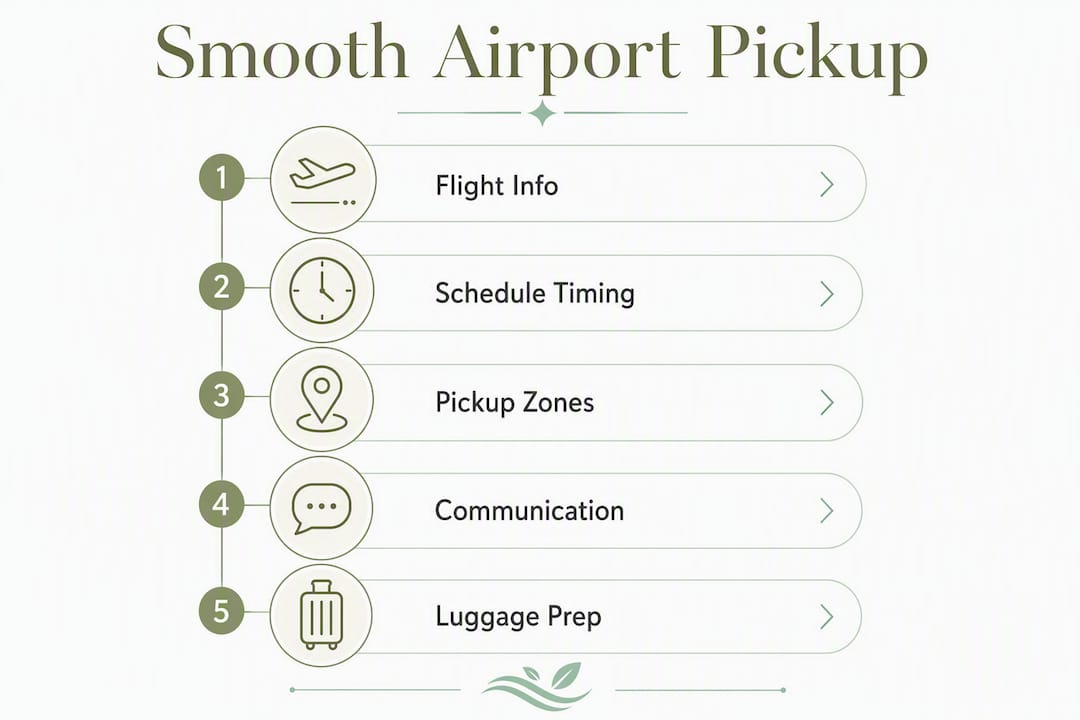
A smooth airport pickup comes down to four coordinated actions: share your flight number for live tracking, choose the correct meeting zone before you land, schedule the pickup with realistic buffers for baggage and customs, and lock in one reliable contact method. Get those four right, and nearly every other variable falls into place.
Quick-action checklist — copy and send to your driver or coordinator:
- Share airline name, flight number, and scheduled arrival time
- Confirm the exact pickup zone (curbside door number, arrivals hall landmark, or cell-phone lot)
- Allow 30 minutes after landing for domestic arrivals and 60 minutes for international.
- Confirm one primary contact channel (SMS or WhatsApp) and one backup
Pro Tip: When booking, state whether you have checked bags or carry-on only. That single detail lets the operator stage the right vehicle size and time the driver’s arrival to the baggage carousel, not the gate.
Table of Contents
- How does real-time flight tracking eliminate pickup timing guesswork?
- When should you schedule pickup for domestic vs. international arrivals?
- Which pickup zone is actually the right one for your situation?
- What does a reliable airport pickup communication plan look like?
- How do luggage type and passenger needs change your vehicle and staging?
- Should you hire a professional meet-and-greet or handle pickup yourself?
- What does the day-of checklist look like for passengers and drivers?
- What are the most common pickup mistakes and how do you fix them fast?
- What do transportation planners need to verify before every pickup?
- Key Takeaways
- What operators wish every traveler understood before landing
- Croatia-private-transfers: private transfers with every detail handled
- Useful sources and further reading
How does real-time flight tracking eliminate pickup timing guesswork?
The flight number is the single most important piece of information you can provide at booking. It gives your operator a live reference point that no estimated arrival time can match. Flights land early, taxi late, and sometimes arrive at an unexpected gate or flow. A flight number enables automatic adjustments for delays and early arrivals, so the driver is staged when you walk out, not circling or waiting an hour early.
Professional dispatch systems monitor actual touchdown times and gate changes, then use that data to trigger chauffeur dispatch at the right moment. That distinction matters: a driver sent based on scheduled arrival time may leave the staging area before a delayed flight lands, or arrive too early and accumulate waiting fees. Touchdown-based dispatch removes both problems.
Tools to use for tracking:
- Airline apps (Delta, United, American) for gate and baggage carousel updates
- FlightAware or FlightRadar24 for independent real-time status
- Your operator’s own dispatch system, which ideally monitors gate changes alongside touchdown
Pro Tip: Ask your operator whether they track touchdown time specifically, not just scheduled arrival. Gate updates are equally valuable for inside-terminal meet-and-greet pickups, since the greeter needs to position at the right arrivals corridor.
Booking details to supply at reservation: airline name, flight number, scheduled arrival time, arrival airport and terminal, and your contact number active on landing.
When should you schedule pickup for domestic vs. international arrivals?
Timing the pickup correctly is where most coordination errors originate. Travelers often assume the landing time equals the pickup time. It does not. Between taxiing to the gate, deplaning, walking to baggage claim, and waiting for bags, the actual exit time is consistently later than the wheels-down moment.
Schedule collection about 30 minutes after landing for domestic flights and about 60 minutes after landing for international flights, where immigration and customs add meaningful time. These buffers are starting points, not guarantees. A busy hub like LAX or JFK during peak hours can push international processing well past 60 minutes.
| Arrival type | Recommended buffer after landing | Typical complimentary wait time | Notes |
|---|---|---|---|
| Domestic (carry-on only) | 30 minutes | 30 minutes | Faster exit; driver stages at curbside |
| Domestic (checked bags) | 30 minutes | 30 minutes | Baggage carousel adds time |
| International (carry-on) | 60 minutes | 60 minutes | Immigration line varies widely |
| International (checked bags) | 60 minutes | 60 minutes | Customs + baggage; longest variable |
Most professional operators include a complimentary wait window after the adjusted arrival time. Once that window closes, additional waiting fees typically apply. Knowing your operator’s policy before you land prevents an unpleasant surprise on the invoice.
Pro Tip: If you are arriving on a long-haul international flight with multiple checked bags, ask your operator explicitly for an extended wait window at booking. Operators almost always accommodate the request when it is made in advance rather than curbside.
- Confirm the wait policy in writing before travel day
- Factor in customs declaration lines, which can double processing time during peak periods
- For families with young children, add 10–15 minutes to any buffer estimate
Which pickup zone is actually the right one for your situation?
Airport pickup zones are not interchangeable, and choosing the wrong one is one of the most common reasons a smooth transfer unravels. Each option suits a different traveler profile, and airport enforcement rules often make the “obvious” choice impractical.

Curbside pickup works well for solo travelers with carry-on luggage who can move quickly and meet a driver within a narrow time window. The problem is enforcement: most major U.S. airports impose strict time limits on curbside stops, and commercial vehicles face permit restrictions that make extended waiting illegal. A driver who cannot find you within two minutes may be forced to circle.
Inside arrivals hall or baggage claim meet-and-greet is the better choice for international arrivals, families, VIPs, or anyone with checked luggage. Meet-and-greet is especially recommended for international arrivals, families, and VIPs because it removes the need to navigate the curb and baggage zones alone. A dedicated greeter holds a name sign, assists with luggage, and escorts the traveler directly to the vehicle.
Cell-phone lots are designed for personal pickups where the driver waits off-airport until the traveler texts “I’m outside.” They are free, legal, and practical for informal pickups, but they add a coordination step that can go wrong if the traveler has no signal.
Parking garages offer the most flexibility for drivers who need to wait without circling, though they add a short walk and a parking fee.
Pro Tip: Before travel day, confirm the exact door number or arrivals hall landmark with your operator. At a large hub like O’Hare or Atlanta Hartsfield-Jackson, “arrivals level” covers hundreds of meters. A specific door number eliminates the guessing entirely.
For a deeper look at what VIP airport pickup entails, including inside-terminal greeter protocols, the distinction between service tiers becomes clear quickly.
What does a reliable airport pickup communication plan look like?
Pickup delays often stem from communication errors: wrong door, incorrect pickup zone, or single-contact failures when the passenger has no signal. The fix is a simple two-channel plan established before the flight departs, not improvised after landing.
Recommended channel setup:
- Primary: SMS or WhatsApp (works on Wi-Fi when cellular roaming is off)
- Backup: A pre-agreed meeting point that requires no message at all
Sample message templates the traveler can send:
- Landed. Heading to baggage claim now.
- Bags in hand. Walking toward arrivals exit, Door 4.
- Outside now. Standing at the pillar left of Door 4.
- Delayed at immigration. Estimate 20 more minutes.
On signboard conventions: the driver should display the traveler’s surname or the booking reference, not a first name or a generic company logo. A surname is unambiguous in a crowded arrivals hall; a first name creates confusion when multiple travelers share it. For corporate bookings, the company name works well when the traveler knows to look for it.
Pro Tip: International arrivals often hit a connectivity gap the moment they step off the plane. Save the driver’s number and the pickup address in your phone before boarding, and screenshot the booking confirmation for offline access. Airport Wi-Fi is not always immediate, and roaming activation can take several minutes.
How do luggage type and passenger needs change your vehicle and staging?
The biggest variable in pickup timing is baggage claim duration. Telling your operator whether you have checked luggage lets them adapt staging windows and avoid unnecessary waiting fees. It also determines whether the vehicle assigned is the right size for your group.

A sedan suits two or three passengers with light carry-on luggage. Add two checked suitcases, a stroller, and a car seat, and that same sedan becomes a problem at the curb. Sizing up to an MPV or minivan at booking costs less than the stress of rearranging curbside.
Booking checklist for luggage and passenger needs:
- Number of checked bags and approximate size (standard vs. oversized)
- Number of carry-on bags
- Child seats required (specify age/weight for correct seat type)
- Mobility assistance or wheelchair access needed
- Oversized items: skis, golf bags, surfboards, strollers
- Pets traveling in-cabin or in a carrier
For oversized items, notify the operator at booking, not on travel day. Most operators can arrange a larger vehicle or a roof carrier when given adequate notice. Requesting baggage assistance or a meet-and-greet service is also the right call for elderly passengers or anyone arriving after a long-haul flight who simply does not want to manage heavy bags alone.
Should you hire a professional meet-and-greet or handle pickup yourself?
The honest answer depends on what you are protecting. For a solo business traveler with a carry-on arriving at a familiar domestic airport, an on-demand option may be entirely adequate. For an international arrival with checked bags, a family with young children, or a VIP guest whose schedule cannot absorb a 20-minute curbside confusion, a prebooked private transfer with meet-and-greet service is the clearly superior choice.
Decision criteria:
- Predictability matters more than cost savings
- Traveler has checked luggage or special items
- International arrival with immigration and customs
- Family, elderly passenger, or VIP profile
- First visit to an unfamiliar airport
Operators recommend booking well in advance when predictability and vehicle choice matter. Last-minute arrangements reduce options and increase coordination risks, particularly during peak travel periods.
Four-item reservation verification checklist:
- Confirmed reservation status — not pending, not “request received”
- Exact pickup terminal and zone — door number or arrivals hall landmark, not just “arrivals”
- Fare inclusions — parking, tolls, waiting time, and any surcharges stated upfront
- Reliable contact method — the number or app channel that will work on arrival
| Option | Price predictability | Live tracking | Included wait time | Inside-terminal meet-and-greet |
|---|---|---|---|---|
| Rideshare / on-demand | Surge pricing possible | App-based | None | No |
| Standard taxi | Metered, variable | None | None | No |
| Prebooked private transfer | Fixed rate | Yes | Typically included | Available |
Private transfers with fixed pricing and included wait time remove the two biggest post-landing stressors: not knowing what you will pay and not knowing whether the driver is still there.
Pro Tip: Book at least 24 hours ahead when your schedule genuinely depends on the pickup. Same-day bookings can still work, but vehicle choice narrows and coordination quality drops.
What does the day-of checklist look like for passengers and drivers?
A well-executed pickup is the result of several small decisions made correctly in sequence. The checklist below gives both sides a clear sequence to follow.
Passenger steps (ordered):
- Charge phone to 100% before boarding
- Screenshot booking confirmation and save driver’s contact number offline
- Download offline maps for the arrival airport
- Send driver a “boarding now” message before takeoff
- On landing, send “landed” message and confirm bags status
- Walk to the agreed pickup zone; send “outside now, Door X” message
- Confirm driver identity by name sign or booking reference before entering the vehicle
Driver/coordinator steps (ordered):
- Confirm flight touchdown via tracking app, not scheduled time
- Stage at the agreed pickup zone with name sign visible
- Send traveler a “I’m at Door X, [vehicle description]” message after touchdown
- Monitor for gate changes if inside-terminal meet-and-greet is booked
- If no contact after 10 minutes past agreed meeting time, call the backup number
Last-minute contingencies:
- Delayed baggage: send a quick message to the driver with an updated time estimate; most operators with included wait time will hold without extra charge within the window
- Gate change: relevant primarily for meet-and-greet; the driver should reposition based on the updated gate corridor
A step-by-step airport transfer guide covers the full sequence in detail for travelers who want a printable reference.
What are the most common pickup mistakes and how do you fix them fast?
Most airport pickup failures trace back to a short list of entirely preventable errors. Recognizing them in advance takes less than five minutes and saves far more time on arrival.
- Assuming landing time equals pickup time. Fix: add the appropriate buffer—30 minutes for domestic arrivals and 60 minutes for international—and share it with your driver.
- Vague pickup instructions. Fix: confirm the exact door number or arrivals hall landmark before travel day, not after landing.
- Single contact method. Fix: set up a primary channel and a backup; save the driver’s number offline before boarding.
- Low phone battery on arrival. Fix: charge to 100% before boarding and carry a battery pack in your carry-on.
- No booking confirmation accessible offline. Fix: screenshot the confirmation and save the driver’s number to your contacts before the flight.
Pro Tip: Peak windows — holiday weekends, Fridays, and major event days — compress driver availability and increase airport congestion. Confirm staging rules and your operator’s peak-period policy at least 48 hours before a high-traffic travel day.
What do transportation planners need to verify before every pickup?
A clean airport pickup depends on accurate booking details: airline, flight number, baggage expectations, passenger contact number, and confirmed pickup terminal or zone. For operators and coordinators, those details are not optional fields. They are the foundation the entire staging plan is built on.
Operational verification checklist:
- Confirmed reservation, not pending. A pending status means the vehicle and driver are not yet assigned. Confirm the booking is active before travel day.
- Exact pickup terminal and zone phrasing. “Arrivals” is not sufficient. The confirmation should name the terminal, the level, and the door or landmark.
- Fare structure with all inclusions stated. Parking, tolls, waiting time, and any peak-period surcharges should be listed on the booking, not discovered at payment.
- Reliable contact method confirmed for arrival. Verify that the passenger’s listed number will work on landing, and establish a backup channel.
When any of these items is missing, the correct action is to contact the operator before travel day and request clarification in writing. A vague booking is a coordination risk, and the time to resolve it is before the flight departs.
The airport transfer booking workflow used by professional operators shows exactly how these details are gathered and confirmed at the reservation stage, which is a useful reference for coordinators building their own verification process.
Key Takeaways
A smooth airport pickup requires four things done well before the plane lands: a flight number for live tracking, a confirmed pickup zone, realistic timing buffers, and a reliable contact method.
| Point | Details |
|---|---|
| Share your flight number | It enables live tracking and automatic adjustments for delays or early arrivals. |
| Buffer after landing | Allow 30 minutes for domestic arrivals and 60 minutes for international to account for baggage and customs. |
| Confirm the exact pickup zone | A specific door number or arrivals hall landmark prevents the most common curbside confusion. |
| Set two contact channels | A primary (SMS or WhatsApp) and a backup meeting point covers connectivity gaps on international arrivals. |
| Croatia-private-transfers | Offers prebooked private transfers with fixed pricing, live flight tracking, and included wait time for travelers who want the pickup handled before they land. |
What operators wish every traveler understood before landing
The gap between a coordinated arrival and a loosely managed booking is rarely visible until something goes wrong. From an operator’s perspective, the traveler’s most valuable contribution is not patience or flexibility. It is accuracy at the booking stage.
Precise baggage information determines staging time and vehicle sizing. A flight number, not just an arrival time, gives the dispatch team a live reference that absorbs delays without a single phone call. A confirmed pickup zone, stated as a door number rather than a general area, removes the most common source of curbside confusion entirely. These are small inputs that produce outsized results.
The other thing operators consistently note is that passengers underestimate how much a charged phone matters. A traveler who lands with 4% battery and no offline copy of the booking confirmation creates a coordination problem that no amount of professional preparation can fully absorb. Saving the driver’s number and screenshotting the confirmation before boarding takes thirty seconds and prevents the most frustrating version of an otherwise well-planned arrival.
Active management is what separates a premium transfer from a scheduled ride. The best operators are not waiting for you to call them. They are watching your flight, adjusting staging, and sending you the right message at the right moment. When that standard is met, the arrival feels calm and handled. When it is not, the experience feels improvised regardless of the vehicle.
Croatia-private-transfers: private transfers with every detail handled
For travelers who want the pickup handled before they ever step off the plane, Croatia-private-transfers offers door-to-door private airport transfers with fixed pricing, live flight tracking, and included wait time across Croatia. There is no surge pricing, no metered uncertainty, and no curbside guessing. English-speaking drivers in premium Mercedes vehicles meet you at the agreed point, assist with luggage, and adapt to your actual arrival time, not the scheduled one.

The service suits international arrivals, families, small groups, and business travelers who need the first hour on the ground to be calm and predictable. Whether you are arriving at Zagreb, Split, or Dubrovnik, the booking process gathers every detail that matters: flight number, baggage count, pickup zone, and your contact method for landing. For travelers extending their trip, private transfers across Croatia connect airports to hotels, ports, and intercity routes with the same fixed-rate clarity.
To arrange your transfer, visit the booking page and provide your flight details. The rest is managed for you.
Useful sources and further reading
Before booking, these resources help you verify terminal maps, wait policies, and meet-and-greet options for your specific airport and route.
- What Is Airport Pickup Coordination? — Detailed explanation of how professional dispatch, flight monitoring, and staging work together; useful for understanding what “active management” actually means in practice.
- How Airport Meet and Greet Works — Covers the full sequence from flight monitoring to luggage handoff; check this before deciding between curbside and inside-terminal pickup.
- Airport Meet and Greet Service: How It Works — Explains greeter positioning, complimentary wait times, and when inside-terminal service is the right call.
- Airport Pickup Checklist Before Your Driver Arrives — Pre-arrival checklist covering booking status, pickup point, fare structure, and fallback plan.
- Airport Transfers with Flight Tracking — Explains timing buffers and how flight numbers enable automatic pickup adjustments.
- Croatia-private-transfers Booking Workflow — Shows the reservation details a professional operator collects; a practical reference for coordinators building their own verification process.
| Resource | Best used for |
|---|---|
| FlightAware / FlightRadar24 | Independent real-time flight status and gate tracking |
| Airline app (Delta, United, American) | Gate assignments and baggage carousel updates |
| Airport official website | Terminal maps, pickup zone rules, and commercial vehicle permits |
| Operator booking confirmation | Pickup zone, fare inclusions, and driver contact details |
| Croatia-private-transfers booking page | Private transfer reservations with flight tracking included |
One-line rule: always check the official airport website for the specific terminal and pickup zone rules before travel day. Enforcement policies differ between hubs and regional airports, and they change more often than third-party guides reflect.