

Transport First Croatia Festivals 2026: 11 Dates for Travelers
INmusic, Ultra Europe, Love International, Defected, Outlook Origins, and Dimensions anchor Croatia’s 2026 festival calendar, running from late June through September across Zagreb, Split, Tisno, and Zrće. The single most important planning move is booking tickets and transport before accommodation fills, since Tisno and Zrće hubs often sell out well in advance every summer. Lock your festival dates first, then secure a private transfer from your arrival airport. Everything else in your trip should build around that sequence.
TL;DR:
- Booking tickets and transport early is crucial, as Tisno and Zrće passes sell out quickly once early-bird sales commence.
- The Croatian festival season spans from June to September with key events in Zagreb, Split, Tisno, and Pag Island, each offering distinct experiences.
- Private transfers provide a reliable, flexible way to move between airports and festival hubs, avoiding delays with shared shuttles and crowded buses.
- Choosing your festival depends on your preferred vibe, duration, and proximity to airports, whether city, resort, or beach-based settings.
- Restocking and recycling initiatives at festivals are reducing environmental impact, but costs for accommodation, food, and transport can surpass ticket prices, requiring careful budgeting.
Table of Contents
- The Full 2026 Festival Calendar for Croatia
- Which Festival Actually Fits Your Trip
- Getting There: Airports, Transfers, and Timing
- How to Pick Your Festival in Five Steps
- Why Private Transfers Solve the Festival Transit Problem
- Beyond the Music: What to Eat and See Between Sets
- Staying Safe and Healthy Through a Long Festival Week
- Age Limits, ID Checks, and What Not to Bring
- How Croatian Festivals Are Cutting Their Environmental Footprint
- What a Croatian Festival Trip Actually Costs
- What the Weather Will Actually Be Like
- Our Take: Plan the Transport Before You Plan the Outfit
- A Smoother Ride Between Festival Stages
- Sources
The Full 2026 Festival Calendar for Croatia
Croatian festivals 2026 stretch across nearly the entire summer, and the order matters as much as the dates themselves. Book too late for The Garden Resort in Tisno, and you’ll be commuting from a town 40 minutes away for a week. Here’s how the season unfolds, town by town.
- INmusic Festival runs June 22 to 24, 2026, at Lake Jarun in Zagreb. The official program mixes international rock and alternative headliners with a growing roster of Croatian acts, and the lakeside setting means you can walk from your hotel to the gates.
- Ultra Europe takes over Park Mladeži in Split in mid-July, drawing the continent’s biggest electronic dance acts to a stadium-scale production. Split’s airport gets slammed in the days before the first set, so plan your arrival window carefully.
- Love International opens the Tisno season in early July, running roughly a week of house and techno programming at The Garden Resort with its signature boat parties along the Adriatic.
- Defected Croatia follows at the same venue from July 29 to August 2, 2026, five nights of house music plus wellness sessions and official afterparties built into the daily schedule.
- Outlook Origins and Dimensions Festival both use the Tisno hub later in summer, leaning into sound-system culture and bass-heavy programming that draws a more underground crowd than the mainstream EDM festivals.
- Sonus Festival brings a multi-day techno lineup to Zrće’s beach clubs, one of several events that make Pag island a rotating stage through July and August.
- Sea Star Festival in Umag pairs alternative and electronic acts with a compact, walkable festival site near the town center.
- Lighthouse Festival offers a smaller, boutique alternative on the coast, appealing to travelers who want a festival atmosphere without the scale of Ultra or Tisno’s week-long resort takeover.
- Selected Festival runs August 4 to 6, 2026, at Jazine Open Air in Zadar, with a lineup and official afterparty schedule published on its event page.
- SHIP Festival closes out the mainland season in Šibenik from September 10 to 13, 2026, a later date that avoids the July and August crowds entirely.
- Night Horizon Festival debuts its first edition on Zrce Bay from August 16 to 21, 2026, built around an above-the-water venue at LIFT Beach Club designed for a slower, sunset-driven atmosphere rather than a high-tempo rave.
Tisno and Zrće events, in particular, tend to sell fast once early-bird tickets move. If a festival on this list overlaps with your travel window, book the pass before you book anything else.
Which Festival Actually Fits Your Trip
INmusic in Zagreb feels closest to a European city festival: three days, a lakeside site at Jarun, and a lineup built for rock and alternative fans who want to sleep in a real bed and walk to the venue. It suits travelers who want one festival day layered into a longer city visit rather than a full week off the grid.
Tisno’s Garden Resort operates on a different logic entirely. Love International, Defected, Outlook Origins, and Dimensions all run out of the same compact venue, and Resident Advisor’s guide to Croatian festivals treats The Garden as the season’s central hub for a reason: you check in once, then move between stages, boat parties, and beach afterparties without touching a car. It rewards people who want a full week of immersion in one scene rather than a single big night.
Zrće Bay, by contrast, is Croatia’s answer to a beach-club strip. Sonus Festival and the newer Night Horizon Festival both use the same stretch of Pag island coastline, but they aim at different moods. Sonus leans into stadium-scale techno stamina; Night Horizon’s above-the-water stage at LIFT Beach Club is built for a cinematic, slower-paced sunset experience. Ultra Europe in Split sits at the opposite end of the spectrum, a stadium-scale EDM spectacle with production values closer to a headline arena show than a beach party. Sea Star in Umag and Lighthouse Festival fill out the season with smaller, walkable sites for travelers who want festival energy without a week-long commitment.
Getting There: Airports, Transfers, and Timing
Split Airport handles the Ultra Europe crowd and gets tight in the 48 hours before the opening set. Zadar Airport is your best entry point for Tisno’s Garden Resort and for Selected Festival in Zadar itself, with a transfer of roughly 40 to 60 minutes depending on the route. Zagreb Airport serves INmusic directly, since Lake Jarun sits inside the city. For Zrće and Pag island events, most travelers fly into Zadar and connect by road or ferry.
Booking order matters more than most festival-goers assume. Secure your ticket first, since Tisno and Zrće passes routinely sell out, according to Time Out’s coverage of Croatian festivals. Book accommodation next, because Garden Resort rooms and nearby Tisno guesthouses fill within weeks of ticket release. Arrange transport last, once your dates are locked, so your transfer matches your actual arrival and departure flights rather than a placeholder guess.
- Public shuttles and shared buses get overloaded at peak arrival times, a pattern reported consistently across multiple festival seasons.
- Camping is available at several sites, but check each festival’s specific policy on tents, vehicles, and overnight parking before you pack.
- If you’re combining a festival with island-hopping, build in a buffer day. Ferry schedules do not bend for a late festival exit.
- Arrive a day before the first headliner and leave the morning after the final act. Roads and airports are markedly quieter outside the festival’s own rush.
Pro Tip: Book your private transfer for a pickup window rather than a fixed minute. Sets run long, lines at the exit gates move slowly, and a driver holding a flexible window saves you from standing on a dark roadside at 3 a.m.
How to Pick Your Festival in Five Steps
- Start with the vibe you actually want: beach-resort immersion (Tisno, Zrće), a city festival with room to explore (INmusic), or a stadium-scale spectacle (Ultra Europe).
- Match the festival’s length to your available days. A single INmusic weekend suits a short trip; Tisno’s back-to-back events suit a full week.
- Check travel time and cost from your entry airport. Zadar feeds Tisno and Zrće; Split feeds Ultra; Zagreb feeds INmusic directly.
- Decide between camping and a nearby town hotel, and weigh whether a private transfer is worth the certainty over a shared shuttle.
Why Private Transfers Solve the Festival Transit Problem
Large groups, late-night flight arrivals, and multi-stop trips between Zadar, Tisno, and Pag island all create the exact scenarios where shared shuttles fall apart. A private transfer gives you a fixed vehicle, a English-speaking driver, and a door-to-door pickup that doesn’t depend on a bus filling up first. Before booking, confirm the vehicle size, luggage allowance, exact meeting point, and cancellation terms. Small details, but they’re the ones that go wrong at 2 a.m.
Beyond the Music: What to Eat and See Between Sets
Croatian festival season doubles as a culinary tour, and the smartest festival-goers treat it that way. Tisno itself is a working fishing town, and the seafood at its harborside konobas (small family-run taverns) tastes nothing like anything you’ll find near a stadium venue. Split’s old town, a short walk from Ultra Europe’s site, layers Roman ruins into daily life. Grabbing a burek or a plate of black risotto between sets isn’t a detour from the festival. It’s part of the reason people keep coming back to Croatia rather than a generic festival field.

Zadar rewards a slower morning after a Selected Festival night out: the Sea Organ and the Greeting to the Sun installation sit right on the waterfront, a quiet contrast to the Jazine Open Air stage. In Zagreb, INmusic weekends pair naturally with the city’s café culture along Tkalčićeva Street, where the food scene runs well past midnight. Umag, home to Sea Star Festival, sits close to Istria’s wine country, so a day trip to a family vineyard between festival days is a realistic option rather than a stretch. None of this requires elaborate planning. A short walk from most festival sites gets you to something worth tasting.
Staying Safe and Healthy Through a Long Festival Week
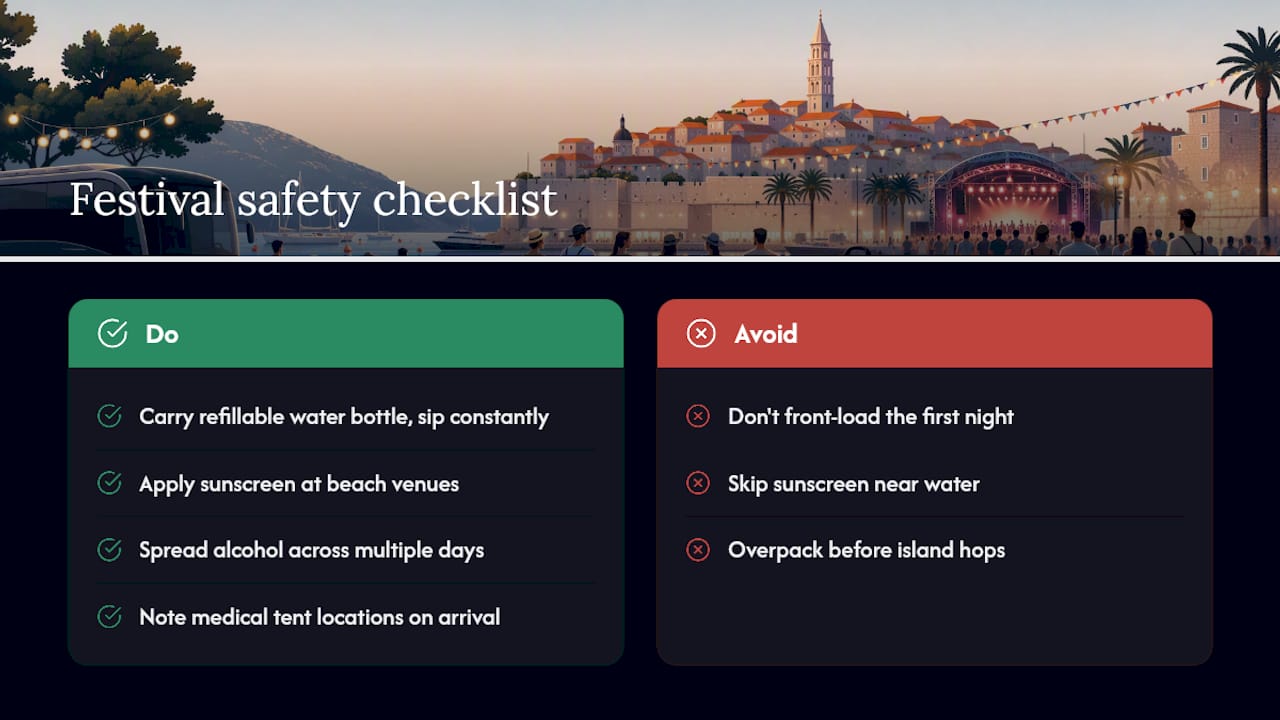
Adriatic summer heat is the biggest health risk at most Croatian festivals, not crowd safety. Temperatures can climb quite high during July and August, and multi-day events like Defected Croatia or Dimensions ask your body to handle heat, alcohol, and sleep deprivation simultaneously. Carry a refillable water bottle and use it constantly, not just when you feel thirsty.
Sunscreen matters more at beach-adjacent venues like Zrće and Tisno than travelers expect, since reflected light off the water intensifies exposure even under cloud cover. Pace your drinking across a multi-day event rather than front-loading the first night. Most festivals station medical tents near main stages. Note their location when you arrive, before you need one.
Footwear deserves more thought than festival-goers usually give it. Beach venues mean sand and uneven paths after dark; city sites like Jarun mean pavement and long walking distances between stages. Bring shoes built for both. If you’re island-hopping between festival stops, pack light enough that a missed ferry connection doesn’t turn into a real problem.
Age Limits, ID Checks, and What Not to Bring
Most major Croatian festivals, including Ultra Europe, INmusic, and the Tisno events, set an 18-plus policy for general admission, though some daytime or family-adjacent programming allows younger attendees with a guardian. Check each festival’s own terms before you buy, since policies vary by event and can change year to year.
Bag searches and ID checks are standard at every entry gate. Prohibited items typically include professional cameras without accreditation, outside alcohol, glass containers, and any weapon regardless of size. Drug policies in Croatia carry serious legal weight, and festival security works alongside local police, so treat any claim that enforcement is relaxed at a beach venue as false. Pack according to each festival’s published list rather than assuming last year’s rules still apply.
How Croatian Festivals Are Cutting Their Environmental Footprint
Reusable cup systems have become standard at larger events, replacing single-use plastic at bar stations across multi-day festivals like Defected Croatia and Love International. The Garden Resort’s concentrated footprint in Tisno, hosting several festivals back to back in the same venue, also reduces the infrastructure waste that comes from building and tearing down separate sites for each event.
Water refill stations appear at most major venues now, cutting down on bottled water sales that used to pile up in festival trash by the ton. Bring a reusable bottle rather than relying on what’s sold onsite. Zrće’s beach clubs face particular scrutiny given their coastal location, and several venues have introduced designated recycling points near the main bars. None of this makes a 15,000-person beach festival carbon neutral, but the trend across Croatia’s festival circuit is toward less waste per attendee each season, not more.

What a Croatian Festival Trip Actually Costs
Tickets are only the starting line. A full pass to a headline event like Ultra Europe or a week-long Tisno festival typically costs more than the accommodation surrounding it, especially if you book early. Beyond the ticket, budget for three real cost categories: accommodation, food and drink, and transport.
Accommodation swings hardest based on timing. A room at The Garden Resort or a Tisno guesthouse booked months ahead costs a fraction of what’s left a few weeks before a sold-out event. Zrće and Split hotels follow the same pattern during Ultra Europe week. Food and drink at festival sites run higher than street prices in town, so budget extra for the days you’re inside the venue and plan a proper meal in a nearby konoba on days you’re not.
Transport is where costs vary most by decision, not just by distance. A shared shuttle from Zadar to Tisno costs less upfront than a private transfer, but it comes with wait times and fixed schedules that don’t match festival hours. For groups of four or more, splitting a private transfer often lands close to shared-shuttle pricing per person, with none of the waiting. Factor in a buffer for the inevitable extra taxi ride between afterparty venues, since Tisno and Zrće nightlife rarely ends when the main stage does.
What the Weather Will Actually Be Like
Croatia’s festival season runs through peak Mediterranean summer, which means consistent sun, minimal rain, and heat that builds through the afternoon into the low 90s Fahrenheit at beach venues like Zrće and Tisno. Zagreb’s INmusic in late June tends to run slightly milder than the July and August coastal events, but still warm enough that shade and water matter by midday.
Pack light, breathable clothing and at least one layer for late-night sets, since coastal temperatures drop noticeably after midnight even during the hottest stretches of summer. A light rain shell is worth the suitcase space. Summer storms are rare but not impossible, and a sudden downpour at an outdoor stage catches unprepared festival-goers every season. Sunglasses and a hat matter more than most first-time visitors expect. Standing in direct sun for a daytime set at Ultra Europe or a beach party at Sea Star Festival adds up fast, even for travelers used to hot climates.
Our Take: Plan the Transport Before You Plan the Outfit
Most festival guides treat transportation as an afterthought, a logistics line squeezed in after the lineup and the packing list. That ordering has it backward. The festivals that go wrong for travelers rarely go wrong because of the music. They go wrong because someone missed a shuttle window, stood on a roadside for two hours after Defected Croatia’s closing set, or discovered too late that the “10-minute transfer” advertised online actually meant a shared van that filled up three times before it left.
The conventional advice, book your ticket and figure out the rest later, works fine for a single city festival like INmusic. It falls apart for Tisno’s back-to-back week or a Zrće beach circuit spanning multiple events, where accommodation and transport windows close fast and don’t reopen. Readers planning a 2026 Croatian festival trip should treat transport booking as equal in priority to the ticket itself, not a detail to sort out once they land. Fix your arrival and departure logistics before you build the rest of the itinerary, and the festival week actually feels like the vacation it’s supposed to be.
— Croatia
A Smoother Ride Between Festival Stages
Shared shuttles and rental cars both ask you to solve your own festival transit puzzle, juggling schedules that rarely line up with a headliner running late or a boat party ending at 4 a.m. Private transfer services offer a more predictable route: door-to-door private transfers with English-speaking drivers and air-conditioned luxury vehicles, built for exactly the kind of unpredictable timing a festival week throws at you.
Whether you’re landing in Split for Ultra Europe, connecting from Zadar to The Garden Resort in Tisno, or moving a group between Zrće’s beach clubs after a late set, the same service covers airport and intercity transfers across Croatia’s major festival regions. Large groups and families get a single vehicle and driver for the whole trip instead of splitting across multiple shuttle bookings, and late-night pickups are built into the model rather than treated as an exception. If you’re also planning a day trip or scenic detour around your festival dates, the same personalized day trip service can extend your itinerary beyond the festival grounds. Check your festival dates against your arrival airport, then book your transfer before accommodation prices climb.
Sources
- INmusic Festival — official site
- RA guide to festivals in Croatia (2026)
- Night Horizon Festival 2026 — official site
- Defected Croatia — official site
- SHIP Festival — official site