

Examples of Luxury Transfers: The Complete Vehicle Guide
Luxury transfers are chauffeur-driven, high-comfort ground journeys that prioritize privacy, punctuality, and premium amenities. The six main categories you’ll encounter span executive sedans, luxury SUVs, Sprinter and VIP van conversions, stretch limousines, mini and motorcoaches, and exotic or supercar options. Each category has a clear home in the market: a Mercedes-Benz S-Class for a solo executive arriving at JFK, a Rolls-Royce Cullinan for a VIP couple heading to a private estate, a converted Sprinter for a family with ski gear, a Lincoln stretch for a wedding party, and a 56-passenger motorcoach for a corporate conference group. What separates a luxury transfer from a standard ride isn’t just the badge on the hood. It’s the trained chauffeur, the pre-arranged amenities, the flight monitoring, and the expectation that every detail has been handled before you step inside.
The top vehicle categories at a glance:
- Executive sedans: Mercedes-Benz S-Class, Mercedes-Maybach S-Class, BMW 7 Series
- Luxury SUVs: Range Rover Autobiography, Bentley Bentayga, Cadillac Escalade, Rolls-Royce Cullinan
- VIP vans and Sprinters: Mercedes-Benz Sprinter (VIP conversion), Mercedes-Benz V-Class
- Stretch limousines: Lincoln stretch limousines (traditional and super-stretch)
- Mini and motorcoaches: Executive mini-coaches (23-passenger), full motorcoaches (up to 56-passenger)
- Exotic and supercars: Rolls-Royce Ghost, Bentley Flying Spur, Lamborghini Urus
Pro Tip: Book the vehicle category before you book the model. Knowing whether you need a private cabin, group seating, or luggage-heavy capacity narrows your options faster than any brand preference.
Table of Contents
- Which vehicle categories give you the best examples of luxury transfers?
- What service types can you book, and when does each one make sense?
- What trust signals should you verify before booking a high-end transfer?
- What does a luxury transfer actually cost, and how far ahead do you need to book?
- Why discreet luxury replaced the stretch limousine as the gold standard
- Key Takeaways
- How we advise affluent clients on choosing a transfer
- Premium transfers for Croatia, arranged the way they should be
Which vehicle categories give you the best examples of luxury transfers?
Every vehicle category in the luxury transfer market serves a distinct traveler profile. Understanding the differences helps you match the right cabin to your actual needs, whether that’s a quiet workspace at 6 AM or a social seating arrangement for eight guests.
Executive sedans
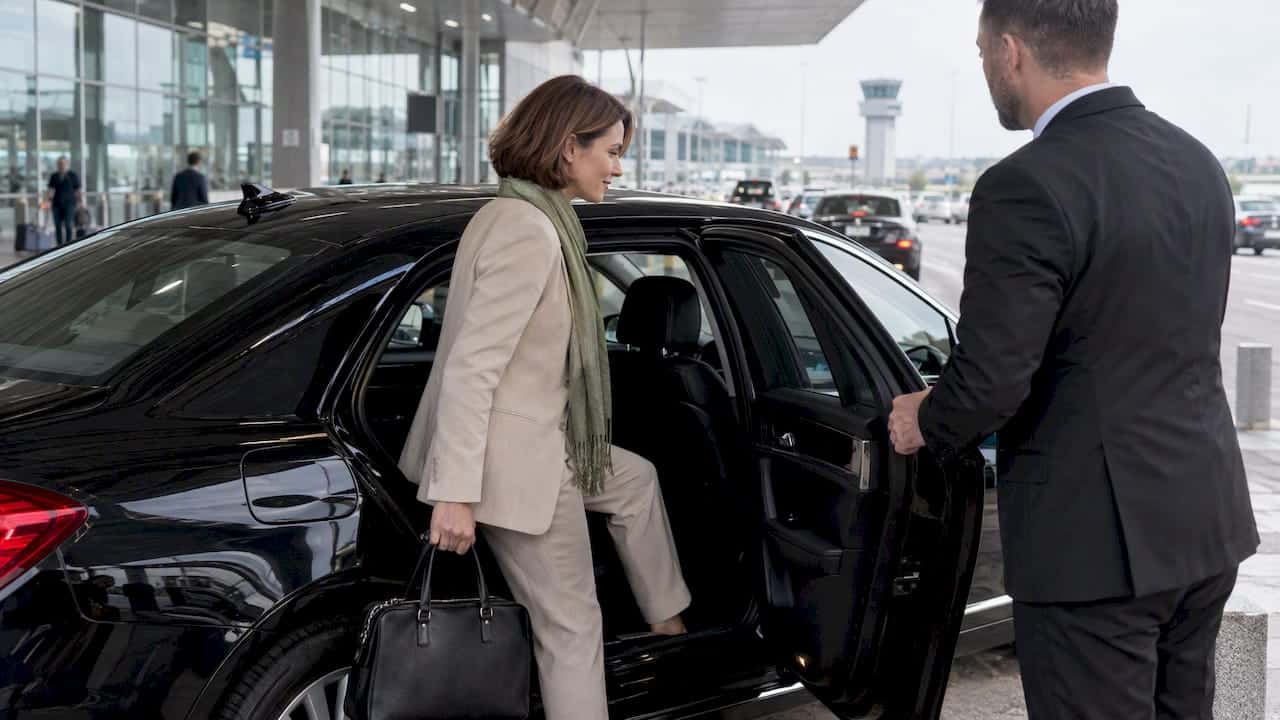
The Mercedes-Benz S-Class and its Maybach variant are the workhorses of executive airport transfers worldwide. The standard S-Class seats three passengers comfortably in the rear, with reclining seats, climate zones, ambient lighting, and a whisper-quiet cabin that makes it genuinely useful as a mobile office. The Maybach S-Class adds rear-seat recline to near-flat, a refrigerated compartment, and a level of acoustic insulation that borders on surreal at highway speeds. The BMW 7 Series competes closely, offering a slightly sportier ride with comparable tech, including a rear-seat entertainment system and available massage seats. These sedans carry one to three passengers and typically accommodate two standard suitcases.

Luxury SUVs
The Range Rover Autobiography is the most versatile vehicle in this tier. It seats four to five passengers with genuine rear legroom, handles varied terrain, and projects a discreet authority that works equally well at a private airport and a five-star hotel entrance. The Bentley Bentayga raises the ceiling on onboard refinement, with hand-stitched leather, a Naim audio system, and a rear cabin that feels closer to a first-class lounge than a car. The Cadillac Escalade is the American standard for group SUV transfers, seating up to seven with substantial cargo space. The Rolls-Royce Cullinan sits at the top of the category: a self-sealing air suspension, a rear viewing suite option, and a presence that announces arrival before the door opens.
VIP Sprinter and van conversions
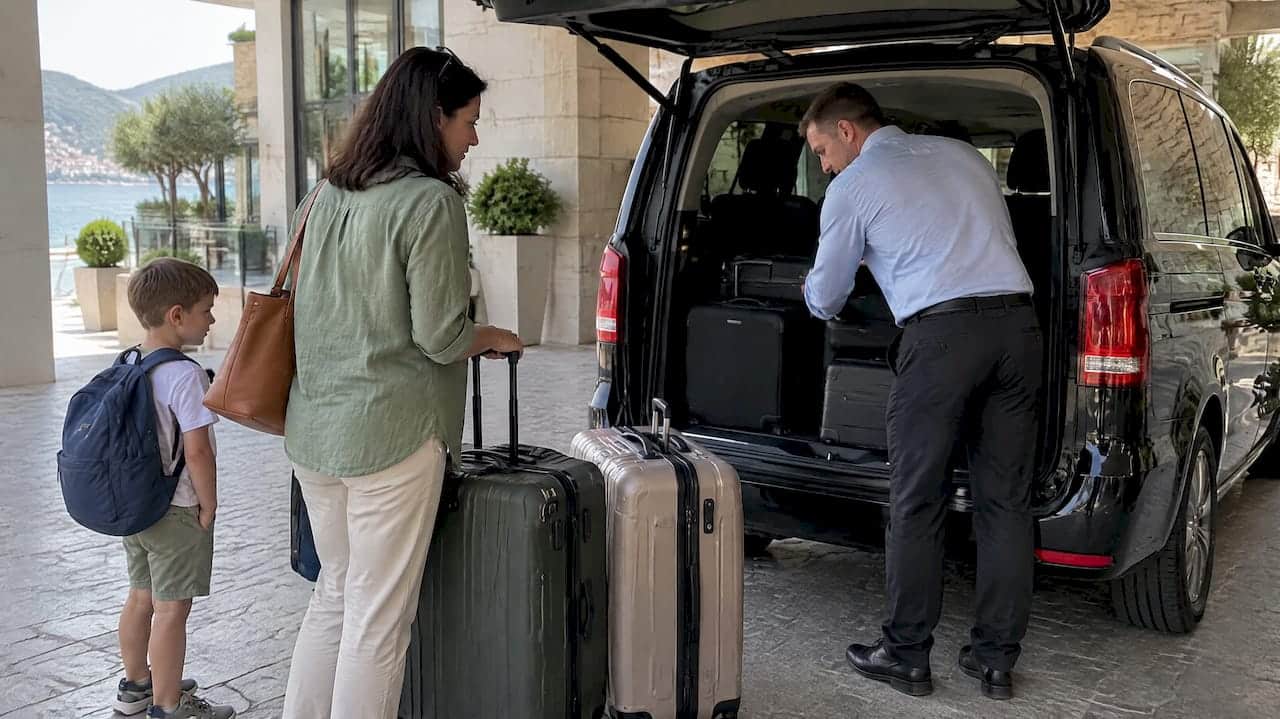
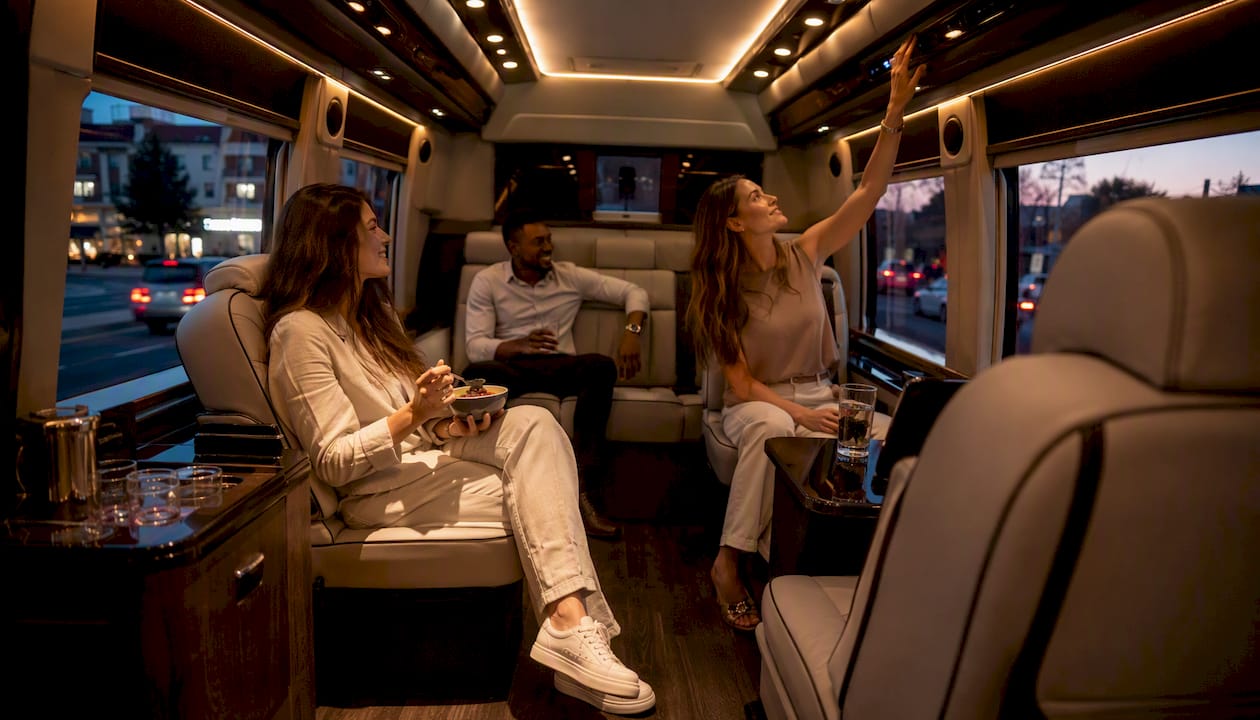
Mercedes-Benz Sprinter VIP conversions are the preferred choice for small groups of four to eight passengers who need both comfort and cargo capacity. Converted cabins typically feature captain’s chairs or club seating, fold-out work tables, Wi-Fi, USB and 110V power outlets, a small refreshment station, and privacy glass. The Mercedes-Benz V-Class offers a slightly more compact footprint for urban routes. Luxury travel vehicles in this category are particularly well-suited to family ski transfers, corporate roadshows with multiple stops, and airport group collections where luggage volume is a real constraint.
Stretch limousines
Lincoln stretch limousines remain the most recognizable symbol of celebratory ground transport in the United States. A standard stretch seats six to eight passengers; super-stretch configurations reach ten to twelve. The interior typically includes a full bar, mood lighting, a sound system, and a privacy partition. These vehicles are purpose-built for visibility and occasion, making them the natural choice for weddings, proms, and milestone celebrations rather than discreet executive travel. Luggage capacity is limited, so they work best when bags travel separately.
Mini-coaches and motorcoaches
For groups of 10 or more, the executive mini-coach (typically 23 passengers) and full motorcoach (up to 56 passengers) are the only practical luxury options. Providers like Premier Transportation in Dallas-Fort Worth operate fleets that serve Fortune 500 corporations, convention groups, and sports teams. Premium coaches include reclining seats, onboard Wi-Fi, entertainment systems, and climate control. Coventry Transportation similarly demonstrates how chauffeur-grade service standards can be applied at coach scale, with professional drivers and maintained fleets serving corporate and event clients.
Exotic and supercars
A Rolls-Royce Ghost or Bentley Flying Spur used as a transfer vehicle signals something special: the arrival itself is part of the experience. These vehicles carry one to three passengers and minimal luggage, so they’re rarely the practical choice. They appear most often in runway-to-road collections, high-profile event arrivals, and exclusive transfer experiences where the vehicle is as much a statement as the destination.
Quick-compare: vehicle categories at a glance
| Vehicle category | Best for | Passengers | Luggage | Common amenities | Typical lead time |
|---|---|---|---|---|---|
| Executive sedan (S-Class, 7 Series) | Solo executive, VIP couple | 1 to 3 | two standard suitcases | Wi-Fi, climate zones, privacy glass | at least 24 hours |
| Luxury SUV (Range Rover, Cullinan, Escalade) | VIP couple, small family | three to five | three to five bags | Heated seats, ambient lighting, refreshments | at least 24 hours |
| VIP Sprinter / V-Class | Family, small group, roadshow | four to eight | 6–10 bags | Club seating, work tables, Wi-Fi, power outlets | at least 48 hours |
| Stretch limousine (Lincoln) | Wedding, celebration | six to twelve | Minimal | Bar, mood lighting, sound system, partition | 48 hours to two weeks |
| Mini-coach / motorcoach | Corporate group, event shuttle | group-sized | High | Wi-Fi, entertainment, reclining seats | advance notice required |
| Exotic / supercar (Ghost, Bentayga) | Runway-to-road, VIP arrival | 1 to 3 | one to two bags | Bespoke interior, chauffeur, privacy | 48 hours to one week |
Pro Tip: When choosing between a luxury SUV and a VIP Sprinter for a group of four, consider the luggage first. Four passengers with ski bags or oversized cases almost always need the Sprinter’s cargo capacity, even if the SUV feels more intimate.
What service types can you book, and when does each one make sense?
The vehicle is only half the equation. The service type you book determines how the transfer is structured, what’s included, and how much flexibility you have on the day.
Airport meet and greet
A chauffeur meets you inside the terminal, typically at the arrivals gate or just past customs, holding a name board. The driver monitors your flight in real time and adjusts pickup time for delays or early arrivals. Long-distance luxury routes, such as the Malpensa to Monte Carlo transfer, include multilingual chauffeurs, Wi-Fi, child seats, and optional scheduled stops as standard features of this format.
Runway-to-road and FBO collections
For ultra-high-net-worth clients and high-profile travelers, runway-to-road pickups allow the vehicle to meet the aircraft directly at the FBO or private terminal, bypassing the public arrivals hall entirely. This requires advance coordination with airport operations and security, and often special permits. The result: zero terminal exposure, immediate vehicle boarding, and a departure from the airport in under ten minutes.
Point-to-point transfers
A fixed-price transfer from one address to another, with no hourly meter running. This is the most common format for airport runs, hotel-to-hotel moves, and intercity transfers. The price is agreed in advance, the route is set, and any deviation (extra stops, route changes) is handled by prior arrangement.
Hourly charters
You book the vehicle and chauffeur for a set number of hours, with freedom to direct the route as needed. This format suits corporate roadshows with multiple client meetings, shopping or dining days in a city, and any itinerary where the schedule is fluid. Providers typically require a minimum of two to four hours.
Group transfers and event shuttles
When the guest count exceeds what a single luxury SUV can carry, a VIP Sprinter, mini-coach, or motorcoach takes over. Event planners booking group transfers for conferences, weddings, or sports events typically work with providers that offer dedicated dispatch, multiple vehicle coordination, and on-site logistics support.
Multi-day chauffeur-driven itineraries
A vehicle and chauffeur are reserved for multiple consecutive days, often with pre-planned scenic or culinary stops built into the route. This format converts a transfer into a curated travel experience, with the chauffeur acting as a local guide and logistics coordinator. Providers offering this service typically include pre-arrival briefings, coordination with hotels and private properties, and bespoke route customization.
Common occasions matched to service type:
- Single executive, late-night arrival → runway-to-road or meet-and-greet in an S-Class or Maybach
- Family of four with ski gear → VIP Sprinter, point-to-point with luggage pre-loading
- Corporate roadshow, three client meetings in one day → hourly charter in a Range Rover Autobiography
- Wedding party of ten → Lincoln stretch or mini-coach, point-to-point with venue coordination
- Conference group of 40 → motorcoach with dedicated dispatch and event-day logistics
- Multi-day coastal tour → Sprinter or luxury SUV with chauffeur on multi-day block booking
What trust signals should you verify before booking a high-end transfer?
A vehicle’s badge tells you nothing about the reliability of the service. The signals that actually matter are operational, not cosmetic.
The core checklist:
- Licensed and insured fleet: Confirm the operator holds commercial transportation licenses and adequate liability insurance for the vehicle class and passenger count.
- Chauffeur background checks and training: Professional providers conduct criminal background checks and defensive driving training. Ask for confirmation in writing.
- Fleet age and maintenance records: Vehicles should be recent-model-year and serviced on a documented schedule. A well-maintained three-year-old S-Class outperforms a neglected new one.
- Flight monitoring policy: Confirm the provider tracks your flight in real time and adjusts pickup time automatically, at no extra charge.
- Written luggage and stop policies: Get the luggage allowance and extra-stop terms in writing before you pay. Verbal assurances don’t hold at 11 PM in an unfamiliar city.
- Transparent cancellation terms: Understand the full refund window and any fees for changes. Reputable providers state these clearly.
- Verified customer reviews: Look for reviews on independent platforms, not only the provider’s own website.
For high-profile or time-sensitive trips, the operational depth goes further. [Runway-to-road coordination](https://www.best-vip.com/car-service-to-southern-california FBOs/) requires the provider to have established relationships with airport operations staff and the permits to execute airside access. Some providers also offer encrypted communications for discreet requests, and mid-route vehicle swaps for clients who require anonymity.
Pro Tip: When making an inquiry, ask the provider two specific questions: “Who monitors my flight, and what is your protocol if my flight diverts?” A provider with a real answer has a real operation. A vague response is a red flag.
For a deeper look at what separates a credible operator from a premium-branded ride-share, the real criteria for luxury transfers are worth reviewing before you commit to a booking.
What does a luxury transfer actually cost, and how far ahead do you need to book?
Pricing in this market is driven by vehicle category, distance, waiting time, airport fees, and any special requests. There is no universal rate card, but the ranges below reflect what travelers commonly encounter in the U.S. market.
Primary price drivers:
- Vehicle category (sedan vs. SUV vs. Sprinter vs. coach)
- Distance and estimated travel time
- Airport surcharges and parking fees
- Waiting time beyond the included grace period (typically 30–60 minutes for flights)
- Extra stops or route deviations
- Special requests: child seats, refreshments, armed security, runway access
Typical price ranges by vehicle category (U.S. market, approximate):
| Vehicle category | Short airport transfer (under 30 miles) | Hourly charter rate | Typical booking lead time |
|---|---|---|---|
| Executive sedan (S-Class, 7 Series) | $150 to $300 | $100 to $200 per hour | at least 24 hours |
| Luxury SUV (Escalade, Range Rover) | $200 to $400 | $150 to $250 per hour | at least 24 hours |
| VIP Sprinter (four to eight passengers) | $350 to $600 | $200 to $350 per hour | at least 48 hours |
| Stretch limousine | $400 to $800 | $250 to $450 per hour | 48 hours to two weeks |
| Mini-coach (23 passengers) | $500 to $900 | $300 to $500 per hour | one to two weeks |
| Motorcoach (up to 56 passengers) | $800 to $1,500 and up | $400–$700/hr | 2–4 weeks |
These are indicative ranges. Individual quotes vary by market, provider, and date. Always request a written quote.
Luxury transfer contracts commonly require advance reservations between 72 hours and 30 days, depending on the vehicle type and the provider’s policies. Same-day bookings are occasionally possible for executive sedans in major cities, but specialty vehicles (Sprinters, coaches, stretch limousines) and runway-to-road services almost always require more lead time. Booking early directly expands your vehicle selection, particularly during peak travel periods.
Standard luggage allowances typically run one checked bag plus one carry-on per passenger. Oversized items (ski bags, golf clubs, large strollers) must be declared at booking and may require a vehicle upgrade. Extra stops beyond the agreed itinerary are usually billed at a per-stop or per-minute rate, so pre-arranging any deviations saves both money and friction on the day.
Why discreet luxury replaced the stretch limousine as the gold standard
The stretch limousine was once the universal shorthand for luxury ground transport. That era has largely passed. The shift isn’t about cost — it’s about what high-net-worth travelers now want from a transfer.
The vehicles that embody this shift are telling. The Mercedes-Maybach S-Class, the Range Rover Autobiography, the Rolls-Royce Cullinan, and the VIP Sprinter for groups all share a common quality: they are extraordinary on the inside and unremarkable on the outside. A Maybach parked outside a hotel looks like a well-specified S-Class. A Cullinan reads as a premium SUV. Neither announces itself the way a white super-stretch does.
What high-profile clients now prioritize, according to professional chauffeurs, centers on three things:
- Discretion: The ability to move through public spaces without attracting attention, including vehicle swaps for anonymity on sensitive routes.
- Anticipation: A chauffeur who has pre-loaded the preferred temperature, music, and refreshments before the client boards, without being asked.
- Secure communications: For clients with genuine privacy requirements, providers offering encrypted communication channels and non-disclosure agreements have become a meaningful differentiator.
The experiential dimension has also grown. Concierge-style transfers now routinely include pre-planned stops at Michelin-starred restaurants, private viewpoints, or boutiques, converting a point-to-point transfer into a curated day. This increases planning complexity and typically requires a full-day vehicle and chauffeur block booking, but for the right client, the transfer itself becomes a highlight of the trip.
Key Takeaways
The most important principle in selecting a luxury transfer is matching the vehicle category to your actual passenger count, luggage profile, and privacy requirements before comparing providers or prices.
| Point | Details |
|---|---|
| Match vehicle to your real needs | Passenger count, luggage volume, and privacy requirements should determine vehicle category before brand preference. |
| Verify operational credentials | Licensed fleet, chauffeur background checks, and flight monitoring matter more than the vehicle model year. |
| Book early for best selection | Specialty vehicles and runway-to-road services require 48 hours to 4 weeks of advance notice; same-day is rarely possible. |
| Discreet luxury leads the market | Acoustic comfort, understated design, and chauffeur professionalism have replaced ostentation as the primary luxury signals. |
| Croatia-private-transfers for Croatia | Croatia-private-transfers offers vetted, English-speaking chauffeurs in premium Mercedes vehicles for private transfers and bespoke multi-day itineraries across Croatia. |
How we advise affluent clients on choosing a transfer
The most common mistake I see affluent travelers make is optimizing for the vehicle badge when they should be optimizing for the chauffeur and the logistics behind the booking. A Maybach driven by an undertrained operator with no flight-monitoring protocol is a worse experience than a well-specified S-Class with a chauffeur who has your itinerary memorized and two contact numbers on file.
When anonymity matters, the vehicle choice shifts entirely. A Range Rover Autobiography or a dark-colored Sprinter draws far less attention than a white Cullinan or a stretch limousine. For clients who genuinely need discretion, I’d recommend discussing vehicle color and model with the provider explicitly, and confirming whether they offer mid-route vehicle swaps.
For groups, the Sprinter or mini-coach is almost always the better call over multiple sedans. Keeping a group together in one vehicle simplifies logistics, eliminates the coordination overhead of convoy driving, and usually costs less per person. The social dynamic is also better: a group that arrives together arrives as a group.
Pre-arranging luggage handling for specialized gear (ski equipment, photography cases, musical instruments) is worth a dedicated conversation at booking, not an afterthought at the curb. The same applies to runway-to-road pickups: these require advance coordination with airport operations, and a provider who hasn’t done it before will tell you they can, then scramble on the day.
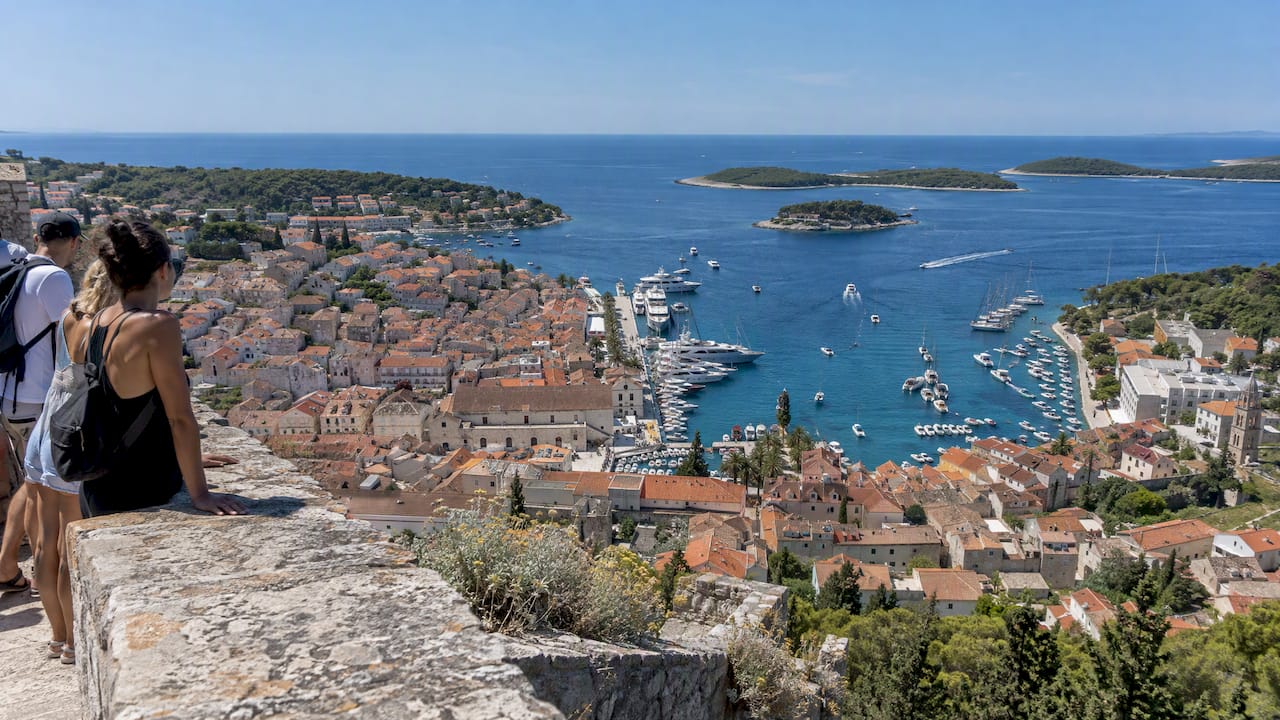
For travel in Croatia specifically, Croatia-private-transfers arranges private transfers and tailored multi-day itineraries with vetted, English-speaking chauffeurs in modern Mercedes vehicles. The service covers airport transfers, intercity routes, and custom day trips to UNESCO sites and coastal destinations, with the kind of local knowledge that turns a transfer into the first memorable moment of a trip.
Authoritative sources and further reading
- Luxury Gold: Door-to-door transfers — covers standard contract norms including luggage allowances and advance reservation requirements.
- Best VIP: Car service to Southern California FBOs — detailed description of runway-to-road coordination, chauffeur discretion standards, and airside pickup logistics.
- VIP NYC Transfers: The art of luxury travel in NYC — covers personalization elements, staging, and encrypted communications for high-profile clients.
- Transfer Lounge: Malpensa to Monte Carlo transfers — example of long-distance premium transfer amenities including flight monitoring, multilingual chauffeurs, and optional stops.
- Courchevel Rentals: Premium Rolls-Royce transfers — illustrates how concierge-style transfers incorporate bespoke stops and multi-day vehicle availability.
- Croatia-private-transfers: Private transfers in Croatia — booking page for private airport and intercity transfers across Croatia with vetted chauffeurs and premium Mercedes vehicles.
- Croatia-private-transfers: What makes a luxury transfer — detailed breakdown of the service standards, driver qualifications, and fleet attributes that define a genuine luxury transfer.
Premium transfers for Croatia, arranged the way they should be
For travelers planning a trip to Croatia, the gap between a standard transfer and a genuinely curated one comes down to local knowledge and vetted operations. Croatia-private-transfers offers exactly that: door-to-door private airport transfers, intercity routes between Split, Dubrovnik, Zagreb, and beyond, and custom multi-day itineraries with English-speaking chauffeurs in modern, air-conditioned Mercedes vehicles.
Whether you’re arriving at Zagreb Airport and heading to a coastal villa, or planning a private day trip to Plitvice Lakes or the Dalmatian coast, every booking is handled with the same attention to detail: flight monitoring, door-to-door luggage assistance, and an itinerary built around your schedule, not a shared timetable. Request a quote directly through the Croatia-private-transfers booking page and receive a tailored proposal for your dates and route.