

Best Coastal Routes Croatia: 7 Drives Worth Every Turn
TL;DR:
- Croatia’s scenic coastal drives include the iconic Adriatic Highway and hidden detours like Mars Road and Pelješac Peninsula. Traveling north to south from Rijeka to Dubrovnik offers breathtaking landscapes, but requires planning for narrow roads, traffic, and parking challenges. The best travel time is May or September when traffic is lighter, and flexible exploration reveals unforgettable coastal moments.
Croatia’s Adriatic coastline is one of Europe’s most visually spectacular stretches of road, yet choosing the best coastal routes Croatia has to offer can feel genuinely overwhelming. Over 1,200 islands, medieval walled cities, and cliffside sea views compete for your attention at every turn. This article cuts through the abundance and delivers a curated selection of the top scenic coastal paths, from the legendary Adriatic Highway to lesser-known island detours that most travelers completely miss. Whether you have five days or three weeks, you will leave with a clear, practical plan.
Table of Contents
- Key takeaways
- 1. How to choose the best coastal routes in Croatia
- 2. The Adriatic Highway (D8): Croatia’s iconic north-to-south drive
- 3. Mars Road on Pag Island: Europe’s most surreal coastal detour
- 4. Pelješac Peninsula: vineyards, oysters, and quiet coastal byways
- 5. Northern coastal drives: Istrian Peninsula and Kvarner Bay
- 6. Top coastal routes compared: a side-by-side guide
- My honest take on Croatia’s coastal drives
- Travel Croatia’s coast without the logistics headaches
- FAQ
Key takeaways
| Point | Details |
|---|---|
| Drive north to south | The Adriatic Highway delivers its most dramatic scenery when driven from Rijeka toward Dubrovnik. |
| Allow more time than GPS predicts | Narrow roads, sharp bends, and irresistible stops make actual drive times significantly longer than estimated. |
| May beats July for road trippers | Peak summer traffic on the D8 is intense; May offers the same beauty with far less congestion. |
| Hidden gems reward detours | Mars Road on Pag Island and the Pelješac Peninsula offer tranquil, photogenic drives away from the crowds. |
| North has its own magic | Istria and Kvarner Bay are culturally distinct and far less visited, making them ideal for unhurried exploration. |
1. How to choose the best coastal routes in Croatia
Before you map a single waypoint, a few practical criteria will shape your entire experience on Croatia coastal drives.
Drive length and pace. Croatia’s coast is long. Seriously long. Trying to cover everything in a week means rushing past the very moments worth stopping for. Honest planning requires matching route distance to available days, leaving room for spontaneous detours.
Road conditions and traffic patterns. The Adriatic Highway has narrow widths of 5 to 7 meters, sharp bends, slopes exceeding six percent, exposure to the powerful Bura wind, and genuine rockfall risk on exposed cliff sections. GPS travel time estimates are consistently optimistic. Plan for considerably longer actual driving times on every coastal segment.
- Seasonal congestion peaks hard in July and August, particularly around Split and Dubrovnik
- May through early June and September offer excellent weather with notably lighter traffic
- Some northern routes through Istria and Kvarner remain manageable even at peak season
Landscape variety and access to attractions. The best routes along Adriatic stretches reward travelers who value the full picture: ancient walled towns, national park viewpoints, secluded coves, and vineyard-lined peninsulas. Prioritize routes that give you genuine access rather than just a view from the car window.
Logistics. Parking in historic coastal towns is notoriously difficult. Staying slightly outside old town centers and pre-booking parking is a practical necessity, not just a suggestion. Ferry connections to islands like Hvar and Brač also require advance scheduling, especially in summer.
Pro Tip: If you are planning a luxury coastal road trip and want to sidestep parking headaches entirely, private coastal transfers let you enjoy every scenic viewpoint without the stress of finding a space in a medieval town center.
2. The Adriatic Highway (D8): Croatia’s iconic north-to-south drive
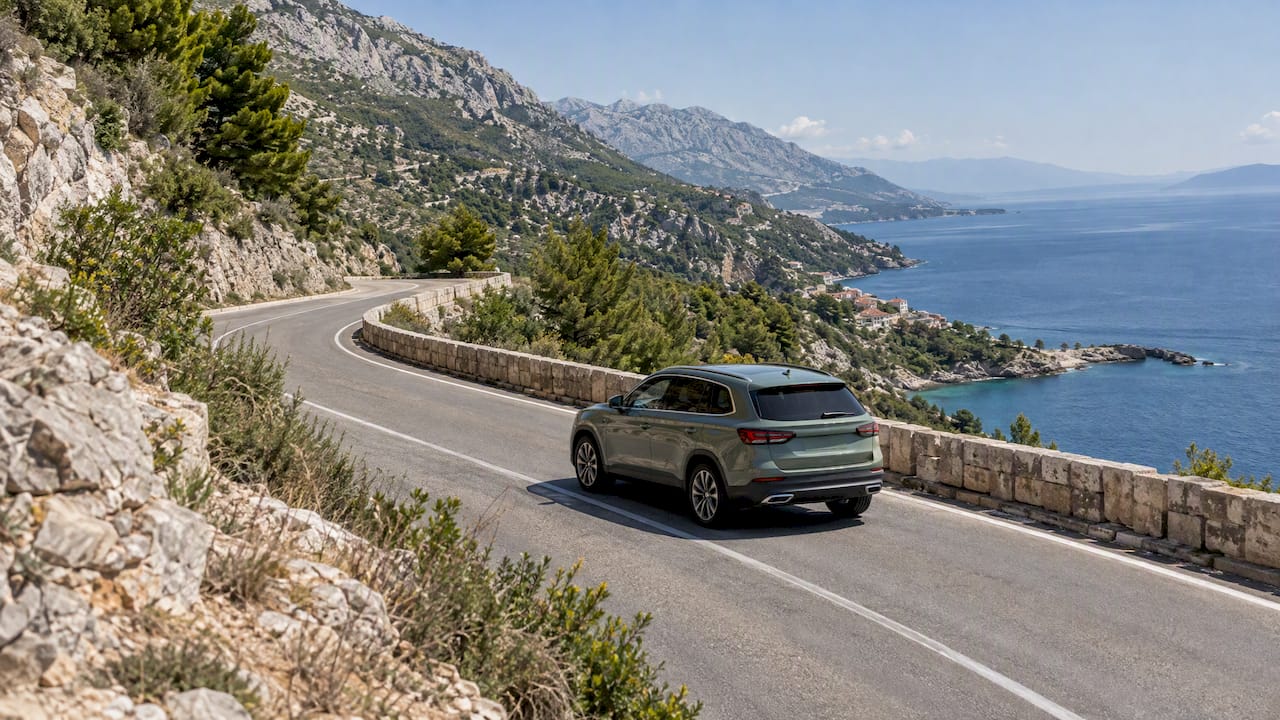
No conversation about the best coastal routes Croatia offers is complete without the Adriatic Highway. The D8 stretches approximately 818 kilometers from Rijeka in the north to Dubrovnik in the south, and the recommended itinerary for an immersive experience is 10 to 14 days.
This is widely considered one of the top five driving roads in the world, and the reputation is earned. But it is also heavily impacted by traffic in July and August, with May standing out as the ideal window for relaxed, crowd-free traveling.
Key stops along the D8 from north to south:
- Rijeka: Industrial port city with an underrated old town and a dramatic karst backdrop
- Zadar: Roman ruins, the Sea Organ, and a sunset that locals claim is the world’s most beautiful
- Šibenik: Croatia’s only medieval city founded by Croats rather than Romans, home to a UNESCO cathedral
- Split: Diocletian’s Palace, where people actually live inside a Roman emperor’s retirement home
- Makarska Riviera: Biokovo mountain meets impossibly blue water in a 60-kilometer stretch of beach
- Pelješac Peninsula: Vineyards rolling to the sea, oysters in Ston, and roads almost entirely free of tourist buses
- Dubrovnik: The walled city that needs no introduction, though arriving by road from the north makes the first glimpse genuinely breathtaking
Driving north to south builds anticipation progressively and eliminates backtracking on what is largely a single coastal road. The panoramas deepen as you move south, and Dubrovnik lands as the emotional peak of the journey rather than the starting point.
Pro Tip: Book accommodation just outside Dubrovnik’s old city walls. The Lapad or Babin Kuk areas offer parking, quick bus access to the center, and considerably lower rates than old town hotels.
3. Mars Road on Pag Island: Europe’s most surreal coastal detour
If you want to impress fellow travelers with a route they have genuinely never heard of, Mars Road on Pag Island is your answer. This 10 to 15 kilometer stretch cuts through white limestone karst terrain so stark and alien that the road earns its name without any exaggeration.
The landscape is virtually devoid of vegetation. Pale rock bleached by sun and salt wind meets deep turquoise water in a visual contrast that photographs cannot fully capture. It is a short drive, perfect as a half-day detour before or after exploring Pag town.
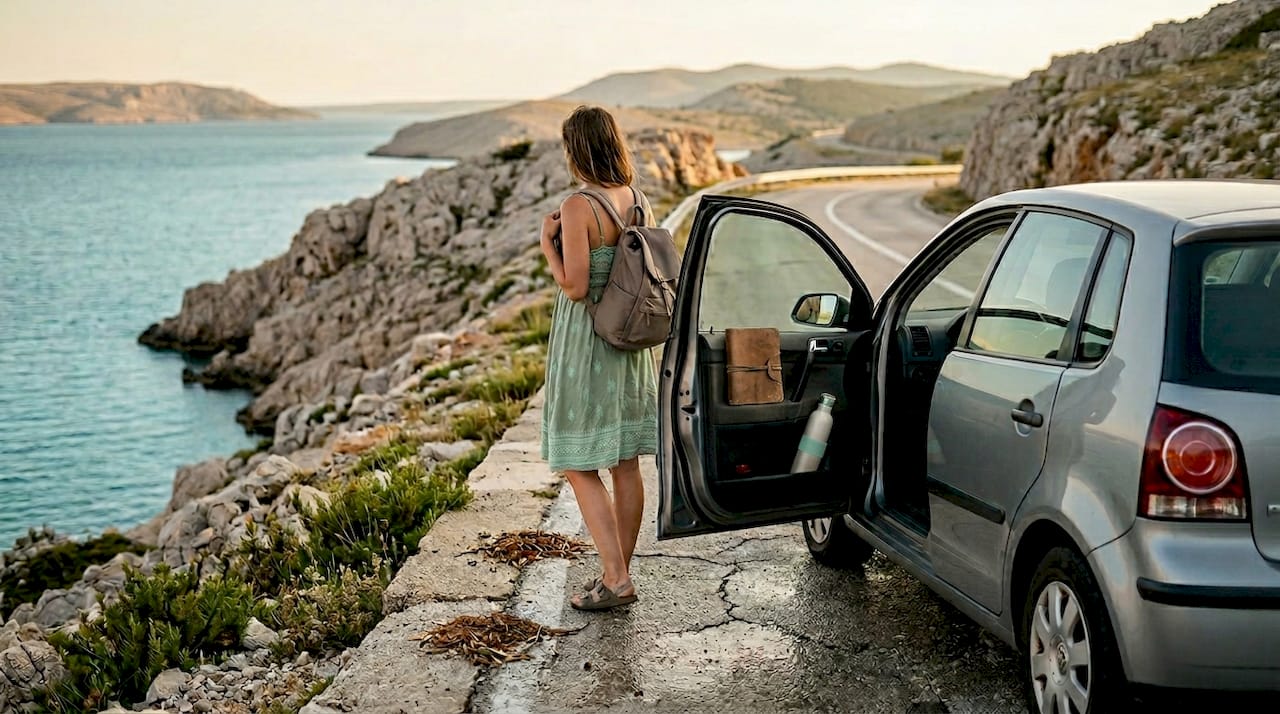
The best time to visit is late spring or early autumn when the light is golden and the road is quiet. Midsummer brings heat that reflects off the white rock intensely, and the tourist trail to Pag for its famous nightlife means more cars on narrow access roads.
4. Pelješac Peninsula: vineyards, oysters, and quiet coastal byways
The Pelješac Peninsula is what the Dalmatian coast looked like before the tourist infrastructure caught up. The drive from the coastal junction near Ston all the way to Orebić traces a narrow finger of land between the open Adriatic and the sheltered Pelješac Channel.
The peninsula is notable for its wineries, oyster farms in Ston, and quiet coves that see a fraction of the visitors who pile into Split or Dubrovnik. The road winds through vine rows heavy with Plavac Mali grapes, the varietal that produces Croatia’s finest red wines. Stopping at a family-run konoba for grilled fish and local wine is not a tourist activity here. It is simply what people do.
- Drive Ston to Orebić for the full peninsula experience (roughly 65 kilometers)
- Stop at the Salt Flats and medieval walls of Ston, one of the longest fortification systems in Europe
- Time oyster tasting for late morning before the day-trip boats arrive from Korčula
Pro Tip: The road between Trstenik and Žuljana along the southern coast of Pelješac is the quietest and most scenic stretch. It is barely on tourist maps, which is exactly the point.
5. Northern coastal drives: Istrian Peninsula and Kvarner Bay
Exploring Croatian coast routes without venturing into Istria means missing a coastal character that feels entirely different from Dalmatia. The Istrian Peninsula carries distinct Italian influences, visible in the Venetian-era architecture of Rovinj, the Roman amphitheater dominating the skyline of Pula, and the Byzantine mosaics of Poreč.
The coastal drives through Istria are well-maintained and less dramatic in gradient than the D8, which makes them well-suited to travelers who prefer a relaxed, scenic drive over an adrenaline-tinged cliff road. The harbors of Rovinj glow terracotta and amber at sunset, and the waterfront restaurants serve Istrian truffles and Malvazija wine that locals have been pairing for generations.
Kvarner Bay connects directly south of Istria, running from the elegant resort town of Opatija down to Karlobag. The bay’s sheltered waters and pine-covered hillsides create a quieter, more intimate version of the Adriatic experience.
- Opatija to Senj: elegant Habsburg-era villas giving way to dramatic limestone cliffs
- The island of Krk is accessible by bridge and worth a half-day loop through its interior and coastal villages
- Rijeka to Karlobag outside peak season offers some of the most uninterrupted sea views on the entire northern coast
Traffic is noticeably more manageable than on the central Dalmatian section of the D8, particularly from April through early June.
6. Top coastal routes compared: a side-by-side guide
Choosing between Croatia’s best coastal drives comes down to your priorities. Here is a clear comparison to help you decide.
| Route | Length | Best Season | Highlights | Difficulty | Best For |
|---|---|---|---|---|---|
| Adriatic Highway (D8) | ~818 km | May, September | Zadar, Split, Dubrovnik | Moderate to challenging | Full road trip travelers |
| Pelješac Peninsula | ~130 km | May to October | Vineyards, oysters, Ston | Easy | Wine lovers, couples |
| Mars Road, Pag Island | 10–15 km | April to June, September | Lunar landscape, turquoise sea | Easy | Day trippers, photographers |
| Istrian Coastal Loop | ~200 km | April to October | Rovinj, Pula, Poreč | Easy | Culture and food lovers |
| Kvarner Bay Drive | ~150 km | May to September | Opatija, Krk, cliff views | Easy to moderate | Families, relaxed travelers |
For families, Istria and Kvarner offer the most forgiving roads with excellent facilities. Solo travelers and couples with flexible itineraries get the most from the full D8. Travelers seeking off-the-beaten-path moments should prioritize Mars Road and Pelješac. For those considering a southern extension beyond Croatia, transfers to Montenegro from Dubrovnik make a natural and rewarding add-on.
Pro Tip: Renting a car gives you freedom to explore hidden beaches and viewpoints at your own pace, but the expanded Croatian motorway network also means you can combine coastal and inland routes to break up the driving and reach places like Plitvice Lakes without significant detours.
My honest take on Croatia’s coastal drives
I have spent enough time on these roads to know what the guidebooks leave out. The Adriatic Highway is genuinely spectacular, but it demands respect. You will find yourself behind a slow-moving camper on a cliff road with nowhere to pass for twenty minutes, and that is fine. The mindset shift from “making time” to “taking time” is the difference between a stressful drive and a transformative one.
The north-to-south direction is not just logistically efficient. It genuinely builds emotionally. By the time Dubrovnik appears on the horizon after days of smaller-scale beauty, the impact is completely different than if you had started there.
What I have found most valuable is the hour or two spent on roads that are not in any itinerary. The unmarked pull-offs above the Makarska Riviera. The fishing village on Pelješac where the only other guests at lunch are locals. These are the moments that make coastal road trips Croatia travelers keep talking about years later.
My honest advice on peak season: if you must travel in July or August, start driving before 8 a.m. The roads are quieter, the light is extraordinary, and you will arrive at your destination before the day-trip crowds do.
— Croatia
Travel Croatia’s coast without the logistics headaches
Croatia’s most spectacular coastal drives deserve your full attention, not a fraction of it while circling a medieval town looking for parking.
Croatia-private-transfers offers door-to-door private transfers across Croatia with licensed, English-speaking drivers and modern, air-conditioned vehicles. Whether you need an airport pickup in Split, an intercity transfer from Zagreb to Dubrovnik, or a fully customized bespoke coastal tour, the team handles every logistical detail so you can focus on the view. Island day trips, winery visits, and cross-border transfers to Montenegro are all available as part of tailored itineraries designed around your pace and preferences.
FAQ
What is the best coastal route in Croatia for a road trip?
The Adriatic Highway (D8) is the definitive coastal road trip route, running approximately 818 kilometers from Rijeka to Dubrovnik with stops at Zadar, Split, and the Makarska Riviera. Allow 10 to 14 days for a genuinely immersive experience.
When is the best time to drive Croatia’s coastal roads?
May and September are the best months for scenic drives in Croatia. Traffic is significantly lighter than in July and August, temperatures are comfortable for driving, and most attractions are fully open.
Is the Adriatic Highway difficult to drive?
The D8 has stretches with narrow road widths, sharp bends, steep gradients, and exposure to strong winds like the Bura. It is manageable for most drivers but requires patience, slower speeds than GPS suggests, and caution on cliff-edge sections.
Are there hidden coastal drives worth exploring beyond the D8?
Yes. Mars Road on Pag Island offers a 10 to 15 kilometer lunar-landscape drive, and the Pelješac Peninsula provides quiet vineyard and coastal scenery that very few tourists discover. Both reward travelers who are willing to leave the main road.
Can I combine Croatia’s coastal drive with a trip to Montenegro?
Absolutely. Dubrovnik sits close to the Croatian-Montenegrin border, and the coastal scenery continues southward. Croatia-private-transfers arranges comfortable cross-border transfers, making this a natural extension for travelers who want more Adriatic coastline.