
Licensed Drivers in Croatia: How to Check Before You Ride
A licensed driver in Croatia is someone who holds a valid B-category license, has completed the required initial qualification, has a clean record, and carries an official taxi driver ID card (kartica autotaksi vozača) displayed inside the vehicle. The company behind the driver also needs its own license and a municipal permit. This applies to a taxi, and by the same logic to a pre-booked private transfer in a Mercedes. Below is what each document means, how to check it in under a minute, and what a well-run private transfer looks like in practice.
TL;DR
- Every professional passenger driver in Croatia needs a taxi driver ID card issued through the Agency for Commercial Operations (AKD), on top of an ordinary B-category license.
- The card must be visible to passengers and carries a QR code, so you can verify it yourself.
- The operator needs a license, and the vehicle needs a permit from the municipality where passengers are picked up.
- A luxury vehicle or an unmarked car is not exempt from these rules.
- Ask your provider for the driver’s details and vehicle before the trip, not at the curb.
Table of Contents
- What “licensed” actually means in Croatia
- The driver ID card: your quickest check
- Does a luxury transfer fall under the same rules?
- Visible pricing: the other sign of a professional
- Foreign operators and the “cross-border” question
- How to verify a provider before you book
- Why the rules matter more on the Adriatic
- Our perspective
- Choosing the right kind of private service
- Red flags worth noticing
- Plan your journey with us
- FAQ
- Sources
What “licensed” actually means in Croatia
In everyday speech, “licensed driver” suggests a single document. In Croatia it is a chain of three, and a legitimate service holds all of them.
- The driver’s card. The taxi driver ID card is issued to drivers who carry out taxi passenger transport. To obtain it, a driver must be at least 21, hold a B-category license, have completed initial qualification under a special program for B-category drivers, and have a good reputation, proven by a criminal record extract that the deciding authority obtains officially.
- The operator’s license. The company or sole trader needs a license to provide taxi services. According to a Croatian guide for taxi operators, it is issued by the county state administration office or, in Zagreb, by the City of Zagreb.
- The municipal permit. Beyond the license, the operator needs a permit from each local government unit where it intends to pick up passengers. The government’s single point of contact for services describes the same two-tier setup: a license for the operator, and a permit covering the vehicle in the city or region where it works.
The age threshold, the B license, the qualification and the clean record are also summarized on the official e-Taxi service page on gov.hr, where drivers apply for the card.
The driver ID card: your quickest check
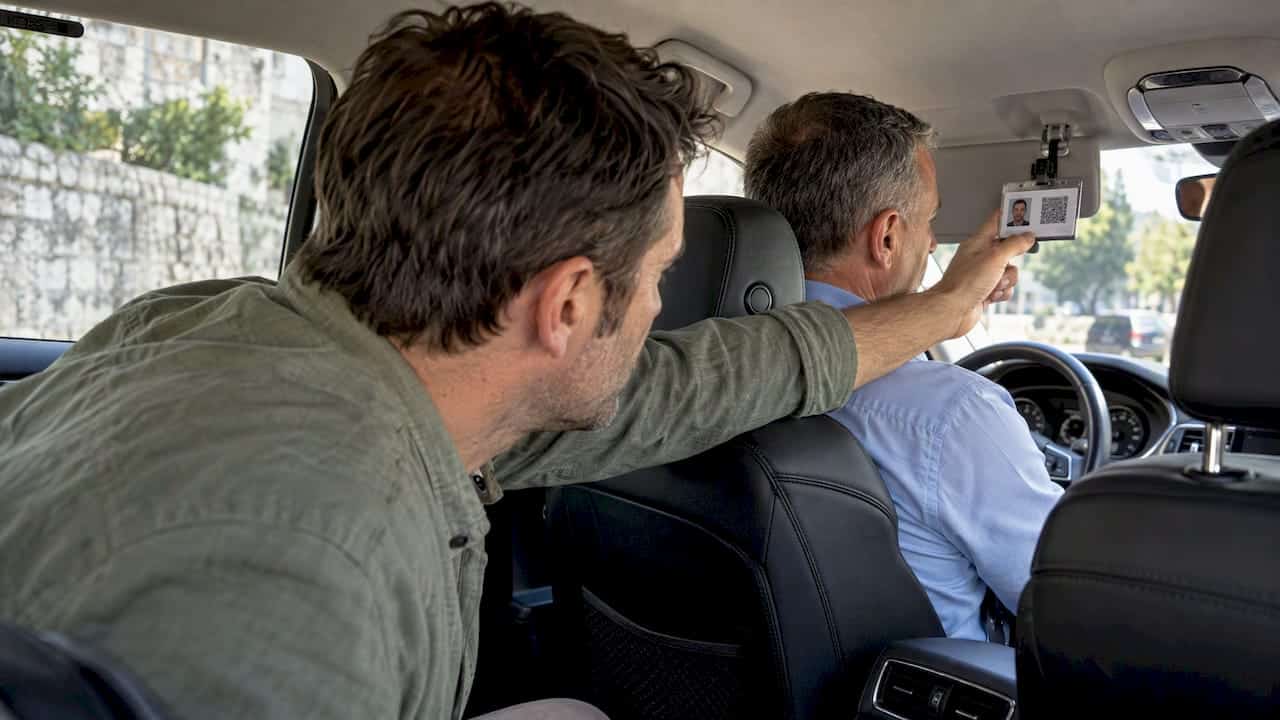
The card is the one document you can see from the back seat. Under the AKD’s description of the card, it must be displayed in the vehicle so that it is fully visible to passengers, and the driver must show it to an inspector on request. It also carries a QR code used to check its validity and the holder’s details.
The operator carries responsibility too: according to the same AKD page, a transport operator may not let anyone drive its vehicle without a valid card. This matters when a company sends a replacement driver at short notice. A valid card should travel with every person at the wheel, not just with the person who took your booking.
A practical routine takes less than a minute:
- Look for the card on the dashboard or windshield area, with a photo and name that match the driver.
- Scan the QR code with your phone if you want confirmation.
- Compare the name on the card with the name your provider sent before the trip.
Does a luxury transfer fall under the same rules?
Yes, and this is the most common misunderstanding among visitors. A black Mercedes with no taxi sign looks like something different from a taxi, so many travelers assume it follows other rules. The Ministry of the Sea, Transport and Infrastructure’s taxi information page treats autotaksi transport as one licensing framework: the operator must apply for a license, and when applying for a permit it must submit a record of the vehicles it plans to use. Pre-booked chauffeur work, transfers and private tours sit within the same passenger transport rules that apply to a taxi.
In practice, that means your driver should hold the card even if the car is unmarked, and the company should be able to tell you which license and permit it operates under. A provider who answers that question vaguely is telling you something.

Visible pricing: the other sign of a professional
Drivers are also expected to display price information in the car. State Secretary Tomislav Mihotić of the Ministry of the Sea, Transport and Infrastructure spoke about the new autotaksi rules in force from 1 January on national television in January 2025, framing licensing and the ID card as the tools that let tourists tell vetted drivers from unverified ones. The ministry’s published material also describes pricing information shown in the vehicle, such as the base price, price per kilometer and time-based costs.
For a private transfer with a fixed price agreed in advance, you pay the agreed amount, not a meter. Even so, a fixed quote should be confirmed in writing before the ride: the route, the vehicle, the number of passengers and luggage, waiting time at the airport and any planned stops. Nothing should be left to negotiation at the destination.
Foreign operators and the “cross-border” question
Some visitors arrive in Croatia on a coach or minivan from a neighboring country and wonder how that fits the rules. The single point of contact for services explains that an operator established elsewhere in the EU or EEA may bring passengers from its home country, but without the right to pick up passengers for the return. For anything else, it needs the Croatian authorizations.
For you, the lesson is simple. If someone offers a ride between two Croatian cities, you should expect a Croatian license and permit behind it, and a driver card to match. A cross-border exemption does not cover a domestic trip from Split to Dubrovnik.

How to verify a provider before you book
Whether you book by email, through a website or via a hotel concierge, the same checklist works.
| Question | What a good answer looks like |
|---|---|
| Is the driver licensed? | Name and confirmation of a valid taxi driver ID card |
| Does the company hold a license and permit? | A direct yes, with the operating company’s name |
| What vehicle will I get? | Make, class and capacity matched to your party and luggage |
| What is included in the price? | A written total covering tolls, waiting time and agreed stops |
| Does the driver speak English? | Confirmed before the trip, not assumed |
| What happens if my flight is delayed? | A clear flight-tracking and waiting policy |
Reputable operators elsewhere do the same thing. For example, one Middle Eastern hire service emphasizes sharing driver and vehicle details before the trip and real-time tracking, which shows how a pre-trip information habit has become a standard in premium transport everywhere. In Croatia, that habit sits on top of a legal minimum.
Why the rules matter more on the Adriatic
Croatian transfers are rarely just “point A to point B.” A typical itinerary covers long distances on the coastal highway, mountain passes, ferry connections and narrow old-town streets. A driver who knows where a vehicle can legally stop in Split’s Old Town, where to meet you in Dubrovnik, or when the Plitvice car parks fill up is solving a problem you would otherwise face yourself. The license is the baseline, and local knowledge is what turns it into a calm journey.
And there is a very practical safety layer. A driver with a card has passed a qualification and a background check. A vehicle with a permit is on the operator’s register. If something goes wrong, you have a named company and a named person, not an anonymous ride.
Our perspective
We built our service around a simple idea: a transfer should be the most reliable part of your trip, not a variable. Our drivers are licensed and English-speaking, and we operate modern, air-conditioned vehicles, including Mercedes sedans and minivans, for private airport transfers, intercity journeys and tailored tours across Croatia.
We also think the question “is my driver licensed?” should never feel awkward. Guests who ask it are being sensible, and we would rather answer it before you board than after. Our view is that a premium service is defined less by the badge on the hood than by what is behind it: documents in order, a confirmed plan, a driver who knows the route and the people who run the place you are heading to. If you want to see how we think about it more broadly, our page on Croatia travel standards and licensed luxury transfers goes into detail, and our guide to what makes a luxury transfer sets out the criteria we hold ourselves to.
— Croatia
Choosing the right kind of private service
Once the legal baseline is clear, the choice comes down to what you need from the day.
- Airport arrival. A pre-booked driver who tracks your flight and meets you at arrivals suits late landings and families with children. See our private airport transfers and the explanation of why a private airport transfer improves a Croatia trip.
- City to city. Routes such as Split to Dubrovnik, Zagreb to Split or Split to Zadar can be done directly or with a stop at a landmark along the way. Our intercity shuttle guide lays out the options.
- Day trips. If you prefer to see Krka, Plitvice or Mostar without driving, a private driver turns the journey into part of the experience. Browse our private day tours.
- Longer journeys. For a week or more across Dalmatia, Istria or the Slovenian border, a multi-day tour with a private driver keeps one familiar face and one plan throughout.
- A driver at your disposal. If your schedule is open-ended, our page on hiring a chauffeur and verifying licenses first explains how to approach it.
Red flags worth noticing
Most problems are visible before you set off.
- No card on display. If the driver cannot show an ID card, or the name does not match, do not get in.
- No company name. A provider that will not name the operating business is hard to hold to account.
- Cash-only, no confirmation. A legitimate service confirms in writing what you are paying for.
- Price changes at the curb. A fixed quote should stay fixed unless you change the route.
- A vehicle that does not match the booking. Different class, fewer seats, no space for luggage.
If you ever suspect a problem, ask for the operator’s details and the driver’s card number before the ride. Inspectors can ask to see the card, and you are entitled to the same courtesy.
Plan your journey with us
If you would like a licensed, English-speaking driver and a vehicle that suits your party, we can arrange a private transfer or a fully tailored itinerary anywhere in Croatia, from a quiet morning arrival in Split to a ten-day journey from the Adriatic coast to the Alps. Start with our private transfers in Croatia, or tell us your plans through the main site and we will shape the route around you.
FAQ
Do private chauffeurs in Croatia need the same ID card as taxi drivers?
Yes. Croatian rules treat pre-booked passenger transport with the same licensing framework as a taxi, so the driver needs the taxi driver ID card, even in an unmarked luxury car. The card is issued through AKD after checks on age, license, qualification and criminal record. Ask to see it, or confirm it with your provider in advance.
How can I tell whether a driver’s card is genuine?
The card should be visible inside the vehicle, show the driver’s details and carry a QR code. The AKD says the code is used to verify the card’s validity. Scan it, and make sure the name and photo match the person at the wheel.
Is a standard driving license enough to drive tourists in Croatia?
No. A B-category license is only one requirement. The driver also needs to be at least 21, complete the initial qualification program and have a clean record. The card is the proof that all of this has been checked.
Can a foreign company drive me from one Croatian city to another?
Generally not without Croatian authorization. The government’s service portal says an EU or EEA operator can bring passengers from its home country but cannot embark passengers on the return. A domestic transfer needs a Croatian license and permit.
Should the price be displayed in the car on a private transfer?
The ministry describes pricing information displayed in the vehicle as part of the rules for taxis. For a fixed-price private transfer, the more useful safeguard is a written confirmation of the total before you travel.
Sources
- Kartice autotaksi vozača, AKD
- e-usluga e-Taksi, gov.hr
- Najvažnije stvari koje svaki autotaksi prijevoznik mora znati
- Taksi prijevoz, Jedinstvena kontaktna točka za usluge
- Taxi transport, Single Point of Contact for Services
- Taksi prijevoz, informacije, Ministarstvo mora, prometa i infrastrukture
- Državni tajnik Mihotić o novim pravilima za autotaksi vozila
- Saudi Sayyah, services