

0.0 g/kg Safety: Driver as Guide in Croatia for Luxury Transfers
A vozač kao vodič, or driver-as-guide, is a licensed professional who drives you between destinations while also narrating the history, arranging last-minute changes, and unlocking local access a map cannot provide. For luxury travelers, families, and small groups visiting UNESCO sites along the Adriatic, that combination beats a standard chauffeur service. Providers build exactly this experience around English-speaking, licensed drivers.
TL;DR:
- Hiring a licensed driver-guide in Croatia offers time-efficient, personalized, and safe transportation with vehicles suited to your group size and itinerary.
- A driver-guide provides real-time narration, itinerary adjustments, and access to local spots unavailable to self-guided travelers.
- Confirm driver licenses, insurance, language fluency, and vehicle class before booking, especially during peak season when availability is limited.
- Croatian law enforces a strict zero-tolerance alcohol limit of 0.0 g/kg for professional drivers, ensuring safer, more compliant service.
- Booking two to four weeks in advance guarantees better availability for premium vehicles and peak-season demands.
Table of Contents
- What Does a Vozač Kao Vodič Actually Do in Croatia?
- Why Hire a Driver-Guide for Private Tours and Transfers?
- How Do You Hire a Driver-Guide in Croatia?
- What Legal and Safety Rules Apply to Drivers in Croatia?
- What Services and Itineraries Can a Driver-Guide Deliver?
- Why Choose a Specialist Private-Transfer Operator in Croatia?
- Ready to Book a Private Driver-Guide in Croatia?
- Where to Verify Croatia’s Driving Rules
- Sources
What Does a Vozač Kao Vodič Actually Do in Croatia?
The distinction between a chauffeur and a driver-guide comes down to what happens between stops. A chauffeur drives. A driver-guide narrates the passing coastline, explains why Diocletian built his palace where he did, and reroutes around a closed road without breaking the day’s rhythm. Industry comparisons across Europe describe the driver-guide role as one that blends navigation with storytelling and access most self-guided travelers never find; learn more about the driver-guide concept and what a tour typically includes in this Battello Garda tour: cosa include la tua escursione.
That access shows up in small but meaningful ways during a tour:
- Live commentary on history, geography, and local culture as you drive.
- Real-time itinerary adjustments for weather, traffic, or closures.
- Reservations at family-run restaurants that do not appear on booking apps.
- Coordination with boat operators for island transfers and timed pier handovers.
Pro Tip: Ask your driver-guide about detour options before the trip starts. The best ones already have a weather-contingency route planned for Plitvice or Krka, so a sudden downpour never derails the day.
Why Hire a Driver-Guide for Private Tours and Transfers?
The case for a driver-guide rests on four practical advantages that matter most to travelers who value their time and privacy.
- Time savings. Door-to-door pickup eliminates parking searches, ticket lines, and the guesswork of public transport, which matters most on tight cruise-port or airport connections.
- Personalization and privacy. A private vehicle means your itinerary bends around your interests, whether that is a slower pace through Rovinj’s old town or an early wine-tasting detour in Istria.
- Safety and compliance. Professional providers hold commercial licenses and follow a zero-tolerance alcohol policy, a stricter standard than casual or informal drivers.
- Vehicle comfort matched to group size. A sedan suits a couple; a minivan or larger vehicle handles families and small groups without cramming luggage or legroom.
Operators often pair these benefits with modern, air-conditioned vehicles, including sedan and minivan classes, so comfort holds up over long coastal drives. Reading up on how to select a local tour guide before booking helps you separate genuine expertise from a driver reciting a memorized script.
How Do You Hire a Driver-Guide in Croatia?
Booking a driver-guide is not complicated, but skipping the verification step is where travelers get burned. Before you commit, confirm the basics: a valid professional license, commercial insurance, verifiable English fluency (or your preferred language), and a vehicle class that fits your group and luggage.
Ask these questions before you pay a deposit:
- Has the driver completed this specific route or site before, and how do they handle timing at Plitvice or Krka?
- What happens if plans change, and what does the cancellation policy actually cover?
- Are payment terms clear, with no vague add-on fees mentioned after booking?
- Does the company disclose its safety and health policies in writing, not just verbally?
Reviewing a checklist like how to select professional drivers for Croatia transfers before your trip gives you a clear benchmark for comparison.
Red flags are usually easy to spot once you know where to look: a provider that cannot confirm licensing on request, vague pricing that changes after you inquire, or reluctance to name the vehicle class you will actually ride in. For luxury vehicles or UNESCO-site tours during peak season (June through September), book at least two to four weeks ahead. Availability for premium Mercedes classes tightens fast in high season.
Pro Tip: If your itinerary includes a boat handover, such as an island-hopping day, ask specifically how the driver-guide coordinates pier timing. A provider who handles this routinely will describe the process without hesitation.
What Legal and Safety Rules Apply to Drivers in Croatia?
Croatia treats professional drivers to a stricter legal standard than everyday motorists, and that gap is the single most reassuring fact for anyone hiring a driver-guide.
Professional drivers and drivers under 24 face a 0.0 g/kg blood alcohol limit in Croatia, compared to a 0.50 g/kg general limit for other drivers, according to the Ministry of the Interior (MUP).
That zero-tolerance standard is written directly into the Road Safety Act’s alcohol provisions, which bars professional drivers from operating under any measurable influence. A few other rules matter for travelers renting a car alongside their driver-guide bookings:
- Turning right on red is not permitted in Croatia unless a green arrow signal explicitly allows it, a common surprise for visitors used to American intersections.
- The minimum age for a full B-category license is 18, though MUP guidance permits supervised driving at 17 with a qualified adult supervisor over 24, a rule the 2026 update refined for families traveling with teens.
Because commercial drivers must hold to the 0.0 g/kg standard, a licensed provider is structurally safer than an informal or unlicensed alternative, regardless of how confident that alternative sounds.
What Services and Itineraries Can a Driver-Guide Deliver?
A driver-guide’s value multiplies once you see the range of trips one professional can cover across a single visit. Standard offerings typically include airport and port transfers, half-day and full-day private tours, multi-day touring packages, intercity transfers between cities like Split and Dubrovnik, and coordinated boat or pier handovers for island stays.
A few frameworks illustrate how these come together:
- Half-day city highlights. A morning departure covering old-town architecture and a scenic coastal viewpoint, ideal for cruise passengers with a return deadline.
- Full-day Plitvice or Krka excursion. Early departure with a pre-booked entry slot cuts wait times dramatically at Plitvice, a strategy that matters most in July and August.
- Island-hopping day with boat transfer. A driver-guide handles the mainland leg and pier handover, coordinating timing so you never wait dockside.
Vehicle choice should match the trip: a Mercedes sedan works well for couples covering city routes, while families or small groups touring multiple UNESCO sites benefit from a minivan’s extra space and luggage capacity.
Why Choose a Specialist Private-Transfer Operator in Croatia?
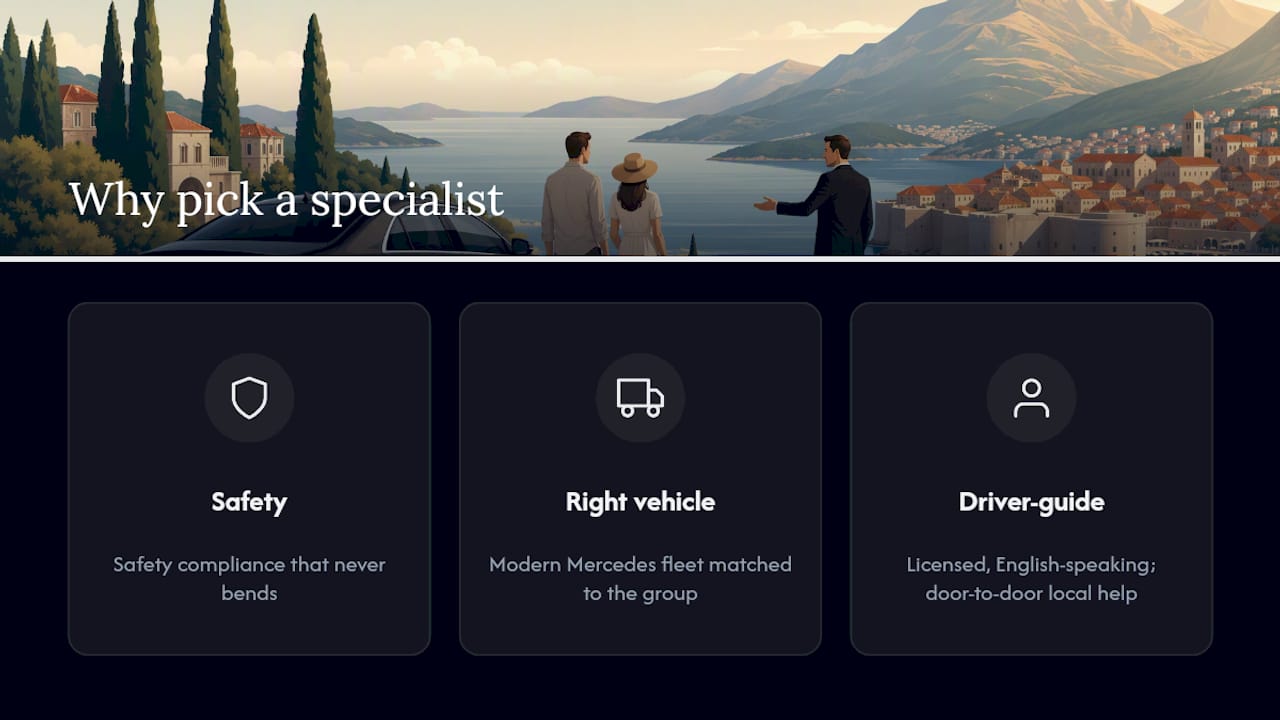
The gap between a good driver-guide and a mediocre one rarely shows up in the brochure. It shows up when a ferry runs late, a restaurant reservation falls through, or a family with young children needs a slower pace than the printed itinerary allows. Operators built around licensed, English-speaking drivers and a modern Mercedes fleet tend to handle those moments without friction, because door-to-door service and local knowledge are baked into how they train drivers, not bolted on afterward.
What sets a specialist apart is the combination: safety compliance that never bends, vehicles suited to the actual group, and a driver who treats your itinerary as a genuine plan rather than a script.
— Croatia
Ready to Book a Private Driver-Guide in Croatia?
A private transfer service gives you what an informal driver or a rental car cannot: a licensed, English-speaking professional who handles the logistics while you enjoy the ride. That means no parking searches, no navigating unfamiliar road signs, and no gambling on whether your driver actually knows the difference between a shortcut and a dead end.
Booking is straightforward. Have your travel dates, group size, and any specific interests (wine regions, coastal stops, UNESCO sites) ready when you reach out, and aim to book two to four weeks ahead for peak season or premium Mercedes classes. Drivers follow a strict zero-tolerance alcohol policy and operate modern, air-conditioned vehicles suited to groups. Start your booking through the private transfers Croatia page and lock in your dates before high-season availability tightens.
Where to Verify Croatia’s Driving Rules
- Alcohol limits and licensing: Ministry of the Interior (MUP)
- Booking a licensed driver-guide: Private Transfers Croatia
Sources
- Ministry of the Interior (MUP) — traffic rules and safety
- 01Portal — reporting on driving-age change in Croatia