


How to Arrange Intercity Transport: A U.S. Booking Plan
For most U.S. intercity trips, the most reliable workflow is to lock the constrained long-haul leg first, then arrange last-mile connections. Whether you’re crossing three states by train or coordinating a family group from door to door, the sequence matters more than the mode you choose.
Two steps you can take right now:
- Search long-haul availability on Amtrak or Greyhound for your travel dates before touching anything else.
- Reserve last-mile transport (a private transfer, Uber, or Lyft) only after the primary leg is confirmed, so your pickup times align with actual arrival windows.
“The structural load-bearing elements of your trip are the constrained legs with limited capacity. Changing them later costs real money.”
— Compass Draft multi-country booking guide
The U.S. Department of Transportation (DOT) licenses intercity carriers and sets baseline safety standards, so verifying a provider’s DOT authority is a practical first checkpoint before you pay.
Table of Contents
- Which transport option fits your trip?
- How to arrange intercity transport step by step
- Practical booking tips that save money and prevent surprises
- When does a private transfer make more sense than a taxi or ride-hail?
- What to confirm with any provider before you pay
- Why hub-and-spoke planning cuts total travel time
- What to do when your original plan falls through
- Key Takeaways
- Why the booking sequence matters more than the mode
- Plan your private intercity transfer with Croatia-private-transfers
- Useful sources and booking pages
Which transport option fits your trip?
The right mode depends on distance, door-to-door need, and how much flexibility you want to preserve. The table below maps the most common U.S. intercity options across the dimensions that actually affect your decision.
| Mode | Typical Cost | Door-to-Door? | Total Travel Time | Comfort / Privacy | Booking Lead Time | Luggage Policy | Flexibility | Coverage |
|---|---|---|---|---|---|---|---|---|
| Private transfer | Premium (flat rate) | Yes | Shortest (no transfers) | High / private | — | Agreed at booking | High (fixed schedule) | Custom routes |
| Train (Amtrak) | Mid-range | No (station-to-station) | Moderate | Comfortable, shared | 2 weeks | 2 bags free, fee after | Moderate (date changes) | Major corridors |
| Intercity bus (Greyhound, Megabus, FlixBus) | Budget | No (terminal-to-terminal) | Longer | Basic, shared | Days to weeks | 1–2 bags; fees vary | Low–moderate | Extensive |
| Ride-hail (Uber, Lyft) | Variable (surge pricing) | Yes | Short to moderate | Moderate, semi-private | Minutes | Limited (trunk space) | High | Urban/suburban |
| Plane | Variable (lowest if booked early) | No (airport-to-airport) | Shortest for 500+ miles | Moderate, shared | 3 weeks | Fees per airline | Low (change fees) | Major hubs |
Two clarifying points on how to read this table:
- For shorter trips, ride-hail or a private transfer often beats a plane once airport time is factored in. For distances above 500 miles, flying typically wins on total time.
- Greyhound covers 1,600+ destinations across the U.S., Canada, and Mexico, making intercity bus the strongest option for routes that bypass major airports. FlixBus adds modern vehicles with live tracking and digital ticketing on a growing U.S. network.
How to arrange intercity transport step by step
Treat your trip as a two-stage project: secure the constrained long-haul leg first, then fill in the connecting pieces. TripSpanner’s multi-modal planning guidance recommends defining origin and destination by exact address, identifying transport hubs, and booking long-haul legs 60–90 days out for routes with limited capacity.
- Define exact addresses. Write down your true origin and destination, including street addresses, not just city names. Door-to-door operators use this to plan routes and terminal approaches.
- Identify hubs if needed. Locate the nearest Amtrak station, bus terminal, or airport at each end of the trip.
- Research long-haul options. Compare train, bus, and flight schedules across your target dates before committing to any of them.
- Book the constrained leg first. Reserve the leg with the fewest alternatives (a specific train departure, a limited bus route) before prices climb or seats disappear.
- Secure connecting legs. Once the primary leg is fixed, book any intermediate surface transport or shuttle.
- Reserve last-mile transport. Arrange a private transfer, Uber, or Lyft pickup timed to your confirmed arrival. Last-mile logistics account for a significant share of travel friction and should never be left to chance.
- Confirm and store receipts. Save written booking confirmations, driver contact details, and cancellation terms in one place before travel day.
Before you pay, tick these off:
- Valid ID or passport matches the name on the booking
- Baggage dimensions and weight confirmed against the carrier’s policy
- Accessibility or child-seat requests submitted in writing
- Payment method accepted by the provider (credit card, not just debit card)
Pro Tip: Book your most constrained leg on a Tuesday or Wednesday morning, when seat inventory on Amtrak and budget bus carriers tends to be at its highest and prices are often lower than weekend release windows.
Practical booking tips that save money and prevent surprises
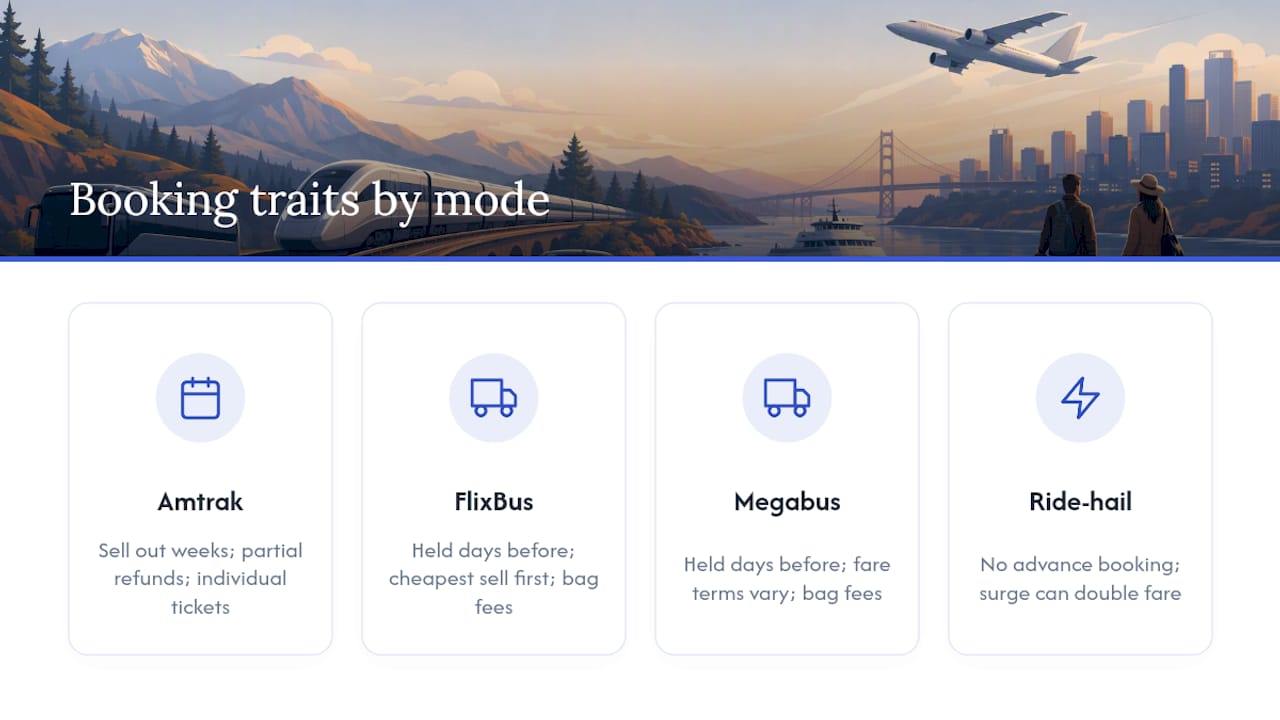
Lead times vary sharply by mode. Amtrak sleeper cars and popular Northeast Corridor trains can sell out weeks in advance, particularly around holidays. FlixBus and Megabus routes often hold seats until days before departure, but the cheapest fares go first. Ride-hail needs no advance booking, though surge pricing during peak hours can double the quoted fare.
Pricing is rarely flat. Seat class, time of booking, route seasonality, and luggage add-ons all shift the final number. A “budget” bus ticket can end up costing more than a train fare once checked-bag fees are added. Always price the full journey, not just the base ticket.
Group travel adds another layer. Most intercity carriers require individual tickets per passenger, and some bus operators charge extra for oversized bags or sports equipment. Private transfers, by contrast, price by vehicle rather than by head, which makes them genuinely cost-competitive for groups of four or more.
On refunds and cancellations: read the policy before you pay, not after. Amtrak offers partial refunds on most fares if canceled before departure; FlixBus and Megabus terms vary by fare type. Ride-hail cancellations within a short window typically incur a fee. For private transfers, cancellation windows and refund percentages are set by the operator, so request written terms upfront.
Payment security: use a credit card rather than a debit card for intercity bookings. Credit cards offer stronger dispute resolution if a carrier fails to deliver the service. Avoid wire transfers or cash payments to any provider you cannot verify through a DOT license number or state operating authority.
When does a private transfer make more sense than a taxi or ride-hail?
Private transfers occupy a distinct tier above ride-hail and well above public carriers. They suit specific situations where reliability, comfort, and door-to-door precision matter more than the lowest possible fare.
Situations that favor a private transfer:
- Complex multi-leg itineraries where a single driver handles multiple pickups or stopovers, removing the coordination risk of chaining separate bookings.
- Fixed-schedule travel (business meetings, VIP events, early flights) where a confirmed pickup time is non-negotiable.
- Groups with luggage, where a premium vehicle like a Mercedes minivan accommodates both passengers and bags without the scramble of multiple ride-hail cars.
- Early-morning or late-night departures, when ride-hail surge pricing is highest and availability is least predictable.
- Travelers who want a curated experience, with English-speaking drivers, planned stopovers, and a vehicle that reflects the quality of the trip itself.
The operational difference is meaningful. A private transfer fixes the pickup address, vehicle type, and driver contact before travel day. There is no dynamic pricing, no uncertainty about whether a driver will accept a long-distance fare, and no station-to-station constraint. Understanding why private transport earns its premium comes down to that reliability guarantee, especially when the cost of a missed connection is high.
For a detailed look at how luxury intercity transfers differ from standard taxi or ride-hail services, including vehicle standards and driver qualifications, Croatia-private-transfers outlines the full picture on its dedicated guide.
What to confirm with any provider before you pay
A written confirmation is not optional. Before completing any intercity booking, verify these specifics:
- Exact pickup and drop-off addresses, confirmed by the provider, not assumed from a city name.
- Driver contact method (direct phone number or app message thread) so you can reach them on travel day without going through a call center.
- Vehicle size and seat count, especially for groups or travelers with mobility equipment.
- Baggage allowance and any extra fees for oversized items, bicycles, or additional bags.
- Wait-time policy: how long will the driver hold at the pickup point, and what happens if your flight or train is delayed?
- Insurance and licensing: ask for the carrier’s DOT authority number or state operating license. Licensed carriers are required to carry liability insurance.
For coordinated airport pickups, the same principle applies: confirm the meet-point (arrivals hall, curbside, or parking lot) in writing before you land, not after.
Why hub-and-spoke planning cuts total travel time
The single most effective structural move in intercity travel planning is to identify the nearest major transport hub at each end of your trip and book the long-haul leg between those hubs first. This hub-and-spoke approach reduces total transit time because it anchors the itinerary around the most reliable, highest-frequency connections.
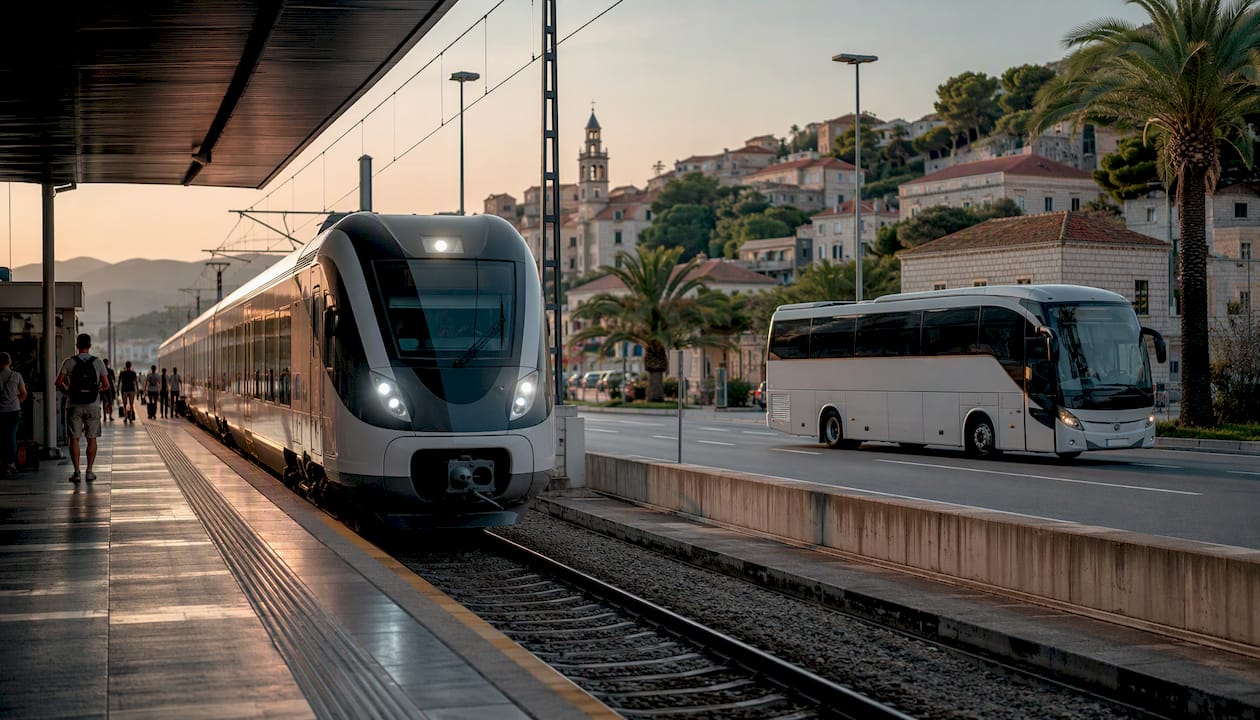
Buffer time is where most plans fail. Switching between different stations or terminals requires longer buffers than travelers typically allow. A train arriving at Penn Station and a flight departing from JFK are not a 45-minute connection, regardless of what a map suggests.
Pro Tip: When mixing modes on a U.S. intercity trip, build a minimum 90-minute buffer between a train arrival and a flight departure at a different terminal. For connections at the same terminal, allow a buffer of at least 60 minutes.
For business travelers, coordinated airport transfers that pre-position a driver at the arrival gate eliminate the buffer-eating scramble of finding ground transport after a delayed flight.
What to do when your original plan falls through
Sold-out routes and cancellations happen. The moment you learn your planned transport is unavailable, run through this sequence:
- Reroute via a nearby hub. If your direct bus or train is sold out, check whether a route through a larger city hub opens up alternatives.
- Combine bus and ride-hail. An intercity bus to the nearest large city, followed by a ride-hail for the final leg, often covers routes that have no direct service.
- Book a private transfer for the full leg. When public options are exhausted, a private transfer from door to door removes every intermediate dependency.
- Use hotel or airport concierge. On-the-ground staff often have direct contacts for local car services that don’t appear on aggregator platforms.
- Contact provider support immediately. The sooner you notify your original carrier of a disruption, the more options remain open for rebooking or refunds.
Key Takeaways
Arranging intercity transport efficiently requires booking the constrained long-haul leg first, confirming last-mile logistics in writing, and building buffer time into every mode switch.
| Point | Details |
|---|---|
| Book long-haul first | Reserve the leg with the fewest alternatives before prices rise or seats disappear. |
| Confirm in writing | Get exact pickup address, driver contact, vehicle details, and cancellation terms before paying. |
| Build buffer time | Allow at least 90 minutes between a train arrival and a flight at a separate terminal, and at least 60 minutes for connections at the same terminal. |
| Private transfers suit groups | A vehicle-priced private transfer is often cost-competitive for four or more travelers with luggage. |
| Croatia-private-transfers | For door-to-door intercity travel with licensed drivers and premium vehicles, book a private transfer directly. |
Why the booking sequence matters more than the mode
Most intercity travel guides focus on comparing prices. The more consequential question is sequencing: which leg do you lock first, and what happens if it changes?
The conventional advice to “compare all your options before booking” is sound in theory but dangerous in practice when applied to all legs simultaneously. Waiting to compare everything means the constrained leg (the overnight train, the limited bus route, the peak-season flight) sells out while you’re still evaluating ride-hail options for the last mile. The private transfer or ride-hail will almost always be available the day before departure. The Amtrak sleeper car will not.
For travelers who value comfort and reliability over the lowest possible fare, a private transfer removes the entire last-mile uncertainty from the equation. There is no surge pricing, no driver cancellation, and no guessing about whether a taxi will be available at 5:00 AM. That predictability has real monetary value when the alternative is a missed connection and an unplanned hotel night.
Plan your private intercity transfer with Croatia-private-transfers
For travelers who want the long-distance leg handled with precision and care, Croatia-private-transfers offers private door-to-door transfers with licensed, English-speaking drivers in premium Mercedes vehicles. The flat-rate pricing model means no surge surprises, and the confirmed pickup time is fixed before travel day, not negotiated on arrival.

This suits families, small groups, and business travelers who need a fixed schedule and a vehicle that accommodates both passengers and luggage without compromise. The booking process is direct: specify your exact pickup and drop-off addresses, confirm the vehicle type, and receive written confirmation with driver details. For anyone planning a multi-leg itinerary where the last mile cannot be left to chance, reserve your transfer and travel with the confidence that every detail is arranged before you leave home.
Useful sources and booking pages
| Resource | Description |
|---|---|
| Private Transfers Croatia | Book door-to-door private intercity transfers with licensed drivers. |
| Why Book Private Transportation | Guide to the benefits and use cases of private transfers. |
| Arrange Private Intercity Travel | Step-by-step booking guidance for private intercity trips. |
| Luxury Intercity Transfer Explained | Vehicle standards, driver qualifications, and service expectations. |
| Greyhound | Intercity bus tickets across 1,600+ U.S., Canadian, and Mexican destinations. |
| FlixBus | Budget intercity bus travel with live tracking and digital ticketing. |
| Compass Draft booking guide | Practical framework for sequencing multi-leg trip bookings. |
| Gopaxo multimodal guide | Buffer time and mode-switching guidance for complex itineraries. |