


Luxury Intercity Transfer Explained for Business Travelers
TL;DR:
- Luxury intercity transfers offer private, chauffeur-driven door-to-door service with fixed pricing, prioritizing schedule reliability and comfort. They benefit business travelers by saving time, ensuring privacy, and enabling productivity during transit, especially on routes over 90 minutes. Croatia-private-transfers provides licensed, English-speaking chauffeurs and premium vehicles across Croatia for seamless city-to-city journeys.
A luxury intercity transfer is a private, chauffeur-driven, door-to-door service that moves you between cities with fixed pricing, professional service, and zero shared passengers. Unlike a taxi hailed at the curb or a rideshare booked on the fly, it is pre-arranged, fully dedicated transport built around your schedule rather than a driver’s availability. The industry sometimes calls this a “long-distance chauffeured transfer” or “executive intercity transport,” and both terms point to the same core promise: predictable, comfortable, city-to-city travel with a professional at the wheel.
Who it fits: Business travelers, VIP guests, medical patients, and leisure travelers who place a premium on time, privacy, and comfort over cost alone.

Primary benefits: Fixed upfront pricing, a dedicated professional chauffeur, door-to-door continuity, and onboard amenities that let you work or rest in transit.
When to choose it: Tight schedules, multi-stop itineraries, high-value passengers, or any trip where a missed connection or a stressful arrival carries real consequences.

For business travelers specifically, the value proposition is straightforward: a luxury intercity transfer protects your schedule the way a first-class flight protects your seat. The vehicle is yours, the driver is focused entirely on your journey, and the clock works in your favor from the moment you step outside your door.
Table of Contents
- What does a luxury intercity transfer actually include?
- Why business travelers prefer luxury intercity transfers
- How does a luxury transfer differ from taxis, rideshares, and coaches?
- What vehicle types and amenities can you expect?
- Common intercity routes and use cases where private transfers excel
- How pricing works and what drives the cost
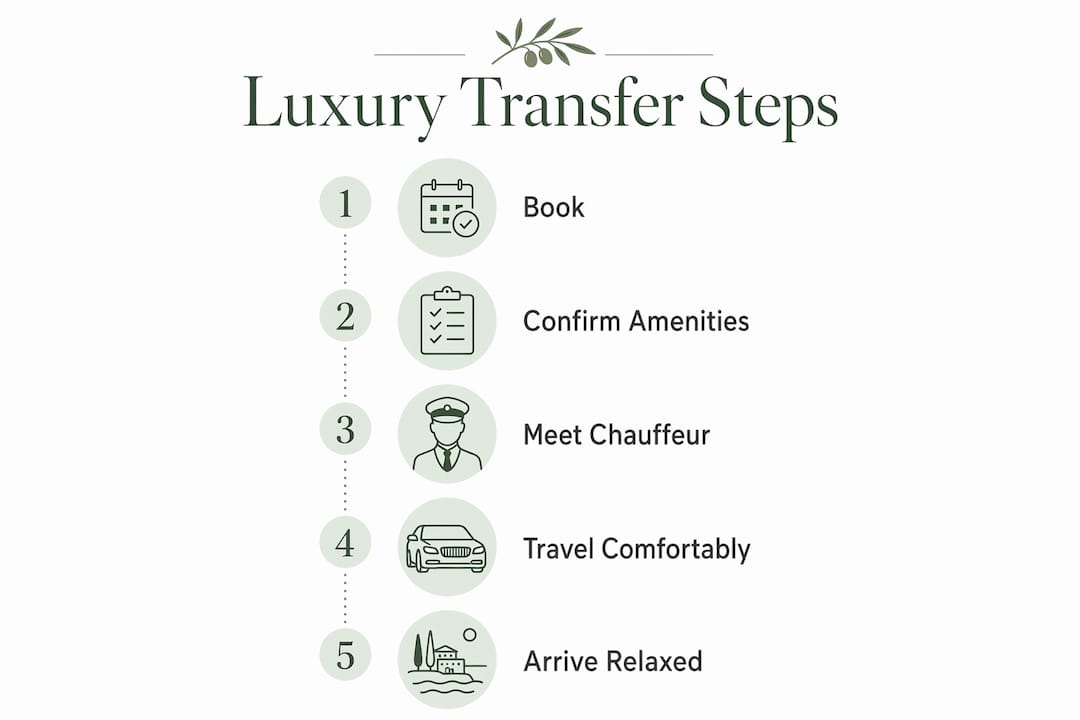
- What to expect on the day of your transfer
- How to choose the right luxury intercity transfer provider
- Why operational predictability matters: the research case
- Key Takeaways
- Why Croatia-private-transfers recommends this approach
- Croatia-private-transfers: private intercity transfers across Croatia
- Useful sources and further reading
What does a luxury intercity transfer actually include?
The service goes well beyond a comfortable car and a polite driver. When you book a premium transfer service, you are purchasing a managed travel experience with several concrete components.
- Exclusive vehicle use: No other passengers share your vehicle. The booking is entirely yours, whether you are traveling solo or with a group.
- Professional chauffeur: A trained, background-checked driver who handles meet-and-greet, luggage loading, and, where applicable, concierge-level assistance such as local recommendations or language support.
- Fixed upfront pricing: The rate is confirmed before departure. Fixed pricing and real-time monitoring eliminate the surge-pricing uncertainty common with app-based ride services.
- Operational monitoring: Flight and traffic tracking, proactive route adjustments, and scheduled wait-time allowances so delays do not cascade into missed appointments.
- Onboard amenities: Leather seating, extended legroom, climate control, Wi-Fi, power outlets, bottled water, and in many cases refreshments or privacy partitions.
- Flexibility: Scheduled stops along the route, itinerary modifications, and overnight driver options for long-haul legs.
Pro Tip: Ask your provider to confirm in writing which amenities are standard versus available on request. Wi-Fi and refreshments, for example, are included by default with most premium operators but may be add-ons with entry-level services.
Why business travelers prefer luxury intercity transfers
The clearest way to understand the appeal is through time. Every hour spent managing ground logistics — waiting for a rideshare, renegotiating a taxi fare, or navigating a coach terminal — is an hour not spent preparing for the meeting ahead. Chauffeur services protect that time by proactively managing schedule risk so the traveler never has to.
- Schedule reliability: The chauffeur tracks your flight or meeting schedule and adjusts pickup windows in real time, removing the uncertainty that public transport and taxis cannot eliminate.
- Productivity in transit: A private cabin with Wi-Fi and power outlets turns a two-hour intercity leg into a working session. Calls, document review, and meeting prep happen en route rather than in a hotel lobby after a stressful arrival.
- Privacy and discretion: Sensitive conversations, confidential documents, and VIP travel all benefit from a vehicle where no other passengers are present and the driver operates under professional confidentiality standards.
- Reduced travel fatigue: Leather seating, climate control, and the absence of crowded terminals or shared shuttles mean you arrive composed rather than drained.
Industry insight: Punctuality and a stress-free environment help travelers arrive refreshed and prepared for business engagements — and many corporate travel managers classify chauffeured intercity transfers as a legitimate business expense precisely because they protect schedule integrity and reduce the risk of missed meetings.
The productivity argument is particularly compelling on routes of 90 minutes or more. On a three-hour intercity leg, a business traveler who works throughout the journey effectively recovers that time entirely.
How does a luxury transfer differ from taxis, rideshares, and coaches?
The differences are sharpest where it matters most: predictability, privacy, and door-to-door continuity.
| Feature | Luxury intercity transfer | Rideshare / taxi | Coach / rail |
|---|---|---|---|
| Pricing model | Fixed upfront rate | Variable / surge pricing | Fixed fare, shared |
| Vehicle exclusivity | Fully private | Shared possible | Always shared |
| Meet-and-greet | Standard | Rarely included | Not included |
| Luggage handling | Chauffeur-assisted | Self-managed | Self-managed |
| Flight / traffic monitoring | Real-time, proactive | None | None |
| Door-to-door continuity | Yes | Partial | Terminal to terminal |
| Onboard amenities | Wi-Fi, refreshments, outlets | Minimal | Variable |
| Schedule flexibility | High | Moderate | Fixed timetable |
Fixed pricing and reliable pickups change the arrival experience in ways that matter for time-sensitive travelers. A rideshare surge during peak hours or a taxi queue at a busy terminal can add 30–45 minutes to a trip that was supposed to be simple. A coach or train, meanwhile, delivers you to a station rather than your destination, requiring a second vehicle and adding a transfer point where delays can compound.
The door-to-door continuity of a private transfer is its most underrated advantage. You are picked up at your hotel, office, or private residence and delivered to the precise address at your destination. No station connections, no luggage trolleys through crowded concourses. For a private transfer versus taxi comparison, the gap in service level becomes especially clear on longer intercity legs where driver professionalism and vehicle comfort accumulate into a meaningfully different experience.
When a luxury intercity transfer is cost-effective:
- Tight schedules where a missed connection carries financial or reputational consequences
- Multi-stop itineraries where a single vehicle eliminates repeated booking friction
- Groups where splitting the cost across passengers narrows the per-person premium
- High-value passengers where the cost of a poor experience outweighs the fare difference
What vehicle types and amenities can you expect?
Fleet options vary by provider, but most reputable luxury intercity operators offer four core vehicle classes. Matching the right vehicle to your group size and purpose is as important as choosing the provider itself.
- Executive sedan (3 passengers, 2–3 bags): The standard choice for solo executives or couples. Think Mercedes E-Class or S-Class: refined, quiet, and well-suited to working in transit.
- Luxury SUV (4–5 passengers, 4 bags): Elevated ride height, more luggage space, and a commanding presence. Preferred for small groups or travelers with substantial baggage.
- Premium MPV / van (6–7 passengers, 6–8 bags): Ideal for small corporate groups or families. Configured with captain’s chairs and ample cargo space.
- Minibus or coach (8–16+ passengers): For larger delegations, conference groups, or resort transfers where keeping the party together matters.
| Vehicle class | Typical seating | Luggage capacity | Best use case | Common amenities |
|---|---|---|---|---|
| Executive sedan | 1–3 | 2–3 bags | Solo executive, couple | Wi-Fi, outlets, water, leather seats |
| Luxury SUV | 1–5 | 4 bags | Small group, family | Wi-Fi, outlets, water, extra legroom |
| Premium MPV / van | 1–7 | 6–8 bags | Corporate group, family | Wi-Fi, outlets, refreshments, privacy |
| Minibus | 8–16+ | Large cargo | Delegations, events | Wi-Fi, climate control, group amenities |
Luxury transfers include hospitality-level service elements such as bilingual chauffeurs, bottled water, and elevated vehicle presentation comparable to a five-star hotel’s airport pickup. Fleet maintenance standards and driver training are part of what separates a genuine luxury operator from a standard car hire dressed up with a nice logo. Ask for fleet maintenance records and confirm that vehicles are commercially insured before you book.
The analogy to crewed hospitality holds here: just as crewed yacht charters deliver a seamless experience through trained staff and meticulously maintained vessels, a well-run luxury transfer operation delivers its quality through the same combination of people and equipment.
Common intercity routes and use cases where private transfers excel
Luxury intercity transfers are most commonly used on routes where the alternatives are genuinely inconvenient, time-consuming, or simply beneath the standard the traveler expects.
Typical route profiles:
- Regional business corridors (city center to city center, 60–200 miles) where no direct rail connection exists or where rail adds a terminal transfer
- Long airport-to-city runs (major international airports to resort towns or secondary cities) where shared shuttles are slow and taxis are unreliable
- Tourist-city circuits (coastal or cultural routes connecting two or more destinations in a single day)
- Cross-border transfers between neighboring countries or regions
Use cases by traveler profile:
- Corporate roadshow: An executive moving between three city offices in a single day books a single vehicle with a planned route, scheduled stops, and a driver who manages timing across all three legs.
- Multi-city meeting day: A legal team traveling from one metropolitan area to another for a morning deposition and an afternoon client meeting needs door-to-door reliability at both ends.
- Medical transfer: A patient traveling between a specialist clinic and home requires a comfortable, private vehicle with no shared passengers and a driver trained to accommodate medical needs.
- Luxury leisure transfer: A couple moving between a coastal resort and a wine-country estate for a weekend stay books an SUV with refreshments and a scenic route option.
- Group resort transfer: A corporate incentive group of twelve traveling from an international airport to a mountain lodge books a minibus with luggage handling and a coordinated arrival.
The timing advantage is clearest on routes of 90 minutes or more. Door-to-door service between urban centers combines comfort, privacy, and operational control in a way that no multimodal alternative can replicate at the same level of convenience.
How pricing works and what drives the cost
Luxury intercity transfer pricing follows a few consistent models, and understanding them helps you evaluate quotes accurately.
Pricing models:
- Distance-based flat rate: The most common structure. A fixed price is quoted for the full route before departure, with no meter running.
- Hourly rate: Used for as-directed bookings where the itinerary is flexible or multi-stop.
- One-way vs. roundtrip: Roundtrip bookings often carry a modest discount; one-way pricing on routes where the driver must return empty may include a repositioning fee.
- Packaged day rate: A full-day vehicle and driver rate, typically used for corporate roadshows or multi-stop leisure itineraries.
Primary cost drivers:
- Vehicle class (sedan vs. SUV vs. minibus)
- Distance and estimated travel time
- Waiting time beyond the included allowance
- Extra stops not specified at booking
- Driver overnight costs on very long routes
- Peak-season or event surcharges
- Airport or city-center access fees
Booking early gives you access to a wider fleet and more favorable rates, particularly during high-demand periods. Most premium operators recommend reserving at least 48 hours in advance for standard bookings and significantly earlier for large groups or specialized vehicles.
When comparing quotes, check for:
- Total door-to-door time (pickup window to drop-off), not just drive time
- Included waiting time at pickup
- Fuel, parking, or toll surcharges
- Gratuity policy (included vs. expected separately)
- Cancellation and modification terms in writing
Pro Tip: Convert the quoted travel time into a true door-to-door duration. Premium providers build in buffer time for urban delays and baggage processing; a quote that looks longer on paper often reflects a more honest estimate of when you will actually arrive.
What to expect on the day of your transfer
The day-of experience is where a luxury intercity transfer earns its reputation. Knowing what to expect removes any remaining uncertainty.
Meet-and-greet: Your chauffeur arrives at the agreed location, whether that is an airport arrivals hall, hotel lobby, or private residence, typically holding a name sign or making contact via the provider’s app. At airports, the driver monitors your flight in real time and adjusts the pickup window if your flight lands early or late.
Luggage handling: The chauffeur loads and unloads your bags. You do not manage your own luggage at any point during the transfer.
En route: The vehicle is yours. You can take calls, work quietly, or simply rest. Scheduled stops for fuel, comfort breaks, or scenic pauses can be arranged in advance or requested during the journey.
Driver conduct: Professional chauffeurs operate with discretion. Conversations are kept to what the passenger initiates, and sensitive discussions in the vehicle remain confidential.
Gratuity: Many luxury operators include gratuity in the quoted price. When it is not included, 10–15% is standard for intercity transfers in the United States. Confirm this at booking so there are no surprises at drop-off.
Delays and changes: If your plans shift en route, contact the provider directly. Reputable operators have dispatch support available to reroute or reschedule without penalty within the terms of their written modification policy.
- Red flag: A provider with no written cancellation or modification policy is one to avoid. The policy should be clear, specific, and provided before you pay a deposit.
How to choose the right luxury intercity transfer provider
The market ranges from genuine luxury operators to standard car services using premium-sounding language. These criteria separate the two.
Trust signals to verify:
- Licensed and commercially insured vehicles (not personal auto insurance)
- Driver background checks and professional licensing
- Fleet maintenance records available on request
- Written cancellation, modification, and refund policy
- Fixed upfront pricing confirmed in writing before deposit
Questions to ask before booking:
- Is the quoted price fixed, or can it change at drop-off?
- How much waiting time is included at pickup?
- What happens if my flight is delayed?
- Are extra stops charged separately, and at what rate?
- Is gratuity included in the quoted price?
- What is your cancellation policy, and is it in writing?
- Are your drivers background-checked and commercially licensed?
Red flags:
- Vague or verbal-only pricing with no written confirmation
- No driver verification process mentioned
- Poor reviews specifically citing punctuality or vehicle condition
- No written agreement before payment
For corporate bookers, also confirm:
- Invoicing format compatible with your expense system
- NDA or confidentiality agreement availability for VIP passengers
- Multilingual driver options if needed
- Account management for recurring or multi-leg bookings
Chauffeured hospitality standards at the top of the market include early arrival policies, trained chauffeurs, and consistent service across a managed fleet. Those standards are the benchmark worth holding any provider to.
Why operational predictability matters: the research case
The business case for luxury intercity transfers rests on a single mechanism: removing schedule uncertainty from the traveler’s hands and placing it in the provider’s.
Chauffeurs track schedules and adapt to delays, effectively purchasing the traveler’s time by eliminating the uncertainty found in public transport or taxi queues. The operational features that deliver this are specific: flight and traffic monitoring, driver early arrival, explicit wait-time allowances, and route contingency planning for multi-stop corporate itineraries.
- Fewer missed meetings: A driver who monitors traffic and adjusts the route in real time reduces the probability of a late arrival in a way that no self-managed transport option can match.
- Lower cognitive load: When ground logistics are managed externally, the traveler’s mental bandwidth stays available for the work ahead.
- Measurable time savings: On a 150-mile intercity leg, eliminating terminal transfers, luggage handling delays, and pickup uncertainty can recover 45–90 minutes of productive time compared to a multimodal alternative.
- Business expense justification: Punctuality and schedule protection are the reasons corporate travel managers classify chauffeured transfers as a legitimate business expense rather than a discretionary upgrade.
The ROI framing is straightforward. If a missed meeting costs more than the difference between a luxury transfer and a rideshare, the transfer is the rational choice. For most business travelers operating at a senior level, that calculation resolves quickly.
Key Takeaways
A luxury intercity transfer is the most reliable, productive, and private way to move between cities when your schedule and comfort cannot be left to chance.
| Point | Details |
|---|---|
| Core definition | A private, chauffeur-driven, door-to-door service between cities with fixed pricing and no shared passengers. |
| When to book one | Tight schedules, multi-stop itineraries, VIP travel, or any trip where a missed connection carries real consequences. |
| Business traveler value | Protects schedule integrity, enables productive transit, and is often classified as a legitimate business expense. |
| Trust signals to check | Licensed/insured vehicles, driver background checks, fleet maintenance records, and a written cancellation policy. |
| Croatia-private-transfers | Offers licensed, English-speaking chauffeurs in Mercedes-class vehicles for intercity and airport transfers across Croatia. |
Why Croatia-private-transfers recommends this approach
The case for luxury intercity transfers is not abstract. Every element of the service, from fixed pricing to real-time flight monitoring to a professionally trained chauffeur, exists to solve a real problem that standard transport leaves unsolved. Having operated private transfers and tailored itineraries across Croatia, the team at Croatia-private-transfers has seen firsthand how the door-to-door model changes the travel experience for business travelers and discerning leisure guests alike.
What strikes us most is how often travelers underestimate the cumulative cost of “good enough” ground transport. A delayed taxi, a shared shuttle that stops four times before your hotel, a rideshare driver unfamiliar with the route — each one is a small friction that adds up to a genuinely diminished arrival. The luxury intercity transfer model eliminates those frictions by design, not by accident.
The providers worth trusting are the ones who treat the transfer as a managed timeline, not a single transaction. That means contingency planning, written policies, and a chauffeur who arrives early rather than on time.
Croatia-private-transfers: private intercity transfers across Croatia
For travelers planning city-to-city journeys in Croatia, Croatia-private-transfers offers exactly the service this article describes: licensed, English-speaking chauffeurs, Mercedes-class vehicles, fixed upfront pricing, and door-to-door service between Croatia’s major cities, airports, and coastal destinations.
Whether you are moving between Zagreb and Split for a business meeting, transferring from Dubrovnik Airport to a coastal resort, or planning a multi-stop leisure itinerary that takes in the Dalmatian coast, Croatia-private-transfers handles the logistics so you arrive composed and on schedule. Every booking includes meet-and-greet service, luggage handling, and real-time monitoring, with no hidden surcharges and a clear written cancellation policy.
Book your private intercity transfer directly through Croatia-private-transfers, or explore the full range of luxury travel services including bespoke tours and custom itineraries for travelers who want more than just a ride from one city to the next.
Useful sources and further reading
The following sources informed this article and offer reliable further reading for travelers and corporate bookers evaluating luxury intercity transfer options.
- Why chauffeured airport transfers are best for travelers — Covers fixed pricing, real-time monitoring, and meet-and-greet protocols; directly supports the pricing and operational predictability claims in this article.
- Top 10 benefits of using a chauffeur service for business travel — Industry commentary on punctuality, schedule protection, and the business-expense rationale for chauffeured services.
- How airport transfers make business travel more efficient and relaxed — Explains the “time-protection” concept and the operational mechanisms (flight tracking, route replanning) that deliver it.
- What Are Long Distance Limo Transfers and Who Needs Them? — Defines long-distance chauffeured transfers and covers door-to-door continuity for intercity routes.
- Luxury Airport Transfers: Are They Worth the Cost? — Reviews amenity standards and hospitality-level service elements that distinguish luxury operators from standard car hire.
- 9 Premium Airport Transfer Benefits That Matter — Emphasizes fixed pricing and reliable pickups as the deciding factors for premium bookings.
- Croatia-private-transfers: private transfers and intercity services — The booking and service page for travelers planning intercity or airport transfers across Croatia; recommended as the next step for readers ready to confirm a journey.