


Personalized Travel Definition: What It Means for You
TL;DR:
- Personalized travel designs trips around an individual’s preferences, constraints, and lifestyle rather than a fixed itinerary. It offers deeper customization through AI tools and human expertise to create unique experiences that reflect the traveler’s true identity. This approach enhances emotional fulfillment, saves planning time, and ensures accessibility and authenticity, making it the future of meaningful tourism.
Personalized travel is defined as a trip designed specifically around an individual’s preferences, constraints, and lifestyle rather than a standardized package itinerary. Unlike a group tour that follows a fixed route, personalized itineraries adapt pacing, activities, and logistics to fit who you are as a traveler. This model spans everything from AI-powered planning tools that generate itineraries in minutes to human concierge services that orchestrate complex multi-country trips. The result is travel that feels less like a product and more like an extension of your own life.
What is the personalized travel definition, and how does it work?
Personalized travel is the practice of creating itineraries aligned to individual preferences, offering greater freedom than traditional packages. The industry term you will encounter most often is customized travel, though “personalized travel” and “bespoke travel” are used interchangeably depending on the provider and the depth of customization involved. Understanding the distinction between these terms matters because it shapes what you can realistically expect when you book.

At its most basic level, personalized travel means your destination, accommodation, pace, and activities are chosen for you specifically, not for a demographic average. A family traveling with a child who uses a wheelchair needs more than a destination swap. They need a provider who has verified accessibility at every stop, confirmed dietary options at each restaurant, and arranged transport that accommodates mobility equipment. That level of fit is what separates genuinely personalized travel from a trip that simply lets you pick your hotel category.
The customized travel market now encompasses services including personalized planning, tailored itineraries, and concierge services at scale. This means the concept has moved well beyond luxury travel agencies. Today, a solo budget traveler using an AI itinerary app and a high-net-worth couple working with a private travel designer are both engaging with forms of personalized travel, just at different price points and depths.
How does personalized travel differ from curated, bespoke, and traditional itineraries?
Industry terminology reflects increasing levels of customization: curated, personalized, bespoke, and hyper-personalized itineraries each represent a deeper degree of individual fit. Knowing where your trip falls on this spectrum helps you select the right provider and set accurate expectations before you book.
A curated itinerary is pre-selected by an expert based on general traveler preferences, such as “art lovers in Rome” or “adventure seekers in Patagonia.” It is thoughtful and well-researched, but it is not built around you specifically. A personalized itinerary takes your stated preferences as the starting point and builds from there. A bespoke itinerary goes further still, incorporating subjective preferences, hard constraints like accessibility or dietary needs, and real-time availability to produce something that could not be replicated for another traveler.
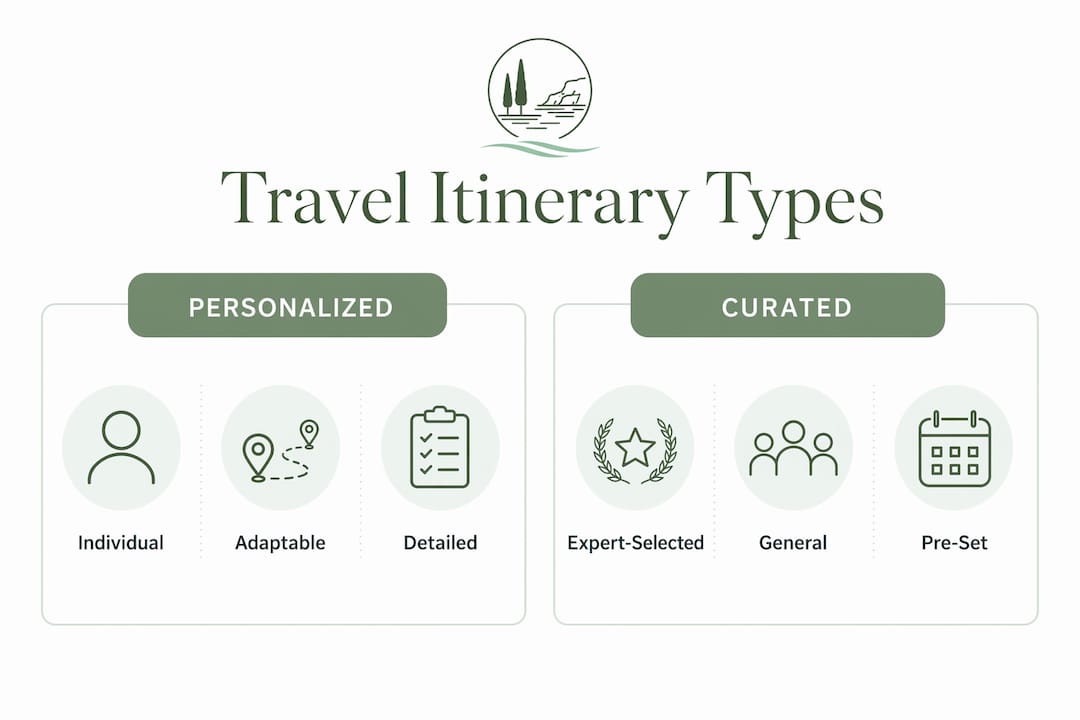
Traditional package tours sit at the opposite end of the spectrum. They are standardized, cost-efficient, and designed for the widest possible audience. They work well for travelers who want simplicity and predictability, but they offer no meaningful adaptation to individual needs.
| Type | Customization level | Who it suits |
|---|---|---|
| Traditional package tour | Fixed itinerary, no adaptation | Budget travelers, first-time visitors |
| Curated itinerary | Expert-selected for a traveler type | Interest-based travelers |
| Personalized itinerary | Built from your stated preferences | Most modern independent travelers |
| Bespoke itinerary | Fully adapted to preferences and constraints | Luxury, accessibility, or complex trip needs |
The practical implication is clear: the further right you move on this table, the more your trip reflects your actual life rather than a marketing persona. For travelers with specific medical, dietary, or mobility requirements, only bespoke or deeply personalized planning genuinely delivers.
What roles do AI technology and human expertise play in creating personalized travel experiences?
AI and human planners are not competing approaches. They are complementary tools that serve different stages and segments of the personalization process. AI agents on platforms like Amazon Bedrock can match real-time flight and hotel availability to customer constraints within seconds, a task that would take a human advisor hours. That speed advantage is real and significant.
However, AI personalization works best when it orchestrates across multiple real-time inventory systems rather than generating content in isolation. An AI tool that suggests a restaurant without checking current opening hours or a hotel without verifying accessibility features is not truly personalizing your trip. It is producing plausible-sounding content that may not hold up in practice.
Human advisors carry a different kind of value. They read between the lines of what a client says, recognize when a stated preference conflicts with an unstated constraint, and take accountability for the outcome. Over 60% of travelers cite AI accuracy as a barrier to full adoption, which explains why luxury travelers in particular still prefer human advisors for complex trips. Trust is not a soft metric here. It directly determines which planning method a traveler chooses.
Traveler segments use these tools very differently:
- Budget travelers rely on AI primarily for cost comparison and basic itinerary structure.
- Family travelers use AI to identify child-friendly options but often verify details with a human.
- Luxury travelers prefer human advisors for orchestration and accountability, using AI only for research.
- Accessibility-focused travelers require human verification at every step because AI tools rarely confirm physical access conditions with sufficient accuracy.
Pro Tip: If your trip involves more than two countries, a medical requirement, or a once-in-a-lifetime event like a wedding or milestone anniversary, work with a human travel designer rather than relying solely on an AI tool. The cost of a planning error at that scale far outweighs the fee.
What are the key benefits and advantages of choosing personalized travel?
The most significant advantage of personalized travel is emotional, not logistical. Modern travelers prioritize identity-driven experiences that mirror their values and lifestyle over sightseeing checklists. A trip that reflects who you are produces a fundamentally different memory than one designed for the average tourist. That distinction is why personalized travel transforms tourism from a transactional purchase into an emotional experience.
The practical benefits are equally compelling:
- Time saved in planning. Thomas Cook India’s AI platform reduced vacation planning time from 48 to 72 hours down to under 10 minutes for many travelers. That is not a marginal improvement. It represents a complete restructuring of how trips are designed.
- Optimized itineraries. A personalized itinerary eliminates the dead time that plagues package tours: the stops that don’t interest you, the restaurants chosen for group logistics rather than quality, the pace that suits no one perfectly.
- Constraint accommodation. Travelers with mobility limitations, dietary restrictions, or medical needs receive itineraries where every stop is verified against their specific requirements, not just flagged as “accessible-friendly.”
- Authentic local access. Personalized trips, especially those arranged through providers with genuine local knowledge, open doors to experiences that standard tours never reach: private wine cellars, off-season coastal routes, family-run restaurants with no online presence.
The real benefits of tailored itineraries extend beyond comfort. They include a measurable reduction in travel stress, because every logistical decision has already been made with your specific situation in mind.
How can travelers practically create personalized travel experiences?
Designing a genuinely personalized trip requires more than listing your favorite activities. It demands a structured approach to communicating who you are as a traveler, what you cannot compromise on, and what you are willing to leave open to discovery. Follow these steps to get the most from any personalization process:
- Document your constraints first, preferences second. Mobility requirements, dietary restrictions, budget ceilings, and travel dates are non-negotiable parameters. State them explicitly before discussing destination preferences.
- Choose the right planning tool for your trip complexity. For a straightforward city break, AI tools like TripIt, Wanderlog, or Google Travel provide solid personalized structure. For multi-destination or constraint-heavy trips, a human travel designer or specialized private tour operator delivers more reliable results.
- Layer your personalization. The most effective itineraries combine stated preferences with real-time data and hard constraints. A provider who asks only “where do you want to go?” is not offering true personalization. Look for one who asks about pace, group dynamics, physical requirements, and interests at the same time.
- Verify credibility before booking. Check that your provider uses licensed guides, confirmed local partnerships, and transparent booking procedures. For private transport, confirm vehicle class, driver language proficiency, and door-to-door service details.
- Build in flexibility. The best personalized itineraries include structured options rather than rigid schedules. A thoughtfully paced day with two or three alternatives at each stop adapts to weather, energy, and spontaneous discovery far better than a minute-by-minute plan.
Pro Tip: When evaluating a private tour or transfer provider, ask specifically how they handle last-minute changes. A provider who can reroute, reschedule, or substitute an activity on the day is offering genuine personalization. One who cannot is offering a curated package with a personalized label.
For travelers exploring Croatia specifically, private tours in Croatia illustrate this layered approach well. Routes between Split, Dubrovnik, and Plitvice Lakes can be adjusted in real time based on traveler pace, weather conditions, and personal interests, something no group tour can replicate.
Key takeaways
Personalized travel delivers the most meaningful experiences when it adapts to both your preferences and your constraints, not just your destination choices.
| Point | Details |
|---|---|
| Definition clarity | Personalized travel is built around individual constraints and preferences, not traveler demographics. |
| Terminology matters | Curated, personalized, and bespoke itineraries represent distinct levels of customization with different provider expectations. |
| AI and human roles | AI excels at speed and data matching; human advisors provide accountability and nuanced judgment for complex trips. |
| Emotional value | Personalized travel produces identity-driven experiences that standard tourism cannot replicate. |
| Practical steps | Documenting constraints before preferences and verifying provider credibility are the two most critical planning actions. |
Why personalized travel is the future of meaningful tourism, from where I stand
I have watched the travel industry shift over the past decade, and the change is not subtle. Travelers who once booked a package tour because it was the easiest option are now actively seeking something that feels like it was made for them. That shift is not driven by marketing. It is driven by a growing awareness that time spent traveling is finite, and spending it on experiences that don’t fit your actual life is a genuine loss.
What I find most interesting is the tension between AI efficiency and human depth. AI tools have genuinely transformed the speed of itinerary creation, and that matters. But the travelers who return most satisfied are almost always those whose trips were shaped by someone who understood not just what they wanted, but why they wanted it. That “why” is something no algorithm has reliably captured yet.
The future of personalized travel is not AI replacing human expertise. It is AI handling the data-heavy logistics while human planners focus on the interpretive, relational work that produces truly memorable experiences. For destinations like Croatia, where the difference between a tourist route and a breathtaking hidden cove is local knowledge accumulated over years, that human layer remains irreplaceable.
— Croatia
Experience personalized travel in Croatia with Croatia-private-transfers
Croatia-private-transfers brings the personalized travel definition to life through private transfers in Croatia and bespoke day tours designed around your schedule, pace, and interests. Whether you are arriving at Split Airport and heading to a private villa on the Dalmatian coast, or planning a full-day visit to Plitvice Lakes with stops tailored to your group’s pace, every detail is arranged with your specific needs in mind. Licensed, English-speaking drivers in modern Mercedes-class vehicles handle the logistics while you focus on the experience. Explore luxury bespoke tours in Croatia and discover what travel designed entirely around you actually feels like.
FAQ
What is the personalized travel definition in simple terms?
Personalized travel is a trip designed specifically around your preferences, constraints, and lifestyle rather than a fixed group itinerary. It adapts pacing, activities, accommodation, and logistics to fit you as an individual traveler.
How does personalized travel differ from a package tour?
A package tour offers a standardized itinerary designed for the broadest possible audience, while personalized travel builds the itinerary from your specific requirements. The key difference is that personalized travel accommodates constraints like accessibility, dietary needs, and travel pace that package tours cannot address.
Can AI really create a personalized travel itinerary?
AI tools can reduce planning time dramatically, cutting it from days to under 10 minutes in some cases, but they work best when connected to real-time inventory data. For complex or constraint-heavy trips, human advisors remain more reliable because over 60% of travelers still cite AI accuracy as a concern.
What is the difference between bespoke and personalized travel?
Personalized travel adapts a trip to your stated preferences, while bespoke travel goes further by incorporating subjective tastes, hard constraints, and real-time availability into a fully custom experience that could not be replicated for another traveler.
What are the main advantages of personalized trips?
The core advantages include emotional fulfillment from identity-driven experiences, time saved in planning, optimized itineraries without irrelevant stops, and accommodation of specific constraints like mobility or dietary requirements that standard tours routinely overlook.