


The Real Role of Itinerary Customization in Travel
TL;DR:
- Thoughtful itinerary customization enhances emotional comfort and reduces decision fatigue during travel.
- Utilizing buffer time, geographic planning, and early communication ensures flexible, enjoyable trips aligned with personal preferences.
Most travelers approach trip planning with a simple goal: pick the highlights, book the hotels, and hope everything holds together. That mindset works until day two, when you realize the schedule is crushing you and half the activities feel wrong. The role of itinerary customization goes far deeper than swapping one museum for another. Thoughtful personalization, what travel professionals call bespoke itinerary design, shapes your emotional experience of a trip from the first morning to the last. This guide covers what customization actually does, how to do it well, and where most travelers quietly go wrong.
Key Takeaways
| Point | Details |
|---|---|
| Customization reduces decision fatigue | Tailored itineraries remove guesswork and keep you focused on experiencing, not deciding. |
| Buffer time is intentional, not optional | Scheduling 30 to 60 minutes of slack around anchor activities protects your entire day from unraveling. |
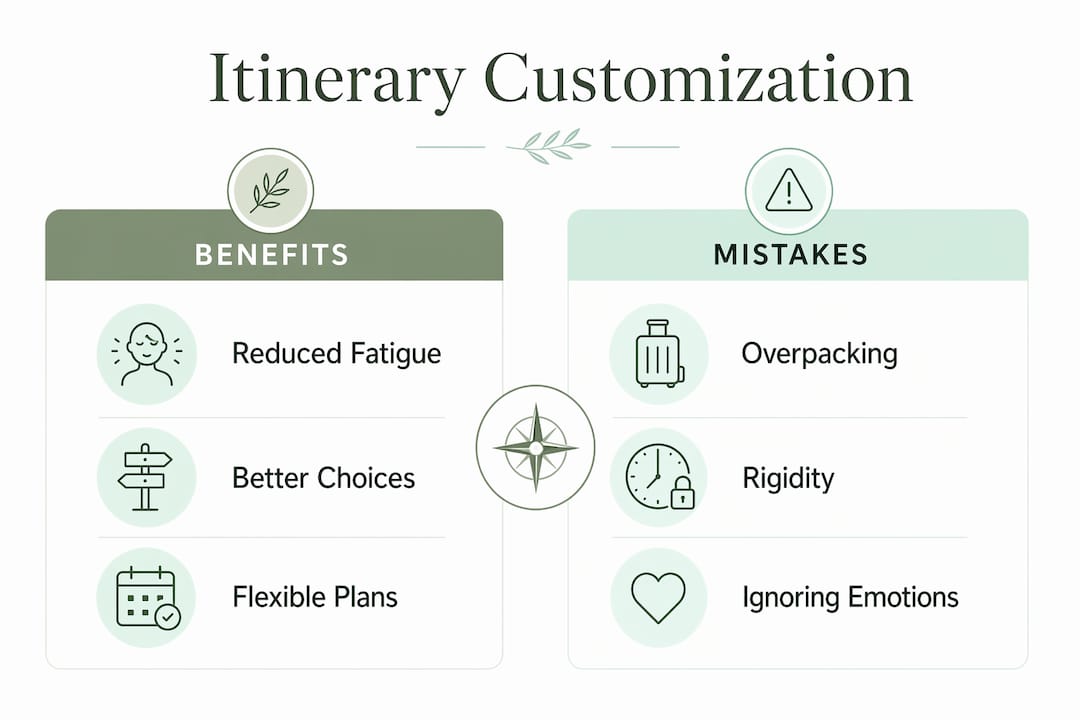
| Overpacking your schedule backfires | Rigid, hour-by-hour planning kills spontaneity and raises stress rather than reducing it. |
| AI tools improve real-time adaptability | Time-aware AI models now adjust itineraries dynamically based on your preferences and constraints. |
| Early communication unlocks options | Sharing your interests with a travel provider before booking gives you access to the widest range of customization choices. |
The role of itinerary customization in your travel experience
The standard travel industry term for tailored trip design is bespoke itinerary planning, and it covers far more than activity selection. At its core, the role of itinerary customization is to align every element of your trip with how you actually travel: your pace, your priorities, your tolerance for crowds, and even your need for downtime.
Here is what that alignment does in practice:
- Reduces decision fatigue. Bundled customization consolidates car rental, lodging, and activities into unified reservations with options you choose in advance, so you are not making exhausting micro-decisions on the road.
- Builds emotional comfort. Knowing your day reflects your actual preferences lowers anxiety and makes you feel more in control. Research confirms that personalization lowers cognitive load and improves emotional wellbeing during travel.
- Improves quality consistency. When your itinerary is designed around your profile rather than a generic group, each experience lands closer to what you actually value.
- Strengthens the traveler-provider relationship. Tailored itineraries build loyalty by demonstrating that a provider has listened and responded specifically to your needs.
Consider how California Viva Holidays approached this for Australian travelers in 2026. Their self-drive itineraries bundle the practical logistics while leaving meaningful room for personalization when travelers communicate preferences early. Families planning a Southern California road trip, for example, receive age-appropriate accommodations and capped daily drives of four to six hours so nobody arrives exhausted.
The insight here is not just that customization makes trips more pleasant. It changes how confidently you make decisions throughout the trip, which reduces the low-grade stress that quietly drains enjoyment from even stunning destinations.
Pro Tip: Ask your travel provider specifically what you can change after booking. Many travelers do not realize that details like departure times, meal preferences, or stop locations can often be adjusted even after an initial confirmation.
Key strategies for building a personalized itinerary
Knowing you want a personalized itinerary is different from knowing how to build one. These strategies translate the importance of trip planning from theory into a schedule that actually holds up.
-
Anchor one or two timed commitments per day. Choose your must-do activity for the morning and leave the afternoon open, or vice versa. This prevents overbooking while protecting the experiences that matter most to you.
-
Treat buffer time as a protected appointment. Scheduling 30 to 60 minutes of slack before and after anchor activities is not wasted time. It absorbs delays, accommodates unexpected discoveries, and keeps the rest of your day intact. Think of it the same way you would a flight connection window: cutting it too close always costs you.
-
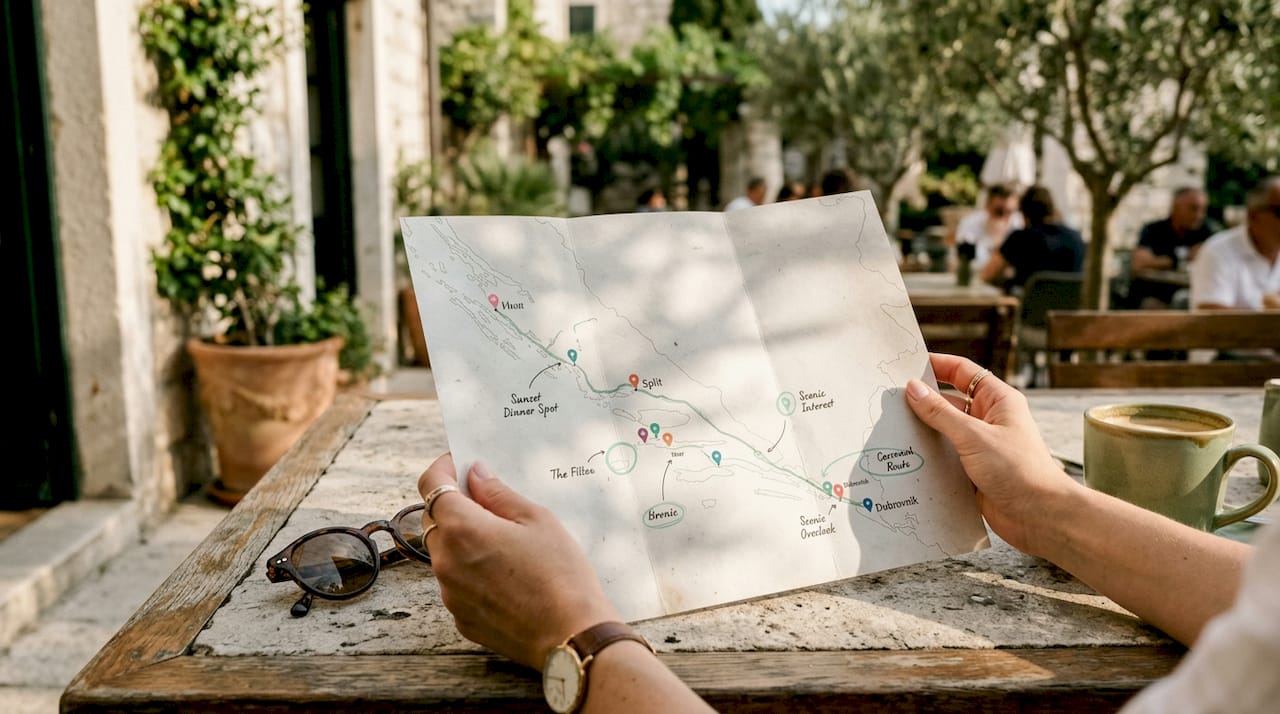
Plan by geographic zone, not category. Grouping activities by location rather than type (all museums on Tuesday, all beaches on Wednesday) eliminates the transit friction that turns a relaxed day into an exhausting commute. On a Croatia trip, for instance, clustering a morning at Plitvice Lakes with an afternoon visit to a nearby village is far less draining than zigzagging back to the coast and out again.
-
Build an options bench. Create a short list of three to five activities you would enjoy but have not committed to. When your anchor activity finishes early or the weather shifts, you have curated alternatives ready without the pressure of researching in the moment.
-
Communicate your interests before you book, not after. The widest customization options are available during the planning phase. Once logistics are locked, changing them costs more time and sometimes money.
-
Use a flexible itinerary as an interactive guide. The best plans avoid rigid scripting and treat the schedule as a tool you work with rather than a contract you follow. If a village market is more interesting than the planned afternoon, adjust without guilt.
Pro Tip: When traveling with a group, poll everyone for their single non-negotiable experience before you plan anything else. Build the itinerary around those anchors first, then fill in the gaps collaboratively. This prevents post-trip resentment and ensures everyone feels the trip was designed for them.
Common customization mistakes and how to avoid them
The importance of itinerary customization is easy to understand in principle. In practice, many travelers still fall into patterns that undermine the very benefits they were trying to create.
Here is a clear comparison of what poor versus thoughtful customization looks like:
| Mistake | What it looks like | Better approach |
|---|---|---|
| Overpacking the schedule | 8 activities planned before noon | 2 anchors per day with open blocks |
| Ignoring emotional needs | All sightseeing, no rest or indulgence | Mix active and restorative experiences |
| Late preference communication | Mentioning dietary needs at check-in | Sharing all preferences at booking |
| Skipping buffer time | Back-to-back transfers and tours | 30 to 60 minutes of slack between events |
| Treating the plan as fixed | Refusing to drop a disappointing stop | Adjusting dynamically when something is not working |
Scheduling rigidity and decision fatigue are the two most consistent culprits when travelers report a trip felt exhausting rather than restorative. A beautifully curated list of sites means nothing if you are too worn out to appreciate them by day three.
The emotional dimension often gets overlooked entirely. You might plan an itinerary that looks impressive on paper yet ignores whether you recharge through solitude or connection, through adventure or reflection. A trip designed for the “ideal traveler” rather than you is simply a different kind of generic.
Failing to use AI-powered travel tools also represents a missed opportunity for dynamic adaptation. These tools can flag when a schedule is unrealistically dense, suggest reordering stops to reduce transit, or alert you to closures before you discover them in person.
How technology shapes personalized itineraries
The future of custom travel experiences is already arriving, and it is more practical than you might expect. AI planning tools are moving well beyond simple suggestions toward genuine real-time travel companions.
New time-aware AI models are the most significant development in this space. These systems incorporate not just your stated preferences but also real-world constraints like venue hours, local traffic, and seasonal conditions. Research from 2026 shows that time-aware adversarial AI models improve itinerary accuracy by 5.5% compared to standard benchmarks, with recall improving by 8.2% and F1 scores rising by 7.3%. In practical terms, that means fewer wasted stops and more experiences that actually fit your day.
The during-trip dimension is equally compelling:
- Real-time adjustment. AI companions can reroute your afternoon when a planned stop closes unexpectedly, pulling from your options bench to recommend alternatives that match your pace and interests.
- Emotional support, not just information. ChatGPT’s social support function has been shown to be a critical factor in traveler satisfaction during dynamic in-trip decisions. The benefit is not just that the AI has the right answer. It is that having a responsive, knowledgeable companion available around the clock reduces the anxiety of uncertain moments.
- Spatiotemporal optimization. Advanced systems can dynamically update plans based on traveler feedback mid-trip, learning what you responded well to on day one and weighting similar experiences more heavily on day three.
- Booking integration. The most capable platforms connect directly with transfer and accommodation providers, making the automation of reservations part of the same adaptive loop.
Technology does not replace the judgment of an experienced local guide or a well-designed private tour. It amplifies both by handling the logistical complexity so your attention stays on the experience itself.
My perspective on personalized travel planning
I have worked with travelers across Croatia for years, and the pattern I see most often is this: the people who plan the most exhaustive itineraries frequently enjoy their trips the least. That sounds counterintuitive, but overly rigid schedules create a particular kind of stress that no amount of beautiful scenery can fully offset.
What I have learned is that the best itineraries contain deliberate empty space. Not because there is nothing worth doing, but because the moments that travelers remember most vividly are often unplanned. A conversation with a winemaker in Istria. A quiet hour on a Dalmatian terrace watching the light change over the water. Those experiences require time to happen.
I also believe most travelers underestimate the power of communicating preferences early. I have seen a simple conversation before departure transform a perfectly adequate tour into something genuinely memorable, simply because the guide knew where to linger and where to move on. The impact of itinerary changes made at the right moment, by someone who understands your interests, is difficult to overstate.
My honest advice: treat your itinerary as a living document. Commit to the anchors, protect your buffer time, and give yourself permission to follow what surprises you. The real benefits of tailored itineraries show up most clearly when travelers stay flexible enough to receive them.
— Croatia
Plan your Croatian adventure with expert support
Knowing the principles of thoughtful customization is one thing. Having a team with deep local knowledge execute them on your behalf is another level entirely. Croatia-private-transfers specializes in exactly that kind of curated, attentive private travel across Croatia.

Whether you are arranging private transfers across Croatia from Split to Dubrovnik, or designing a day around Plitvice Lakes and a hidden inland village, every detail adapts to your group’s pace and interests. Travelers choosing custom day trips in Croatia report 35% higher satisfaction than those on standard group tours, and it is easy to see why. When your driver speaks English, your route reflects your priorities, and your stops are chosen for you specifically, every hour of the day feels worth it. Explore the full range of luxury travel services and find the itinerary that fits you perfectly.
FAQ
What is itinerary customization and why does it matter?
Itinerary customization, also called bespoke itinerary design, is the practice of tailoring every element of a trip to a traveler’s specific interests, pace, and preferences. It matters because personalized plans reduce decision fatigue, lower travel stress, and produce significantly higher satisfaction than standard group itineraries.
How much buffer time should I add to my itinerary?
Travel planning experts recommend scheduling 30 to 60 minutes of buffer time before and after each anchor activity. This slack absorbs unexpected delays and prevents one disruption from collapsing the rest of your day.
Can I customize a private transfer itinerary after booking?
In many cases, yes. Providers like Croatia-private-transfers allow travelers to adjust stop locations, departure times, and route details, particularly when changes are communicated early. The broader your customization request, the better your outcome when raised during the planning phase rather than on the day of travel.
How do AI tools improve personalized travel planning?
Time-aware AI planning models improve itinerary accuracy by 5.5% and recall by 8.2% compared to standard benchmarks by integrating real-world constraints like venue hours, traffic, and traveler feedback. During a trip, AI companions also improve decision confidence by providing responsive, contextually aware support.
What is the biggest mistake travelers make when customizing their itinerary?
The most common error is overpacking the schedule. Scheduling rigidity and decision fatigue consistently reduce trip enjoyment, even when the individual activities are excellent. Anchoring one to two timed commitments per day and leaving open blocks gives your itinerary room to breathe.