

Which Type of Luxury Vehicle Should You Book for Your Transfer?
For most private transfers, a luxury sedan comfortably handles one or two travelers with up to three standard suitcases, while a luxury SUV suits small groups or extra bags, and an executive van or Sprinter is the safest bet for six or more passengers, oversized luggage, or a mixed group with children. The category names, industry-speak like PHV (private hire vehicle), and even the small print vary between providers, so a shared decision rule helps.
Before booking, check two things:
- Your exact passenger count, including children who need a seat.
- Every confirmed piece of luggage, from carry-ons to golf bags or extra equipment cases.
Pro Tip: If you’re unsure between two vehicle classes, book the larger one. Operators routinely advise clients to size up rather than risk a cramped ride, since downgrading at the curb almost never works. Once you know your numbers, Croatia Private Transfers & Tours can match you to the right car within minutes.
Key Takeaways
Matching passenger count and luggage volume to the correct vehicle class is the single decision that prevents most transfer-day problems.
| Point | Details |
|---|---|
| Sedans fit small groups | One to three passengers with two to three large suitcases fit comfortably in an executive sedan. |
| SUVs bridge groups and gear | Four to six passengers or extra luggage call for a luxury SUV or premium MPV. |
| Vans handle scale | Six to fourteen passengers or heavy, oversized luggage need an executive van or Sprinter. |
| When unsure, upsize | Booking a larger class avoids the day-of friction caused by downgrading at pickup. |
| Confirm extras early | Child seats, accessibility needs, and amenities should go on the booking confirmation, not be requested at pickup. |
| Croatia Private Transfers & Tours fits every scenario | Its fleet of Mercedes-class sedans and minivans, run by licensed English-speaking drivers, covers transfers from solo airport trips to multi-day tours. |
Table of Contents
- What Are the Main Types of Luxury Vehicles for Private Transfers?
- How Should You Choose the Right Vehicle When Booking?
- How Many Passengers and Suitcases Fit in Each Vehicle?
- What Amenities and Extras Can You Request?
- What Drives the Price and Timing of a Luxury Transfer?
- Does Fuel Type Affect Your Luxury Transfer Experience?
- What Should You Expect from a Professional Chauffeur?
- How Do Comfort and Technology Differ Across Vehicle Classes?
- Why Matching the Vehicle to the Itinerary Matters
- Book the Right Vehicle with Croatia Private Transfers & Tours
- Sources
What Are the Main Types of Luxury Vehicles for Private Transfers?
Private chauffeur fleets generally fall into five categories, and understanding them is the fastest way to book correctly the first time. Each class serves a distinct group size, luggage load, and travel purpose, and knowing the difference between “luxury SUV options” and a full-size executive van saves you from an uncomfortable surprise on pickup day.
Executive sedan. Seats one to three passengers and typically holds two to three large suitcases plus a carry-on or two, depending on the model. This is the workhorse of luxury sedans for solo business travelers and couples who want a quiet, direct airport run. Expect leather seating, generous rear legroom, and a driver who treats the ride as a private office rather than a taxi.
- Best for: solo business travel, couples, and direct transfers.
- Signature comfort: quiet cabin, climate control, minimal loading time.
Luxury SUV. Seats four to six and typically carries four to six suitcases, making it one of the more versatile luxury SUV options on the road. It works well for families with strollers, small groups touring together, or anyone who simply wants more elbow room and a higher ride height on coastal or mountain routes.
- Best for: families, small groups, trips with strollers or sports gear.
- Signature comfort: elevated seating position, reclining rear seats, extra headroom.
Premium MPV or minivan. Seats six to seven with sliding doors and a boxier cargo hold suited to bulky items. This class bridges the gap between an SUV and a full-size van, and it’s a smart pick for a family day tour where kids, car seats, and beach gear all need to fit at once.
- Best for: family day tours, multi-generational groups, moderate luggage loads.
- Signature comfort: sliding-door access, flexible seat configurations.
Executive van or Sprinter. Seats eight to fourteen and handles a genuinely large luggage volume, which makes it the standard choice once a group or its baggage outgrows an SUV. Corporate roadshows, wedding parties, and multi-day tour groups all lean on this class because it keeps everyone together in one vehicle.
- Best for: corporate roadshows, wedding groups, multi-day tours with heavy luggage.
- Signature comfort: high roof for standing room, individual captain’s chairs, onboard charging.
Minibus or mini-coach. Seats fifteen and up, built for larger groups moving between cities or touring together for a full day. Comfort features scale down slightly compared to a Sprinter, but the seating and luggage capacity make it the only sensible option once a group crosses into double digits.
- Best for: large group tours, conference transfers, extended sightseeing days.
- Signature comfort: panoramic windows, dedicated luggage bay, PA system on some models.
Pro Tip: Always reserve a buffer above your exact headcount. A group of five with two golf bags and a stroller often needs Sprinter-level cargo space even though five passengers alone would fit an SUV.
How Should You Choose the Right Vehicle When Booking?
A five-minute checklist at the time of booking prevents nearly every sizing mistake travelers make.
- Confirm your exact passenger count, including anyone under twelve who needs a booster or child seat.
- Count large suitcases and carry-ons separately. Most sedans handle two to three large bags; anything beyond that pushes you toward an SUV or van.
- Declare oversize items up front. Skis, golf clubs, and musical instruments change the calculation even with a small headcount.
- Ask about child seats or accessibility needs, since not every vehicle carries them as standard equipment.
- Request flight tracking and meet-and-greet service for airport pickups so a delayed landing doesn’t strand you.
Watch for these red flags in a quote before you confirm it: vague or missing luggage allowances, no mention of the driver’s English fluency, and no fixed price for airport waiting time. Any of these should prompt a follow-up question, not a booking.
A simple message speeds up accurate quoting: “Pickup at Split Airport, drop-off at Hvar ferry terminal, four passengers, three large suitcases and two carry-ons, one child seat needed, flight number LH1234, please confirm meet-and-greet.”
How Many Passengers and Suitcases Fit in Each Vehicle?
Think of it as a quick calculator: passengers plus large suitcases equals your minimum vehicle class.
- 1 to 2 passengers, light luggage → executive sedan (two to three suitcases).
- 3 to 5 passengers, or weather and comfort matter → luxury SUV or premium MPV (four to six suitcases).
- 6 to 14 passengers, or heavy and oversized luggage → executive van or Sprinter.
- 15 or more passengers → minibus or mini-coach.
Edge cases matter more than averages. A couple traveling with four large suitcases for a month-long trip often needs SUV-level cargo space despite only two seats being filled. A business roadshow with three executives and two equipment cases frequently needs a van, not a sedan, once you factor in laptop bags and presentation gear.
What Amenities and Extras Can You Request?
Most premium vehicles offer Wi-Fi, USB or 12V charging, and bottled water as standard, while reclining captain’s chairs, a privacy partition, and a refrigerated cooling box tend to appear in vans and larger SUVs rather than sedans. Infotainment systems with route displays are increasingly common across every class.
- Child booster seats and ISOFIX fittings, confirmed at booking, not on arrival.
- Wheelchair accessibility, which requires advance notice since not every vehicle in a fleet is equipped for it.
- Refrigeration or cooling boxes for wine tours, medical needs, or simply keeping drinks cold on a long coastal drive.
Pro Tip: List every amenity you need directly on your booking confirmation. A driver who knows in advance that you need a booster seat or a cooler can have it ready before you even land.
What Drives the Price and Timing of a Luxury Transfer?
Vehicle class is the single biggest price driver, but distance, waiting time, and timing all stack on top of it. A sedan for a short airport run sits at the low end of the range, an SUV or MPV lands in the middle, and a Sprinter or minibus commands the highest rates because of fuel, insurance, and driver requirements.
- Vehicle class: sedans are the most economical, SUVs and MPVs sit mid-range, vans and minibuses cost the most.
- Trip distance and duration: intercity transfers and multi-day charters cost more than a single point-to-point ride.
- Waiting or meet-and-greet time: airport delays and long stops add to the fare unless a fixed price is agreed upfront.
- Peak dates: summer weekends and holiday periods often carry surcharges across every vehicle class.
Book at least a few days ahead for standard transfers, and give more lead time for child seats, wheelchair access, or multi-vehicle group bookings. Larger vehicles also need more loading time at pickup, so factor an extra five to ten minutes into your schedule when booking a van or minibus.
Does Fuel Type Affect Your Luxury Transfer Experience?
Diesel remains the standard fuel across most premium sedans and vans because of its range and torque on longer intercity routes, but hybrid and electric options are steadily entering luxury fleets, particularly in the sedan and SUV categories. A hybrid sedan offers noticeably quieter running in city traffic and lower emissions on short airport transfers, which matters if your itinerary includes stop-and-go segments through historic town centers with restricted vehicle access.
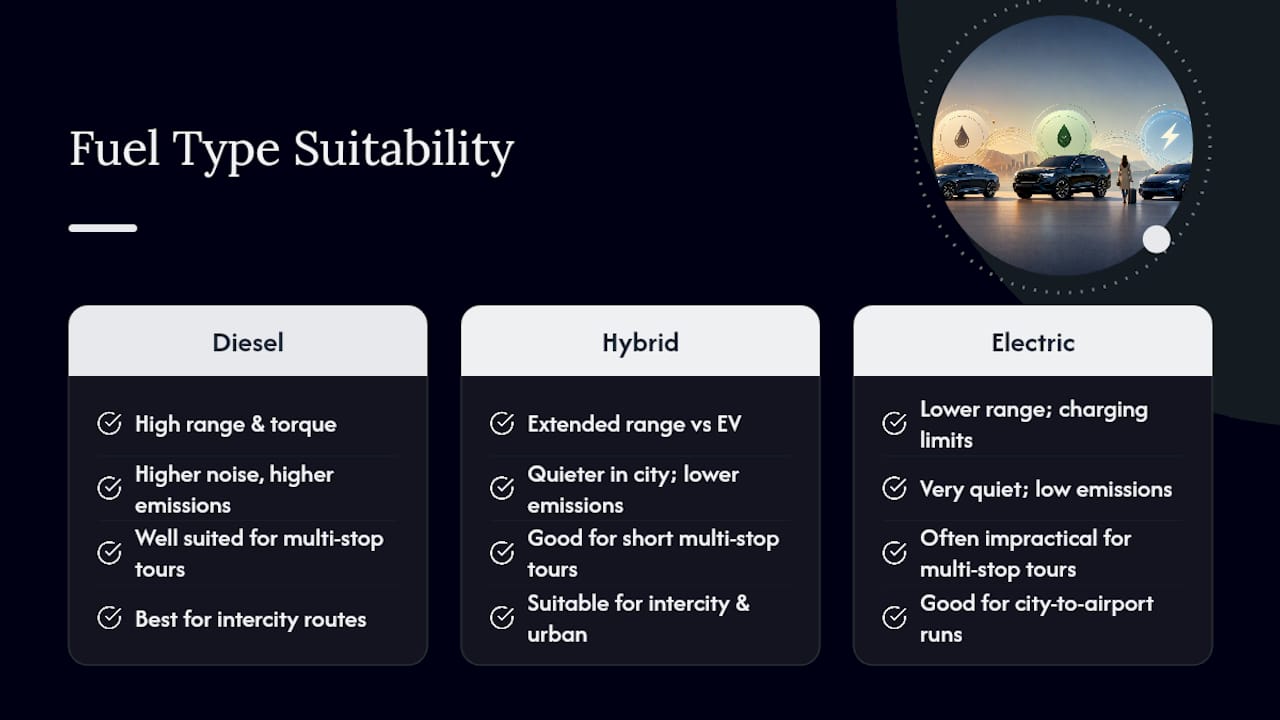
Electric vehicles still face practical limits for longer, multi-stop tours. Charging infrastructure along coastal and rural routes remains inconsistent, so a full-day tour with several sightseeing stops is often better served by a hybrid or a well-maintained diesel vehicle that won’t require an unplanned charging detour. For a straightforward city-to-airport run, an electric or hybrid sedan can be a genuinely pleasant, low-emission choice.
If sustainability matters to your booking decision, ask your provider directly what portion of their fleet is hybrid or electric and whether that option applies to your specific route. Availability shifts by vehicle class and by region, and a provider that’s transparent about it upfront saves you from assuming green options exist where they don’t.
What Should You Expect from a Professional Chauffeur?
A licensed, English-speaking driver is the baseline standard for any legitimate luxury transfer service, not an upsell. Licensing requirements vary by country, but the common thread is a commercial driving credential specific to passenger transport, distinct from a standard driver’s license.
Professionalism shows up in details that are easy to overlook when comparing quotes: a driver who tracks your flight and adjusts pickup timing automatically, one who helps load and secure luggage rather than leaving you to manage it, and one who confirms the route and any special stops before departure rather than during it.
Vetting matters too. Reputable operators run background checks, require defensive-driving training, and maintain their vehicles to documented safety and insurance standards rather than relying on a driver’s personal judgment about roadworthiness. When you’re comparing providers, asking directly about driver licensing, language fluency, and vehicle insurance coverage is a fair and expected question, not an awkward one.
How Do Comfort and Technology Differ Across Vehicle Classes?
Legroom and noise insulation scale up with vehicle size, but not always in the way travelers expect. A well-built executive sedan often has better sound insulation than a larger van, simply because it has fewer body panels and door seams for road noise to enter through. What it lacks is space to stretch out on a long drive.
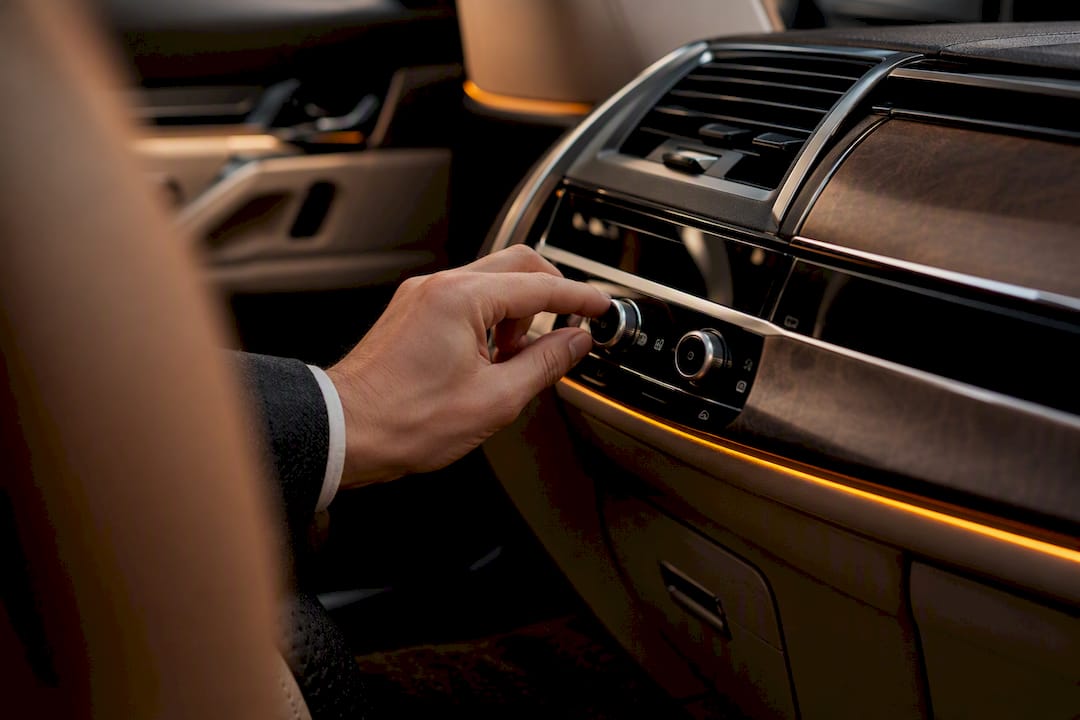
Luxury SUVs typically split the difference: elevated seating, strong noise dampening, and enough width for three adults to sit comfortably across the second row, though headroom in the third row (where present) is noticeably tighter. Premium MPVs trade some of that noise insulation for sliding-door practicality and flexible seating, which matters more on a family day tour than on a formal business transfer.
Executive vans and Sprinters offer the most legroom and often individual captain’s chairs with independent recline, but road and engine noise are more noticeable at highway speed unless the vehicle has upgraded insulation. Infotainment systems, from route displays to onboard Wi-Fi, are increasingly standard from the SUV class upward, while sedans tend to keep the cabin simpler and quieter by design.
Why Matching the Vehicle to the Itinerary Matters
We push clients toward sizing up for luggage and multi-stop itineraries because a cramped ride undoes even the best-planned tour. Guests consistently report that the trip felt smoother the moment the vehicle actually matched their group and their bags.
Book the Right Vehicle with Croatia Private Transfers & Tours
Once you know your passenger count and luggage total, booking the right vehicle should take minutes, not back-and-forth emails. Croatia Private Transfers & Tours runs a fleet of modern, air-conditioned vehicles, including Mercedes-class sedans and minivans, paired with licensed, English-speaking chauffeurs who handle everything from a solo airport pickup to a multi-day coastal tour.
The service covers private airport transfers, intercity routes between major Croatian destinations, and fully bespoke day or multi-day tours built around your interests, whether that’s wine tasting, UNESCO sites, or island hopping. Every booking includes insured, professionally maintained vehicles, so you’re not left guessing about safety standards or fleet condition. If you want a deeper look at how vehicle choice shapes the overall trip, the role of vehicles in luxury travel is worth a read before you confirm.
Ready to lock in the right vehicle for your dates? Get a quote through the private transfers Croatia booking page and specify your passenger count, luggage, and any special requests so your driver arrives fully prepared.
Sources
- Types of Chauffeur Vehicles Explained – Sedans, SUVs, Vans…