

Door-to-Door Transfer: What Travelers and Businesses Need to Know
A door-to-door transfer is a prebooked transport service that collects a passenger or cargo at one named address and delivers it to another named address under a single arrangement, with one party responsible for the entire journey.
Two contexts define how the term is used in practice:
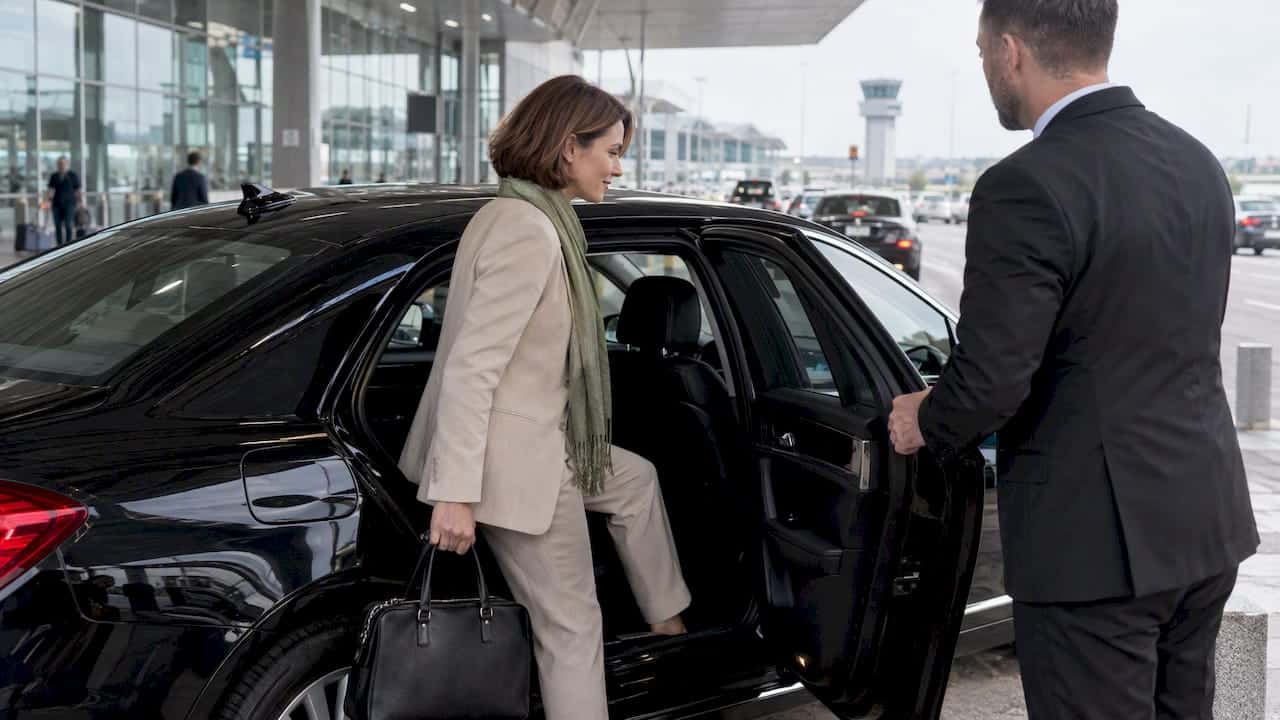
- Passenger transfers: A private vehicle picks you up at your home, hotel, or terminal and delivers you directly to your destination, whether that is an airport, cruise port, or city hotel, with no connections or shared stops required.
- Freight and logistics: A carrier or freight forwarder collects a shipment at the shipper’s warehouse or address, manages inland transport, export and import customs clearance (when crossing borders), and completes final-mile delivery to the consignee’s door. Agencies such as U.S. Customs and Border Protection, the U.S. Department of Transportation, and the World Trade Organization each govern portions of this chain.
Table of Contents
- What is a door-to-door transfer, exactly?
- How a door-to-door transfer works, step by step
- What types of services use door-to-door transport?
- Why door-to-door transportation is worth the premium
- What affects the cost and timeline of a door-to-door transfer?
- How door-to-door relates to trade terms like DAP and DDP
- When door-to-door is the right choice, and when it is not
- Questions to ask before booking a door-to-door transfer
- Common problems with door-to-door transfers and how to avoid them
- The operational value of single-point accountability in D2D services
- Key Takeaways
- Why single-point accountability changes how you should choose a transfer
- Croatia-private-transfers: private door-to-door transfers across Croatia
- Authoritative sources for further reading
What is a door-to-door transfer, exactly?
The phrase covers a contractual scope, not just a travel style. When you book a door-to-door service, you are purchasing a single arrangement that spans the full journey from origin to destination. No separate legs to coordinate, no terminal handoffs to manage yourself.
In freight, door-to-door shipping consolidates origin pickup, inland transport, export customs clearance, main carriage, import customs clearance, and final-mile delivery into one contract and one invoice. That consolidation is what separates it from port-to-port or terminal-to-terminal arrangements, where the shipper handles the first and last miles independently.
For passengers, the same principle applies. A pre-arranged vehicle waits for you at a confirmed address, your driver tracks your flight, and the journey ends at your named destination without any improvised connections. The “door” in both contexts is literal: your front door, your warehouse loading bay, or the hotel entrance, depending on the service type.
How a door-to-door transfer works, step by step
Understanding the operational flow helps you know who is responsible at each stage and where to ask questions before you book.
For passenger transfers:
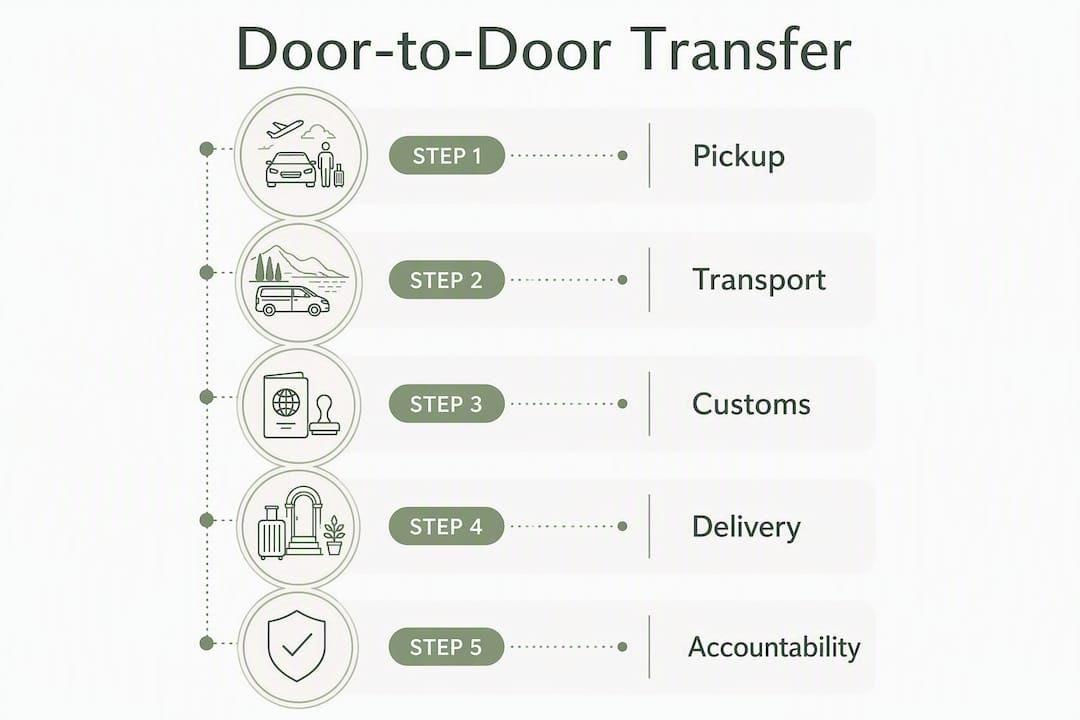
- Booking confirmation: You provide pickup address, destination, travel date, and flight details. The provider reserves a vehicle and assigns a driver.
- Flight or schedule monitoring: A quality provider tracks your arrival in real time, adjusting pickup timing for delays.
- Origin pickup: The driver arrives at your named address, assists with luggage, and confirms the destination.
- Direct transit: The vehicle travels without detours or shared stops to your destination.
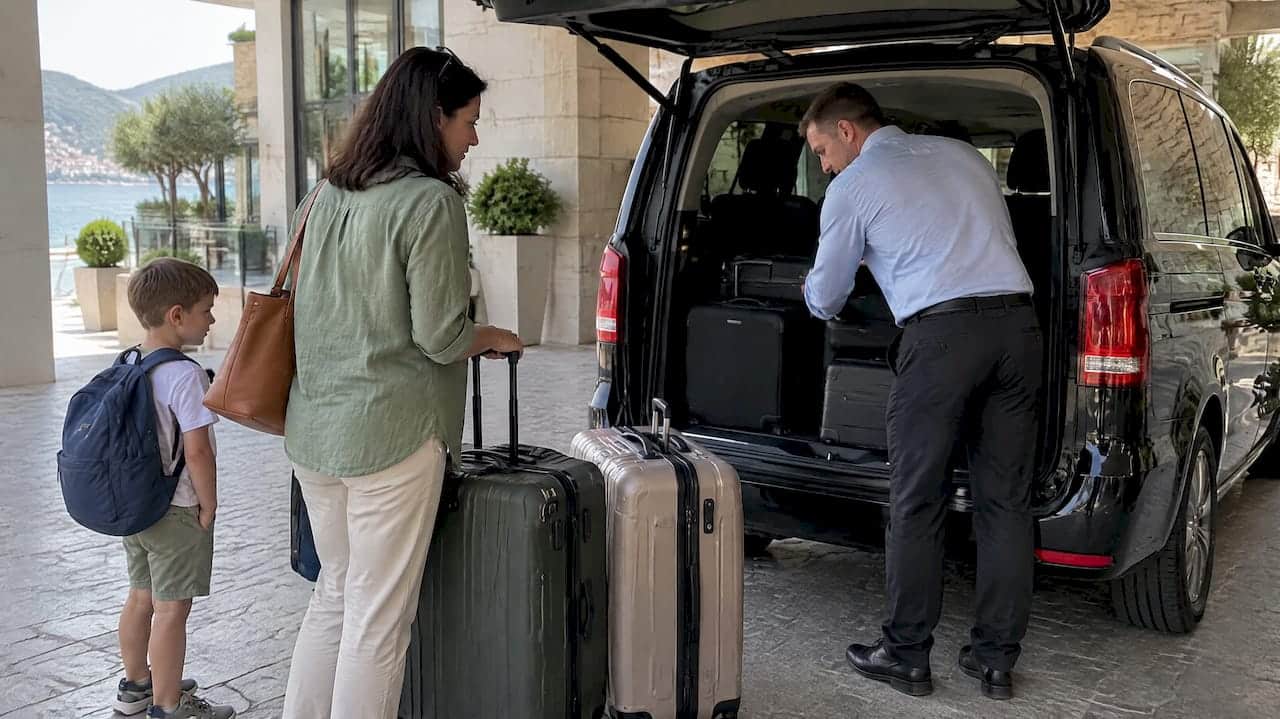
- Destination delivery: The driver delivers you to the exact address, assists with bags, and confirms arrival.
For freight and international shipments:
- Booking and documentation: Shipper provides cargo details, customs documents, and named addresses.
- Origin pickup: Carrier or freight forwarder collects cargo at the shipper’s door.
- Inland transport to port or hub: Cargo moves to the export point.
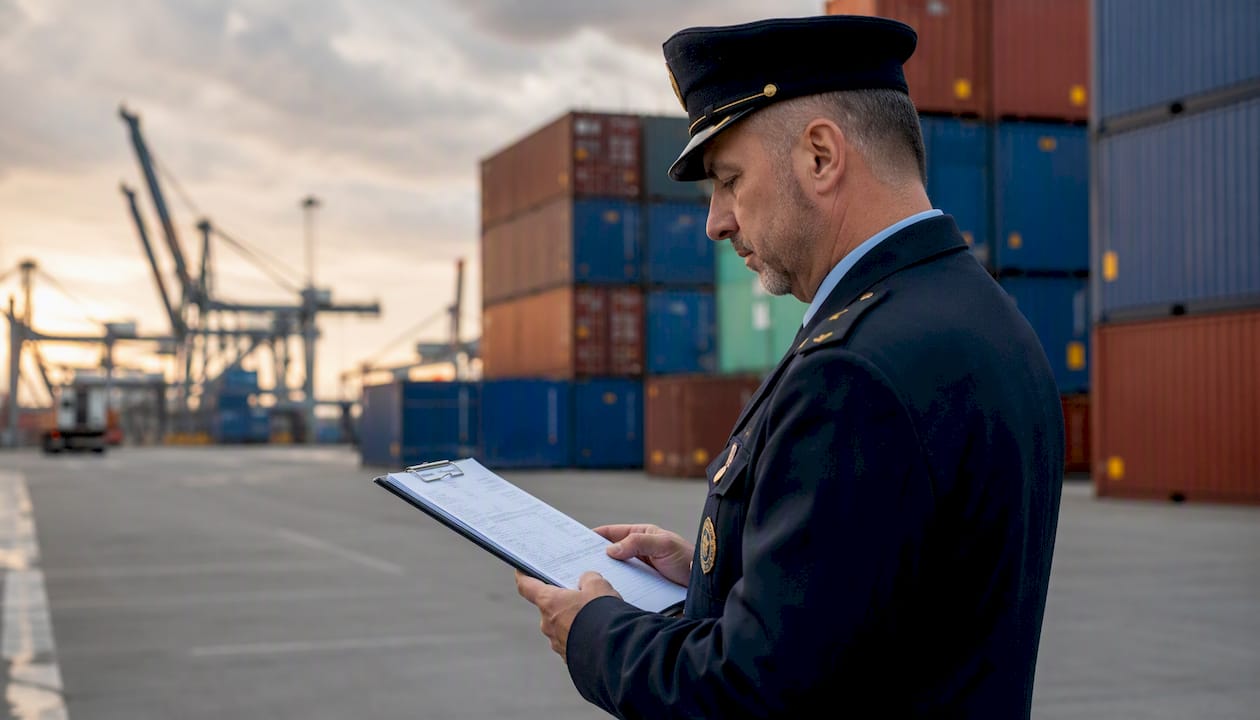
- Export customs clearance: The provider manages export declarations and compliance.
- Main carriage: Ocean, air, or road transit to the destination country.
- Import customs clearance: The provider handles duties, taxes, and import documentation at the destination.
- Final-mile delivery: Cargo is delivered to the consignee’s named address, with proof of delivery issued.
A key callout: under a true door-to-door contract, single-point accountability means one entity takes responsibility for the full chain. Claims, tracking, and invoicing all flow through that single party, rather than being divided across multiple subcontractors you have to chase separately.

What types of services use door-to-door transport?
The phrase applies across several distinct service categories, and what “door” means varies by context.
- Domestic parcel and home delivery: The most familiar form. A courier picks up a package at a sender’s address and delivers it to a recipient’s home. The “door” is the residential or business entrance.
- International freight (D2D shipping): An all-in-one freight service covering the full export-to-import chain. Particularly valuable for businesses shipping high-value goods across borders, where customs complexity makes a single accountable provider worth the premium.
- Vehicle and car transport: Auto shippers collect a vehicle from a private driveway or dealership lot and deliver it to a named address at the destination. This is common for cross-country relocations and collector car moves.
- Private airport transfers: A pre-booked vehicle and driver planned around your flight time and luggage needs. The “door” is your home or hotel entrance at one end and the terminal kerb or arrivals hall at the other. Learn more about what a door-to-door shuttle includes for travelers.
- Premium airport transfers with Meet & Assist: At the top end, premium services coordinate with airport concierges to meet you inside the terminal, assist through immigration or baggage claim, and escort you directly to a waiting vehicle, eliminating queues and wayfinding entirely.
- Non-emergency medical and senior transport: Some U.S. local programs provide door-to-door transport for eligible seniors and people with disabilities at no fee, covering medical appointments and essential errands. Private providers offer comparable services on a paid, per-ride basis.
- Shared shuttle vs. exclusive private transfer: Providers use “door-to-door” loosely. A shared shuttle may collect multiple passengers from different addresses before reaching the destination, while a truly exclusive transfer carries only your party with no detours. Confirming which model applies before booking is worth the extra minute.
Why door-to-door transportation is worth the premium
The core value is not just convenience. It is the removal of coordination risk at every handoff point.
- Single-point accountability: One provider, one contract, one claims contact if something goes wrong. This matters most for fragile cargo, high-value shipments, or travelers with tight connections.
- Fewer handling points: Each transfer between carriers or vehicles is a moment where damage or loss can occur. Door-to-door minimizes those moments.
- Time savings and reduced decision fatigue: A pre-booked transfer removes the need to find parking, hail a cab, or navigate an unfamiliar transit system after a long flight. For business travelers, that recovered time and mental bandwidth has real value.
- Flight monitoring and coordinated handoffs: Premium passenger services track your arrival and adjust pickup timing automatically, so a delayed flight does not strand you at the kerb.
- Consolidated billing and tracking for freight: One invoice covering the full chain simplifies accounting and makes cost-per-shipment analysis straightforward.
- Appointment-based final-mile delivery: For freight, door-to-door providers often offer scheduled delivery windows, reducing the risk of missed deliveries.
Pro Tip: Before confirming any door-to-door booking, ask specifically whether the service is exclusive or shared, and what “door” assistance actually includes. Driver-to-door luggage help is standard in premium passenger transfers; in-home assistance requires a specialized medical transport agreement.
Explore the full benefits of luxury transport for travelers who prioritize comfort and accountability.
What affects the cost and timeline of a door-to-door transfer?
Price and transit time vary significantly depending on service type, distance, and complexity.
Primary cost drivers:
- Distance and transport mode: Air freight is faster and more expensive than ocean; road transfers scale with mileage and vehicle class.
- Pickup and destination accessibility: Remote addresses, narrow roads, or locations requiring special equipment add cost.
- Customs and duties: For international freight, import duties and taxes can materially change the landed cost. These are sometimes quoted separately from the base freight rate.
- Insurance and declared value: Higher-value shipments require higher coverage, which adds to the total.
- Seasonality and fuel surcharges: Peak travel seasons and fuel price fluctuations affect passenger and freight rates alike.
- Private vs. shared service: An exclusive vehicle costs more than a shared shuttle but eliminates detours and schedule uncertainty.
Typical timeframes for U.S. scenarios:
- Domestic private passenger transfer: Same day, typically a matter of hours from pickup to destination.
- Domestic freight, local LTL (less-than-truckload): 1–3 business days.
- Domestic freight, interstate: Multi-day, depending on distance and carrier routing.
- International D2D by air: 2–7 days, subject to customs clearance at both ends.
- International D2D by ocean: 2–8+ weeks, with customs clearance adding days at the destination port.
U.S. Customs and Border Protection clearance timelines and U.S. DOT commercial driver regulations can both affect how quickly a shipment or vehicle moves through the chain. Providing complete customs documentation in advance is the single most effective way to avoid clearance delays.
How door-to-door relates to trade terms like DAP and DDP
“Door-to-door” is a service scope description, not a formal Incoterm. Understanding how it maps to trade terms helps you know exactly what is included in a quoted price.
| Term | Who arranges customs | Who pays import duties | Delivery point |
|---|---|---|---|
| Port-to-port | Buyer arranges both ends | Buyer | Origin and destination ports |
| DAP (Delivered at Place) | Seller arranges export; buyer handles import | Buyer | Named destination address |
| DDP (Delivered Duty Paid) | Seller arranges both | Seller | Named destination address |
| Door-to-door (D2D service) | Provider arranges full chain | Depends on quote terms | Named origin and destination addresses |
Door-to-door as an operational promise can sit above any of these Incoterms. A D2D freight provider might quote a DDP-equivalent service (duties included) or a DAP-equivalent (duties billed separately). The label “door-to-door” tells you the provider handles the logistics chain end-to-end; it does not automatically tell you who pays the duties.
Pro Tip: Always ask whether duties, taxes, and import clearance fees are included in the quoted rate or billed separately. A headline D2D price that excludes duties can become significantly more expensive once import charges are added at the destination.
When door-to-door is the right choice, and when it is not
Door-to-door is not always the most cost-efficient option. The right choice depends on your priorities.
Choose door-to-door when:
- Your schedule is tight and a missed connection or late delivery has real consequences.
- You are shipping high-value, fragile, or time-sensitive cargo where fewer handling points reduce risk.
- You need customs clearance handled without managing multiple parties.
- You are traveling with heavy luggage, young children, or have limited mobility.
- You want a single invoice and a single point of contact for the full journey.
Consider alternatives when:
- Cost is the primary concern and you can manage first/last-mile logistics yourself (port-to-port or terminal-to-terminal freight).
- You are traveling light on a flexible schedule and a shared shuttle or public transit works fine.
- Your destination is a major hub with reliable onward connections.
A short decision checklist:
- Is a single contract and single point of accountability important to you?
- Does the shipment or journey cross an international border requiring customs clearance?
- Is door access available at both the origin and destination addresses?
- Is the timing fixed, or do you have flexibility to absorb delays?
- Does the value of the cargo or the cost of a missed connection justify the premium?
If you answered yes to questions 1, 2, or 5, door-to-door is likely the right fit. For a deeper comparison of private transfers versus taxis, the tradeoffs become even clearer for passenger services.
Questions to ask before booking a door-to-door transfer
A well-structured booking conversation protects you from scope gaps and hidden costs.
Booking checklist:
- Is the service exclusive to my party, or will other passengers or shipments share the vehicle or container?
- Does pickup and drop-off cover exact named addresses, or only terminal kerbs and depot gates?
- Are customs clearance, duties, and import taxes included in the quoted price?
- What is the cancellation and amendment policy, and what triggers additional charges?
- Who is the contractual carrier, and who do I contact if there is a problem mid-journey?
- Is flight monitoring included, and how will the driver communicate if my arrival time changes?
- What proof of delivery or booking confirmation will I receive?
Red flags to watch for:
- Vague answers about who handles customs or which subcontractors are involved.
- No tracking number, booking reference, or written confirmation provided.
- “Door-to-door” described in marketing copy but no clear address-to-address guarantee in the contract.
- Multiple handoffs between unnamed parties with no single accountable carrier identified.
Documentation to collect:
- Written quote with full scope itemized (pickup address, destination, inclusions, exclusions).
- Booking reference and driver or carrier contact details.
- Proof of delivery or signed receipt at the destination end.
Pro Tip: For freight, request supplier packing photographs before the shipment leaves the origin. If damage is discovered at delivery, those photos establish the condition at pickup and significantly strengthen any insurance claim.
Common problems with door-to-door transfers and how to avoid them
Most problems with door-to-door services trace back to scope assumptions, not service failures.
- Unclear pickup or delivery scope: “Door-to-door” sometimes means kerb-to-kerb in practice. Confirm the exact address, floor, and whether the driver assists with luggage or cargo beyond the vehicle.
- Customs documentation errors: Missing or incorrect paperwork is the leading cause of customs holds for international freight. Provide complete, accurate documents well before the shipment departs.
- Missed flight or arrival windows: If the provider does not monitor your flight, a delay can leave you waiting with no driver. Confirm flight-tracking is included, not optional.
- Damage during transshipment: Even under a D2D contract, cargo passes through multiple physical environments. Insure high-value shipments and request that the provider minimizes transshipment points.
- Assumptions about in-home assistance: Standard passenger transfers cover driver-to-door luggage help. Assistance inside a private residence requires a specialized medical or care transport agreement.
Pro Tip: For time-sensitive freight, request appointment-based final-mile delivery windows in writing. An open-ended “delivery by end of day” commitment gives the carrier too much flexibility and leaves you waiting.
Pro Tip: For international shipments, supply your freight forwarder with all customs documents at least 48 hours before the cargo reaches the export point. Late paperwork is the most common cause of avoidable customs holds.
The operational value of single-point accountability in D2D services
The most important thing door-to-door does is concentrate responsibility. According to DocShipper’s logistics glossary, door-to-door creates single-point accountability: one entity takes responsibility for the full journey, reducing the coordination failures that fragment multi-party shipping chains.
Three practical implications for buyers:
- Simpler invoicing: One bill covers the full chain, making cost-per-shipment analysis and budget forecasting straightforward.
- Fewer coordination failures: When each leg has a separate provider, gaps between handoffs are where delays and damage most often occur. A single accountable party closes those gaps.
- Clearer claims process: If something goes wrong, you contact one party, not three. That clarity has real value when time or cargo value is at stake.
Three things to request in writing to verify single-point accountability:
- The name of the contractual carrier (the party legally responsible for the full journey).
- Proof of insurance coverage for the full chain, including any subcontracted legs.
- The claims contact name, process, and response time commitment (SLA).
Key Takeaways
A door-to-door transfer is defined by single-point accountability: one contract, one responsible party, and one journey from a named origin to a named destination address.
| Point | Details |
|---|---|
| Core definition | One contract covers pickup at a named origin and delivery to a named destination, with one party responsible throughout. |
| When to choose D2D | Tight schedules, high-value cargo, customs complexity, or travelers with heavy luggage or limited mobility all favor door-to-door. |
| Biggest booking check | Confirm whether the service is exclusive or shared, and whether duties and customs clearance are included in the quoted price. |
| Verify accountability | Request the contractual carrier name, insurance coverage for the full chain, and a written claims contact before confirming. |
| Croatia-private-transfers | Offers exclusive, pre-booked door-to-door private transfers with flight monitoring and licensed drivers across Croatia. |
Why single-point accountability changes how you should choose a transfer
The conventional wisdom says door-to-door is about convenience. That framing undersells the real value. Convenience is a byproduct. The actual advantage is contractual clarity: one party owns the outcome, which means one party has an incentive to solve problems rather than redirect blame to the next link in the chain.
Travelers who have experienced a fragmented transfer, a taxi that did not show, a shuttle that stopped for four other passengers, or a shipment held at customs because the freight forwarder and the customs broker were pointing at each other, understand this intuitively. The premium you pay for a true door-to-door arrangement is not for a nicer vehicle or faster transit. It is for the removal of that coordination risk entirely.
For passenger services, the most overlooked dimension is what happens when something goes wrong mid-journey: a delayed flight, a road closure, a change in luggage. A provider with flight monitoring and a dedicated driver absorbs those variables without requiring you to make calls and rebook. That is the version of door-to-door worth paying for.
Pro Tip: Book premium door-to-door transfers at least 48 hours in advance to secure the best vehicle and driver match for your schedule and group size. Last-minute bookings limit availability and reduce the provider’s ability to tailor the service to your specific needs.
Croatia-private-transfers: private door-to-door transfers across Croatia
For travelers who have read this far and understand what a properly arranged door-to-door transfer actually delivers, Croatia-private-transfers offers exactly that: exclusive, pre-booked private transfers with licensed, English-speaking drivers in premium Mercedes vehicles, planned around your flight times and itinerary.
Every booking includes flight monitoring, direct address-to-address service, and luggage assistance, with no shared stops or unannounced detours. Whether you are arriving at Zagreb Airport, connecting between Split and Dubrovnik, or planning a multi-day tour of the Dalmatian coast, the service is built around your schedule, not a fixed route. Book your private transfer in Croatia and confirm your vehicle, driver, and exact pickup details in one step.
Authoritative sources for further reading
These resources cover the key dimensions of door-to-door transport from government, logistics, and passenger service perspectives.
- U.S. Customs and Border Protection (CBP): The primary U.S. government source for import documentation requirements, customs clearance procedures, and duty rates. Verify what paperwork your international D2D shipment requires before it departs.
- U.S. Department of Transportation (DOT): Governs commercial carrier regulations, hours-of-service rules for drivers, and interstate transport compliance. Relevant for understanding how DOT rules affect freight timelines.
- SeaRates: Door-to-Door Shipping Explained: A practical logistics glossary entry covering the freight definition of D2D, contract scope, and how it compares to port-to-port services.
- DocShipper: Door-to-Door Definition and Guide: Detailed breakdown of D2D logistics, including how duties and taxes are quoted, and why single-point accountability matters for buyers.
- Hillsborough County Public Transportation Assistance: A U.S. example of publicly funded door-to-door transport for seniors and people with disabilities, useful for understanding eligibility and program scope.
- International Chamber of Commerce: Incoterms: The authoritative source for DAP, DDP, and all other Incoterms definitions. Use this to verify how a quoted D2D freight rate maps to formal trade term obligations.