
Split to Dubrovnik Drive Time: Routes, Traffic and Stops
The drive from Split to Dubrovnik covers roughly 230 km and takes about three hours on the A1 motorway and the Pelješac Bridge. On the coastal road it takes four hours or more, and in peak summer it can stretch well beyond that. The real answer depends on the route you choose, the month you travel and how many times you want to stop. This guide sets out all three, so you can plan the day with confidence.
TL;DR
- Motorway route (A1 and Pelješac Bridge): about 3 to 3.5 hours without long stops, with one toll of around €10 according to Croatia Atlas.
- Coastal road (D8): about 4 to 4.5 hours in normal conditions, and 5 to 6 hours at the height of summer.
- Timing matters more than distance: in July and August, leaving before 9:00 AM can save over an hour on the Makarska Riviera.
- Plan your stops first: Ston, Mostar and the Pelješac Peninsula each add real time, so decide before you leave how much of the day you want to spend in the car.
Table of Contents
- How long does the drive take?
- The two routes: A1 motorway or D8 coastal road
- Why summer changes the answer
- Choosing the best route for your day
- Stops that are worth the minutes
- Other ways to cover the distance
- Arriving in Dubrovnik: parking and the last mile
- A note from us on time
- Making the day easier with a private transfer
- Planning checklist for the drive
- FAQ
- Sources
How long does the drive take?
The distance is close to 230 km, though sources differ slightly by route. One routing service lists 234.6 km and 3 hours 21 minutes for a standard car journey, while another guide quotes roughly 220 km and a range of 2.5 to 4 hours, with more time in peak season. That spread is honest: it reflects the difference between an early-morning run in April and a Saturday afternoon in August.
A useful way to think about it:
| Scenario | Realistic driving time |
|---|---|
| Motorway, low season, no stops | About 3 hours |
| Motorway, summer weekend | 3 to 3.5 hours |
| D8 coastal road, shoulder season | 4 to 4.5 hours |
| D8 coastal road, July or August midday | 5 to 6 hours |
| Motorway with lunch in Ston and a viewpoint stop | 4.5 to 5 hours door to door |
The motorway and coastal figures follow the Croatia Atlas comparison of transport options. The last row is our own planning estimate, based on adding stops to the driving time.
The two routes: A1 motorway or D8 coastal road
Split and Dubrovnik are linked by two very different drives, and the choice shapes the whole day.
The A1 motorway and the Pelješac Bridge
The motorway is the fast option. It runs inland from Split, passes the Biokovo massif and ends near Ploče, from where you continue south toward the Pelješac Peninsula. Since the Pelješac Bridge opened, there is no longer a border crossing at Neum, and the bridge itself is free of charge. The tolls are on the A1 section.
The motorway also bypasses the bottlenecks that slow the older road, including the Omiš canyon and the town of Makarska. Its trade-off is scenery: you see far less of the sea.
The D8 Adriatic Highway
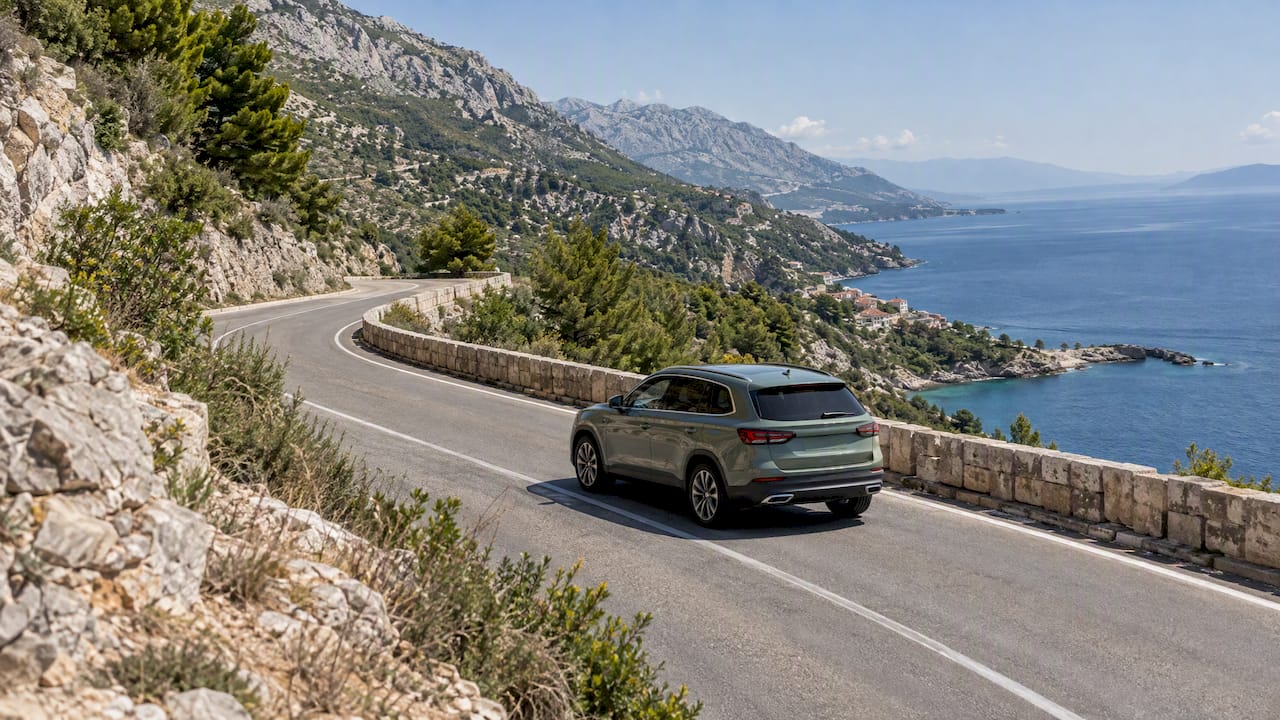
The D8 hugs the coast. It is widely regarded as one of the most beautiful drives in Croatia, passing Omiš, the Makarska Riviera and the Neretva delta. It is also slower, with towns, traffic lights, beach crowds and many places where you will want to pull over.
For guests who are not in a hurry, this is often the better choice. For anyone with a flight, a dinner reservation or small children in the back, the motorway is the safer bet.
Why summer changes the answer
Outside the season, the drive is simple. In July and August it is not. The same coastal route that takes about 3.5 hours on a quiet day can turn into a 5 to 6 hour crawl when beach traffic, local errands and holiday arrivals meet on a single carriageway.
The most effective fix is timing. A car-rental guide to the route suggests that departing before 9:00 AM lets you pass the Makarska Riviera before the heaviest traffic builds, potentially saving more than an hour compared with a midday start.
A few practical habits help:
- Leave early, or leave after the afternoon peak if your plans allow.
- Avoid Saturday changeover traffic when you can, since many holiday rentals turn over that day.
- Build slack into the day. A tight schedule is what turns delays into stress.
- If you stop on the coast, do it before lunch, when parking is still easy.
Choosing the best route for your day
The best route is the one that matches the kind of day you want. Here is how we would decide.
- You have a flight or a fixed check-in. Take the motorway and keep stops short.
- You want a scenic journey but have most of the day. Take the motorway south and add one or two considered stops, such as Ston.
- You want the coast to be the experience. Take the D8 in spring or autumn, and leave early.
- You want to see something beyond Croatia. Add a detour through Bosnia and Herzegovina, as described below.
Our own guide to the scenic route between Split and Dubrovnik goes into more detail on how to balance beauty against time.
Stops that are worth the minutes
Every stop adds time, so choose the ones that repay it.
Ston and the Pelješac Peninsula
Ston is known for its long defensive walls and for its oysters. It sits on the Pelješac Peninsula, so it fits naturally into a drive that crosses the bridge. Allow 1.5 to 2 hours for a walk and a relaxed lunch. The Pelješac area is also wine country, which suits travelers who would like a tasting without the worry of driving afterward.
Mostar and Blagaj
Mostar lies in Bosnia and Herzegovina, so this is a longer detour that crosses a border. It turns a three-hour transfer into a full day, typically 7 to 9 hours with time to explore, and a passport is needed for everyone in the vehicle. It is a rewarding day for guests who want history and architecture along the way.

The Makarska Riviera and Omiš
On the D8, these are the places where the road earns its reputation. Omiš sits where the Cetina river meets the sea, and Makarska offers a promenade and a beach at the foot of Biokovo. Both are also where traffic is worst in summer, which is why an early start matters.
Other ways to cover the distance
Driving is not the only option, and it helps to see the comparison honestly.
| Mode | Typical time | Typical cost | Good to know |
|---|---|---|---|
| Private car or transfer | About 3 to 3.5 hours | Varies by vehicle and route | Door to door, flexible stops |
| Bus | About 3 hours 45 minutes to 4 hours 30 minutes | €12 to €30 | Frequent departures, year-round |
| Catamaran | 4.5 to 6 hours | €45 to €55 per person | Seasonal, with island stops possible |
| Flight | Under an hour in the air | Varies | Airport transfers add time at both ends |
The bus and catamaran figures come from Croatia Atlas, which notes that the catamaran runs between May and October. A second guide adds that catamaran sailings are sensitive to weather, especially the bura, so tight itineraries should leave a buffer.
Public transport is reliable, but it is tied to fixed stations and schedules. That is where a private vehicle changes the day: the car collects you at your door, waits when you want to stop, and delivers you to your hotel.

Arriving in Dubrovnik: parking and the last mile
The drive can be easy and the arrival difficult. Parking in the Old Town is scarce and expensive, and the surrounding streets are narrow. One guide recommends that visitors who drive themselves use the Ilijina Glavica park-and-ride facility rather than trying to reach the historic center directly.
If your hotel is inside or near the walls, ask it in advance where a vehicle can stop to unload. With a driver, this question disappears: you are dropped as close as local access allows and your luggage goes with you.
A note from us on time
We are asked about drive time more than almost any other question, and we have learned that the number on the map is rarely the number that matters. What matters is how the day feels.
A guest who arrives in Dubrovnik after four relaxed hours, with lunch in Ston behind them, is usually happier than one who arrives after three tense hours of motorway. We plan around that. We suggest the route, the departure time and the stops that suit the party, and we adjust when families, business travelers or couples want a different pace.
Summer is where this matters most. A direct drive can turn tiring in July and August, which is why we favor flexible, professionally managed itineraries over fixed ones. Our drivers are licensed and English-speaking, and the vehicles are air-conditioned Mercedes sedans and minivans, so the hours in the car are comfortable rather than something to endure.
— Croatia
Making the day easier with a private transfer
If you would rather spend the journey looking out of the window than at a navigation screen, a private transfer is the simplest way to do it. We offer door-to-door transfers between Split and Dubrovnik with stops built to your preferences, including a route via Ston and a day that passes through Mostar and Blagaj. You can see what families typically pay on our transfer pricing page, or browse all intercity private transfers.
If you are linking the transfer with a longer stay, our multi-day tours with a private driver include itineraries such as a nine-day journey from Dubrovnik to Split.
Planning checklist for the drive
Whether you drive yourself or travel with us, these points save time:
- Choose your route first. Motorway for speed, D8 for scenery.
- Fix your departure time. Before 9:00 AM in summer is the single most useful decision.
- Decide on two stops, not five. Each one costs 1 to 2 hours once parking and lunch are counted.
- Carry cash or a card for the motorway toll. Tolls are on the A1; the bridge is free.
- Bring passports if you plan to enter Bosnia and Herzegovina. This applies to a Mostar detour.
- Confirm hotel access in Dubrovnik. Ask where the vehicle may stop.
- Allow a buffer for flights. If you are flying out the same day, aim to arrive in Dubrovnik with generous time to spare.
FAQ
How long is the drive from Split to Dubrovnik?
On the A1 motorway and the Pelješac Bridge, the drive takes about 3 to 3.5 hours in normal conditions. The coastal D8 generally takes 4 to 4.5 hours. In peak summer traffic it can reach 5 to 6 hours.
How far is Split from Dubrovnik?
The distance is roughly 230 km, depending on the route. Routing services quote figures from about 220 km to 234.6 km, because the motorway and coastal options differ slightly.
Do I need to cross a border between Split and Dubrovnik?
Not any more. The Pelješac Bridge lets you stay in Croatia the entire way, so the old crossing at Neum is no longer needed. You only cross a border if you choose to detour into Bosnia and Herzegovina, for example to Mostar.
What is the best time to leave Split in summer?
Before 9:00 AM is the usual advice, because you pass the Makarska Riviera before beach and local traffic builds. Leaving later in the day is possible on the motorway, but expect slower progress on the coastal road.
Is a private transfer faster than the bus?
The private vehicle is usually quicker on the road, since the bus takes about 3 hours 45 minutes to 4 hours 30 minutes. The bigger difference is convenience: you leave from your door, on your own schedule, and stops can be added if you wish.
Sources
- Croatia Atlas: Od Splita do Dubrovnika, katamaran, autobus, auto ili avion
- On the Road Croatia: Driving Split to Dubrovnik
- Croatia Car Rental: Split to Dubrovnik by Car
- Croatia Spirit: Split to Dubrovnik guide
- Auto-karta: Split do Dubrovnik automobilom